
Mastercard announced its agreement to acquire stablecoin infrastructure provider BVNK on March 17, 2026, for up to $1.8 billion, including $300 million in contingent payments. The acquisition was completed on August 3, bringing BVNK’s infrastructure for connecting fiat currencies, stablecoins, blockchain networks, and existing financial rails into Mastercard.
For businesses choosing a crypto payment gateway, the more useful question is not whether Mastercard is “going crypto.” It is what Mastercard considered valuable enough to buy. The problem is that businesses optimize for the cost of accepting a payment before evaluating the cost of managing everything that happens after it. Mastercard’s BVNK acquisition shows why that approach is incomplete.
The Problem: Businesses Choose a Gateway by Coin List and Price
When a business compares crypto payment solutions, the evaluation usually starts and ends with two questions: How many coins are supported? What is the fee?
That approach treats a payment gateway as a commodity, a checkout button with a price tag. It works for a basic use case, but it misses where the actual value of payment infrastructure sits.
The consequences show up later:
- Revenue arrives in assets the business cannot efficiently manage or convert.
- Funds sit in custody balances that do not connect to treasury workflows.
- Payouts to sellers, affiliates, or contractors require a separate tool with a separate integration.
- Operations scale linearly with volume because nothing is automated.
- The business ends up paying less per transaction but more in total operational cost.
A low fee on an incomplete infrastructure is not a saving. It is a deferred expense.
What Mastercard Actually Bought with BVNK
BVNK provides infrastructure between traditional finance and blockchain-based money. Businesses can use it to send, receive, store, and convert fiat currencies and stablecoins while connecting with banking systems and blockchain networks.
BVNK also reports more than $39 billion in annualized volume, so Mastercard is acquiring operating infrastructure rather than an experimental checkout product.
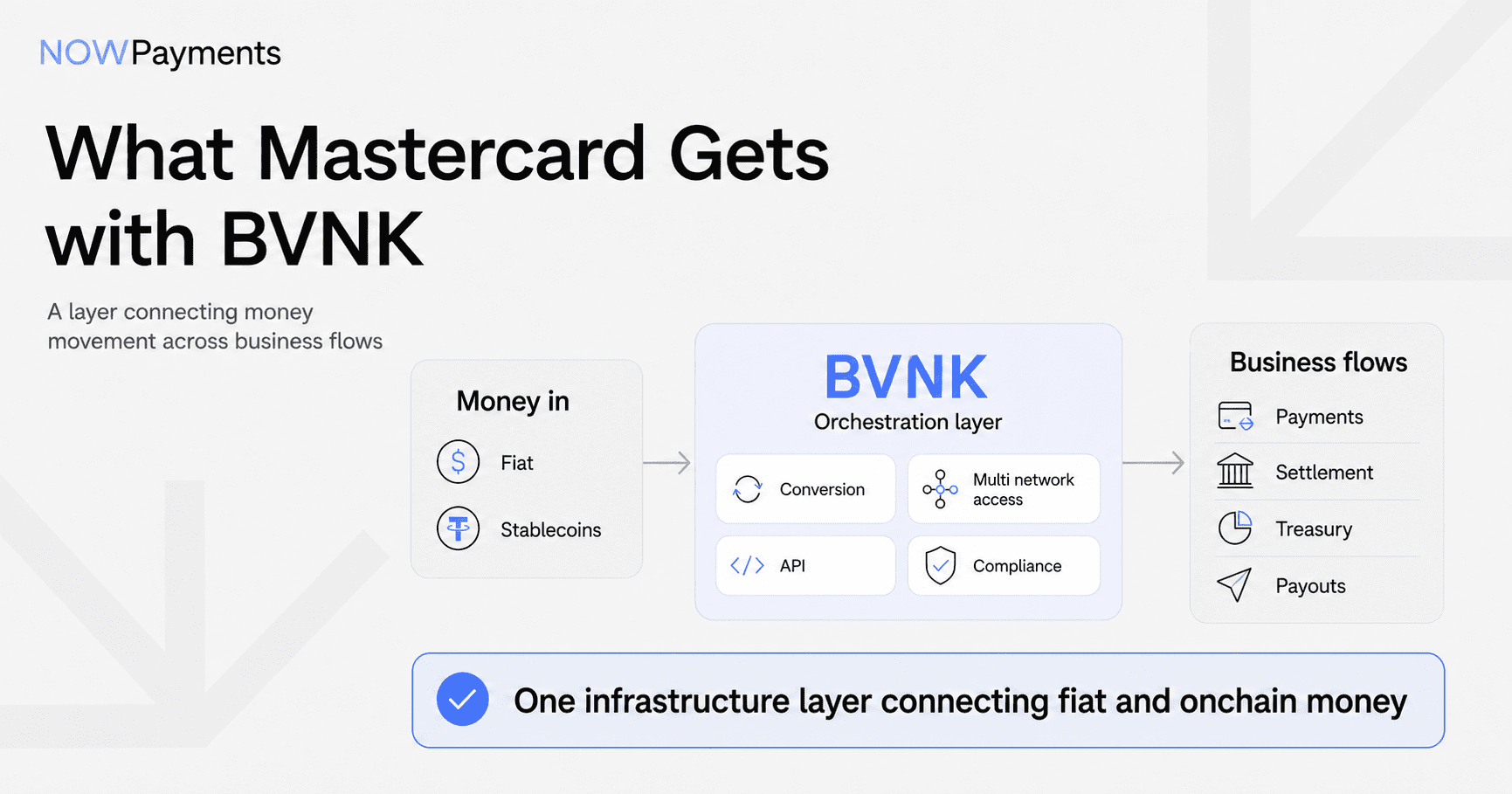
The important part is what sits between money coming in and money going out.
Mastercard already has payment acceptance and global distribution. What BVNK adds is infrastructure that connects different forms of money and lets funds move through conversion, settlement, treasury, and payout workflows without every component being built separately.
That changes the lesson of the acquisition for businesses choosing their own payment provider.
The question is no longer only:
Can this gateway accept the currencies my customers want to use?
It is also:
What happens to the money after the payment arrives?
Proof 1: Checkout Implementation Affects Completed Revenue
A long currency list does not guarantee that a payment setup will perform well.
Our recent Cryptopolitan analysis looked at where businesses lose customers during checkout and how payment implementation affects conversion. Across six months of NOWPayments e-commerce data, 63.81% of created payments reached Finished status, while 19.95% expired. The analysis also found that asset demand differs substantially between merchant audiences.
The conclusion is important when choosing a gateway: adding crypto is not enough. The provider has to fit the customer’s actual payment behavior, and the implementation has to make completing the payment easy.
Read the Cryptopolitan analysis: The 22% Sales Boost Hiding in Your Crypto Checkout
That is the first reason coin count and headline fees are not enough to compare providers: the quality of the payment flow can directly affect how much customer intent becomes completed revenue.
Proof Point 2: The Infrastructure Problem Continues After Checkout
Conversion is only the first part of the equation.
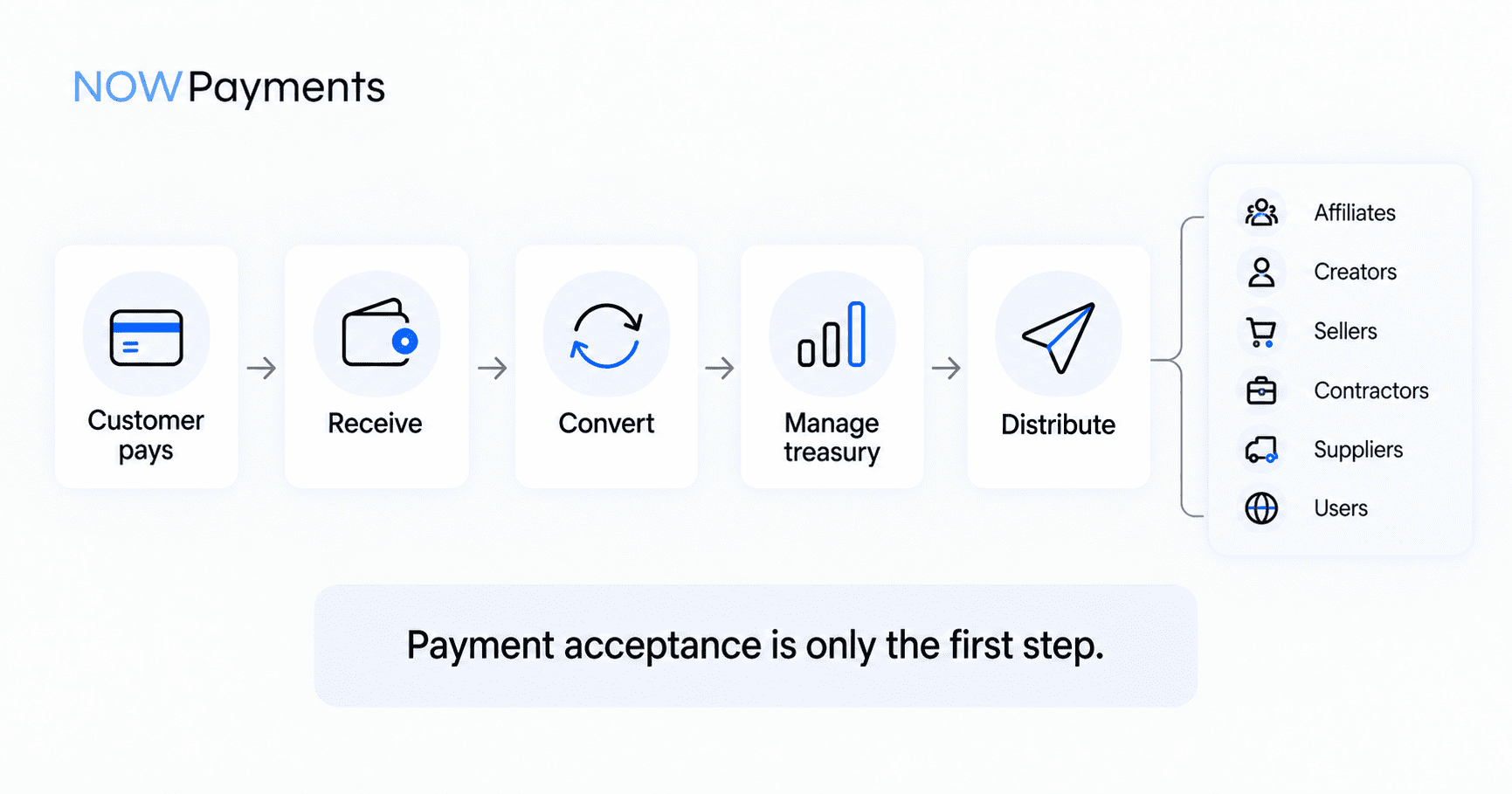
Once revenue enters the business, it may need to be converted, stored, settled, reconciled, or sent to another recipient. For marketplaces and platforms in particular, money often enters from customers and leaves again through seller or supplier payouts.
This is where the difference between a payment gateway and broader payment infrastructure becomes visible.
Checkout performance is only one side of the provider decision. The second question is what happens to the funds once the payment succeeds.
The Genghis marketplace is a good example. Instead of connecting separate systems for checkout, settlement, fulfillment, treasury, and supplier payouts, Genghis uses NOWPayments to connect these stages through one infrastructure.
SkinSwap follows a similar model for a digital skin marketplace. Customer payments, blockchain transaction monitoring, settlements, conversions, fulfillment, and seller payouts can work through the same integration rather than a separate provider for each stage.
These examples make the Mastercard BVNK lesson more practical. Infrastructure depth is not an abstract enterprise concern. It determines how many additional systems a business has to build and operate around its gateway.
What Businesses Should Evaluate Beyond Acceptance
Coin coverage and processing fees should still be part of the comparison. However, they should not be the only factors in the comparison.
| Area | What to evaluate |
| Acceptance | Asset and network coverage matched to actual customer demand |
| Custody | Balances, security controls, and where funds sit between receipt and use |
| Conversion | Stablecoin management and asset flexibility after funds arrive |
| Treasury | Settlement options, automation, and reporting |
| Payouts | Mass payouts, recipient experience, and money out scalability |
| Integration | API depth, webhooks, permissions, and implementation support |
The difference is simple.
A traditional gateway answers how the customer pays.
A broader infrastructure also answers what the business can do with the funds next.
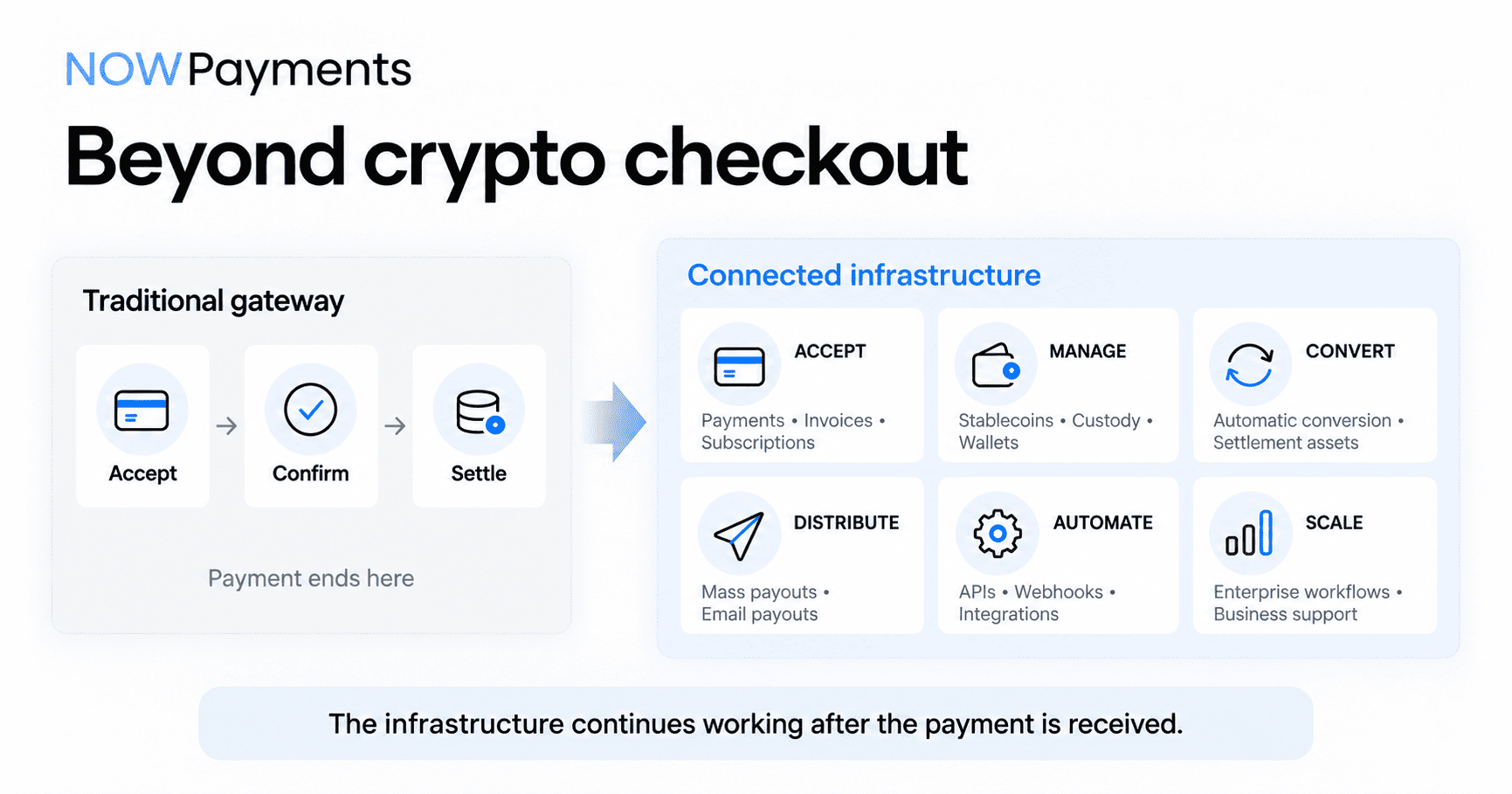
That distinction becomes more important as transaction volume grows. A manual workaround that works for 50 payments can become an operational problem at 50,000.
What This Looks Like with the NOWPayments Ecosystem
NOWPayments follows this broader infrastructure model. Businesses can start with crypto payment acceptance and use the same ecosystem to manage the next stages of the fund lifecycle.
For incoming revenue, businesses can accept cryptocurrencies and stablecoins through APIs, invoices, subscriptions, payment links, and integrations.
Once funds arrive, custody balances, automatic conversions, stablecoin support, and settlement workflows help manage how those assets are held and used. NOWPayments supports more than 30 stablecoins, including USDT and USDC across multiple blockchain networks.
For money moving out, Mass Payouts supports high-volume distributions through API, CSV, or dashboard workflows with a 0% NOWPayments service fee. ChangeNOW payouts add another option for eligible ecosystem transfers, allowing funds to reach recipients in under one second without network or service fees.
APIs, webhooks, integrations, and custom enterprise workflows connect these operations with existing business systems.
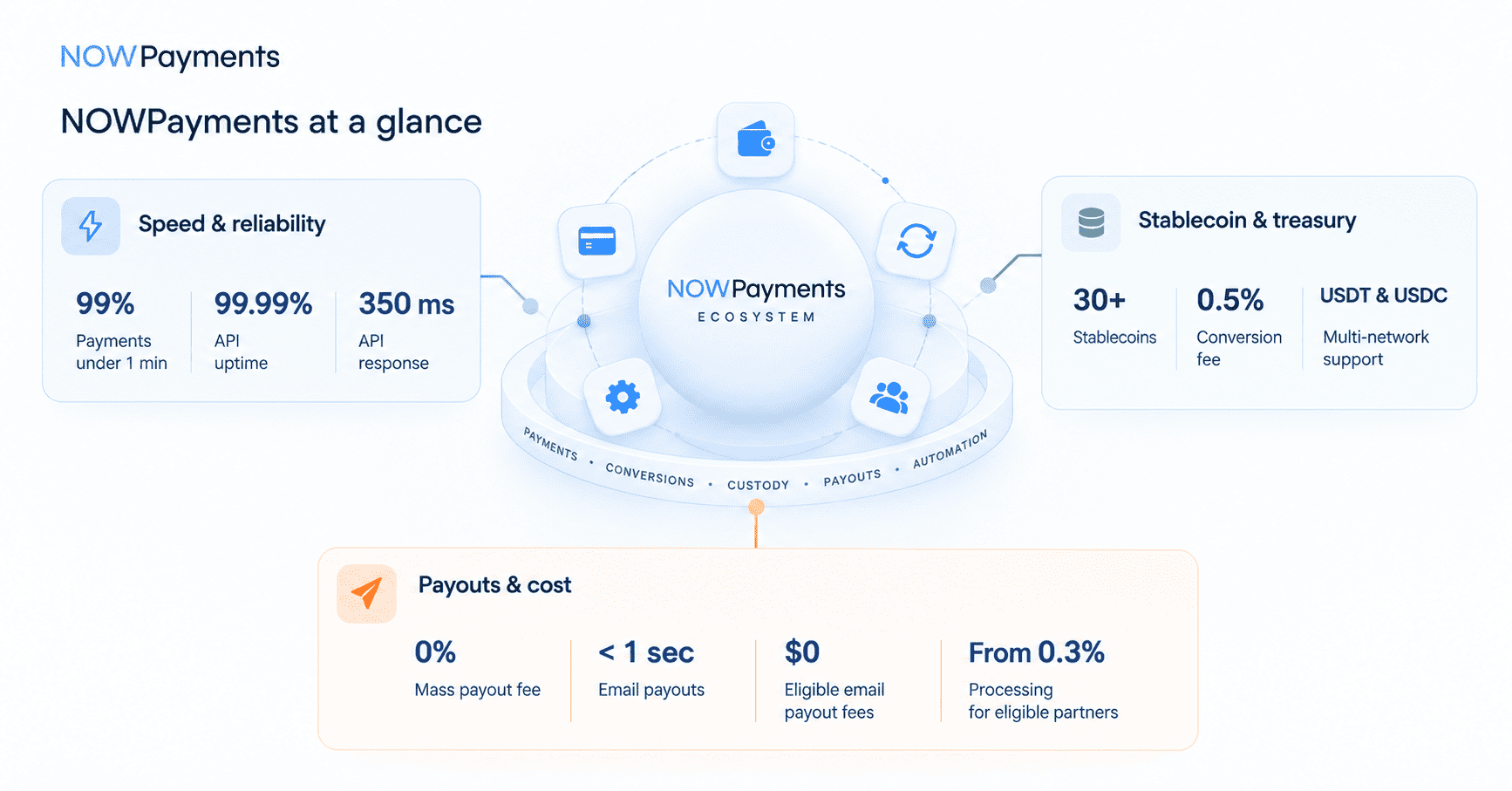
The point is not that every business needs every function from day one. It is that choosing infrastructure with the next stages already available can prevent the business from rebuilding its payment stack every time its operations become more complex.
A Better Way to Compare Crypto Payment Providers
Instead of asking only how many coins a gateway supports and what percentage it charges, businesses can start with a different set of questions.
| Question | Why it matters |
| Can it support the full business fund lifecycle? | Look beyond acceptance to balances, stablecoin management, conversions, treasury, payouts, and recipient experience. |
| How flexible is its stablecoin infrastructure? | Check USDT and USDC networks, custody, conversion, and settlement options. |
| Can it support money in and money out at scale? | Payments and payouts both need to remain reliable as volume grows. |
| How deeply can it integrate with operations? | Evaluate APIs, webhooks, reporting, treasury automation, permissions, and implementation support. |
| What is the complete business value? | Consider cost together with reliability, recipient experience, operational workload, settlement flexibility, and possible monetization opportunities. |
This does not mean the provider with the largest product list is automatically the best choice. A simple payment gateway can be enough for a business that only needs checkout.
The point is to understand the real requirement before comparing the price.
If payments need to connect with custody, conversions, treasury, payouts, fulfillment, or other business systems, those functions belong in the gateway evaluation from the beginning.
Conclusion
Mastercard’s BVNK acquisition is useful because it puts a price on something businesses often overlook when choosing payment providers.
The valuable part is not only accepting the transaction. It is the infrastructure that keeps working after the transaction has been accepted.
For a business choosing a crypto payment gateway, coin count and transaction fee are therefore only the starting point. Implementation quality affects how much payment demand turns into completed revenue. Infrastructure depth determines what happens to that revenue next. And the number of additional systems needed around the gateway affects the real operating cost.
Mastercard looked beyond checkout when it bought BVNK. Businesses evaluating their own crypto payment infrastructure should do the same.
Build your payment, treasury, and payout infrastructure with NOWPayments