
A security audit is an essential milestone for any Web3 project preparing to handle real user funds. It can uncover vulnerabilities in smart contracts, permissions, integrations, and application logic before they cause financial or reputational damage.
However, audited code alone does not secure the entire payment journey.
Once a project begins accepting cryptocurrency, it must also protect payment APIs, wallets, administrative access, transaction notifications, treasury operations, and payouts. Choosing a reliable cryptocurrency payment gateway should therefore be part of a broader security strategy.
This is where Vital Block Security and NOWPayments bring complementary expertise. Vital Block helps Web3 teams assess smart contracts, dApps, protocols, APIs, wallets, and connected infrastructure. NOWPayments provides the tools required to accept, manage, convert, and distribute cryptocurrency.
Why an Audit Is Only the Beginning
A security audit reviews a defined version of a project within an agreed scope. It can identify vulnerabilities in code and infrastructure, but it cannot prevent every operational error after launch.
Even an audited project may remain exposed if:
- a production API key is stored insecurely;
- an administrator account is compromised;
- the deployed code differs from the audited version;
- a payment notification is processed twice;
- funds are sent to an unverified destination;
- employees have more permissions than they need.
Web3 teams should therefore evaluate the complete payment lifecycle—from payment creation and blockchain confirmation to settlement, conversion, treasury management, and payouts.
“The strongest blockchain projects don’t just build faster — they secure better.”
— Vital Block Security
This principle applies not only to smart contracts, but also to every system and internal process surrounding them.
From Security Audit to Payment Integration
The first stage of secure crypto payment acceptance is building a reliable technical foundation.
Projects should begin by reviewing the complete architecture, including smart contracts, wallet logic, backend services, APIs, access permissions, bridges, and third-party integrations. Audit findings should be resolved before launch, and the production deployment should match the version reviewed by the auditor.
The next step is choosing a crypto payment processor that supports the project’s actual business model. A simple checkout, a subscription service, a gaming platform, and a Web3 marketplace may all require different payment flows.
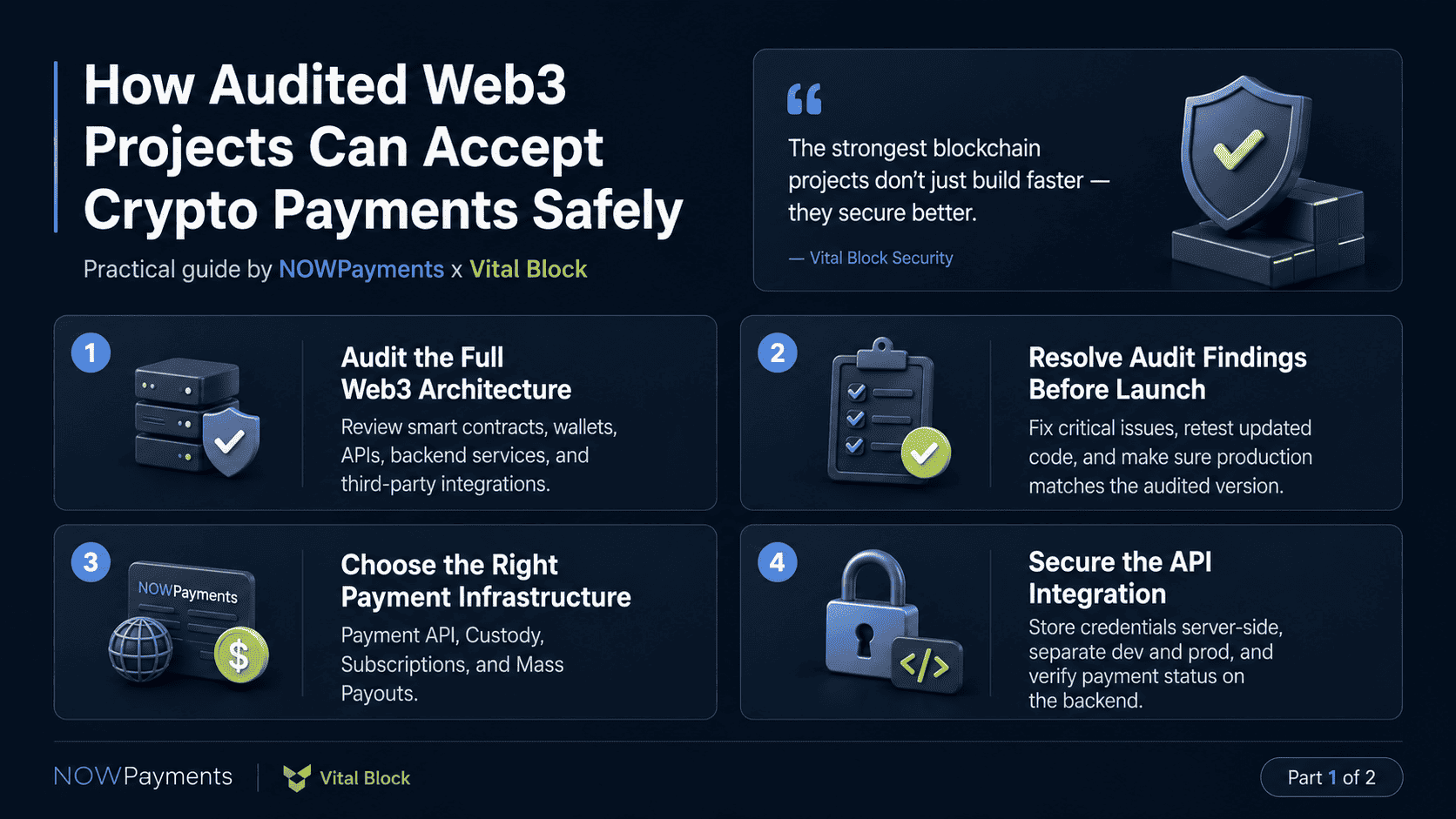
NOWPayments offers several products that can be combined depending on the project’s requirements:
- Payment API for integrating crypto payments into a website, application, or platform;
- Custody for managing received funds and internal balances;
- crypto subscriptions for recurring billing;
- Mass Payouts for distributing cryptocurrency to multiple recipients.
Choosing the right infrastructure early reduces the amount of sensitive payment logic that a Web3 project must build and maintain internally.
The integration itself must also be protected. API credentials should remain in a secure server-side environment, development and production accounts should be separated, and access should follow the principle of least privilege.
A payment should never be considered successful only because the customer reaches a confirmation page. The backend should verify the payment status, expected amount, selected asset, blockchain network, and associated order.
The system should also handle delayed confirmations, expired payments, underpayments, overpayments, partially paid transactions, and duplicate callbacks. Processing should be idempotent, meaning that the same notification cannot create the same order, subscription, balance update, refund, or payout twice.
Protecting Treasury and Crypto Payouts
Receiving customer payments and managing company funds are two different responsibilities.
Before going live, a Web3 project should define:
- which cryptocurrencies it wants to accept;
- which assets it wants to hold;
- whether incoming payments should be converted;
- how much liquidity is required for refunds and payouts;
- when funds should be moved to the main treasury;
- who can approve large transfers.
Sensitive operations may require approval limits, verified destination addresses, or multi-signature wallets. A documented treasury policy reduces mistakes and makes it easier to reconcile payments, conversions, refunds, and operating expenses.
Payouts require their own controls. Web3 businesses may need to pay affiliates, creators, contributors, marketplace sellers, contractors, community members, or remote employees.
NOWPayments Mass Payouts enables businesses to send cryptocurrency to multiple recipients through an API or dashboard-based flow. Recipient information should still be verified, administrative access should be restricted, and unusual payout activity should be monitored.
Projects that make frequent transfers can also use Zero-Fee Ecosystem Payouts. This solution allows businesses to send funds from NOWPayments to ChangeNOW Pro ecosystem wallets by email, with zero fees inside the ecosystem.
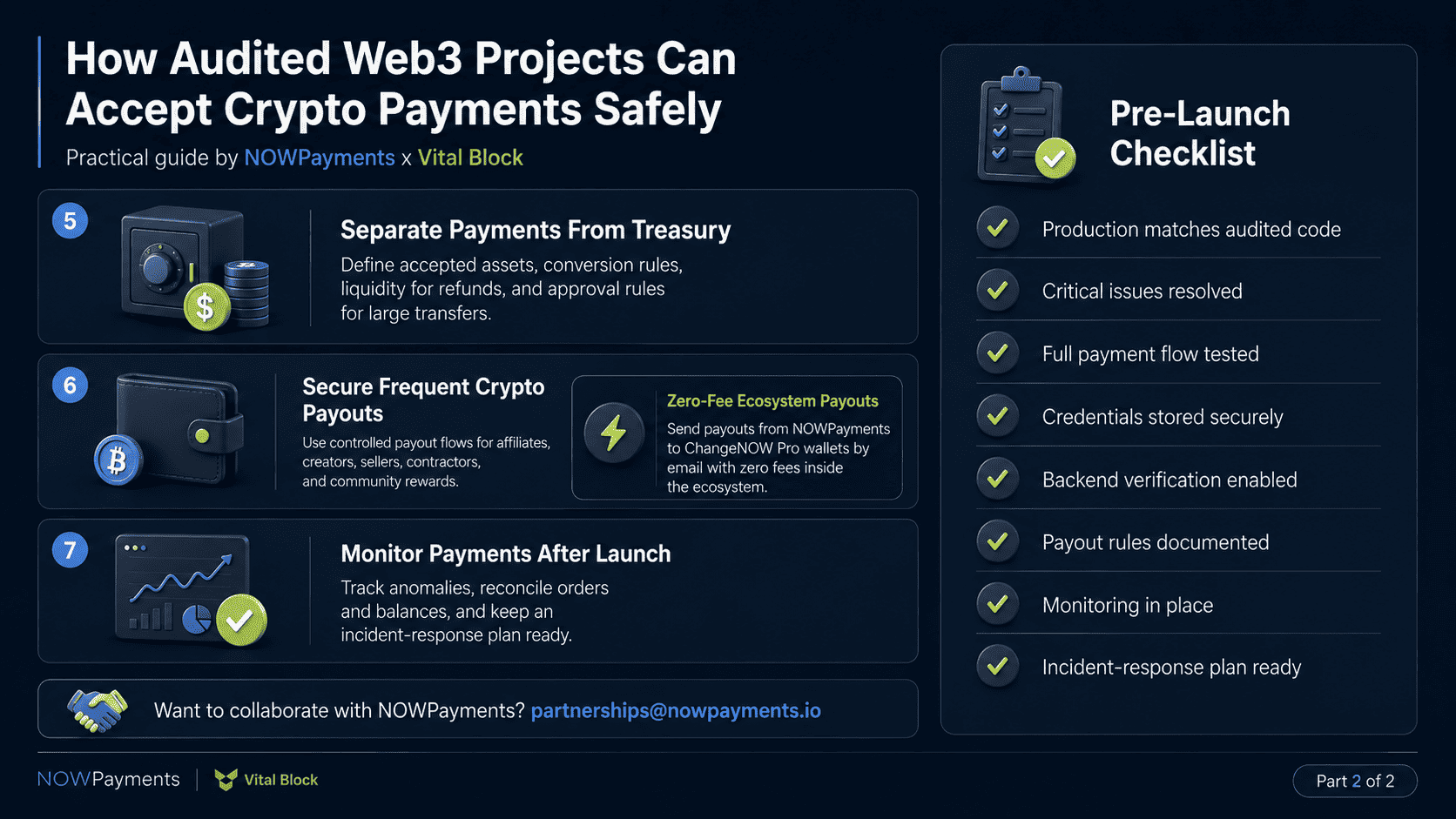
The second part of the guide also highlights an important post-launch responsibility: continuous monitoring.
Teams should watch for unusual changes in payment volume, repeated transaction failures, new payout destinations, unexpected wallet-setting changes, and differences between internal records and blockchain transactions.
Payment activity should be reconciled with customer orders, balances, subscriptions, conversions, refunds, and payouts.
Prepare for Security Incidents
Every project accepting cryptocurrency should have a documented incident-response plan.
The team should know how to:
- pause an affected payment or payout flow;
- rotate compromised API credentials;
- restrict administrative access;
- preserve logs and transaction records;
- contact the auditor and payment provider;
- communicate with users and partners;
- move funds to a safer environment.
These procedures should be prepared before an incident happens.
A new audit or security assessment may also be required after major changes to smart contracts, wallet infrastructure, backend architecture, access permissions, payment logic, or payout functionality.
A Shared Security Model
Vital Block and NOWPayments cover different but connected layers of Web3 payment security.
Vital Block Security helps projects identify vulnerabilities in smart contracts, dApps, protocols, APIs, wallets, backend systems, and blockchain integrations.
NOWPayments provides crypto payment gateway infrastructure for accepting cryptocurrency, managing funds, setting up subscriptions, converting assets, and distributing payouts.
The Web3 project remains responsible for secure deployment, access management, treasury approvals, backend verification, monitoring, and incident response.
Together, these responsibilities create a stronger model:
Audited code + secure payment infrastructure + disciplined operations.
Final Thoughts
A security audit gives Web3 projects a stronger foundation, but it is only one layer of payment security.
Projects must also protect their APIs, wallets, backend logic, administrative accounts, treasury operations, and payout processes. They need payment infrastructure that fits their business model and internal controls that continue working after the first transaction is completed.
By combining Vital Block’s Web3 security expertise with NOWPayments’ payment infrastructure, projects can build crypto payment flows that are more secure, easier to manage, and ready to scale.
Collaborate With NOWPayments
NOWPayments is open to collaborations with blockchain security companies, Web3 platforms, infrastructure providers, developers, and other crypto businesses.
To discuss joint educational content, expert contributions, case studies, or other co-marketing opportunities, contact us at [email protected].