
Payment automation works well when every transaction follows the expected flow. The real test starts when something disrupts the expected flow.
A customer sends the wrong asset or uses the wrong network. A payment fails after funds have already moved. A payout stops because of an account setting. At that point, someone has to investigate the transaction, communicate with the customer, coordinate the next step, and bring the process to a resolution.
If that work stays with the merchant, every exception becomes an internal cost and can delay a sale, payout, or customer resolution. When the payment provider takes ownership of the exception, the merchant can keep its own team focused on the business while payment operations continue moving.
The five cases below show how NOWPayments support handled different payment exceptions and what changed for the business as a result.
When Payment Exceptions Become Business Costs
A payment exception is rarely limited to one transaction. It can create work across customer support, finance, treasury, and payment operations.
Depending on the issue, the merchant may need to:
- investigate why a payment was not completed;
- reconcile a transaction manually;
- coordinate a refund or recovery;
- troubleshoot a payout blocker;
- keep the customer updated while the issue is being resolved.
At low volume, one exception may be manageable. At scale, exception handling becomes an operational process of its own.
The cases below show what changes when the payment provider handles that process instead.
Case 1. A $105 Payment Exception Became a Completed Sale
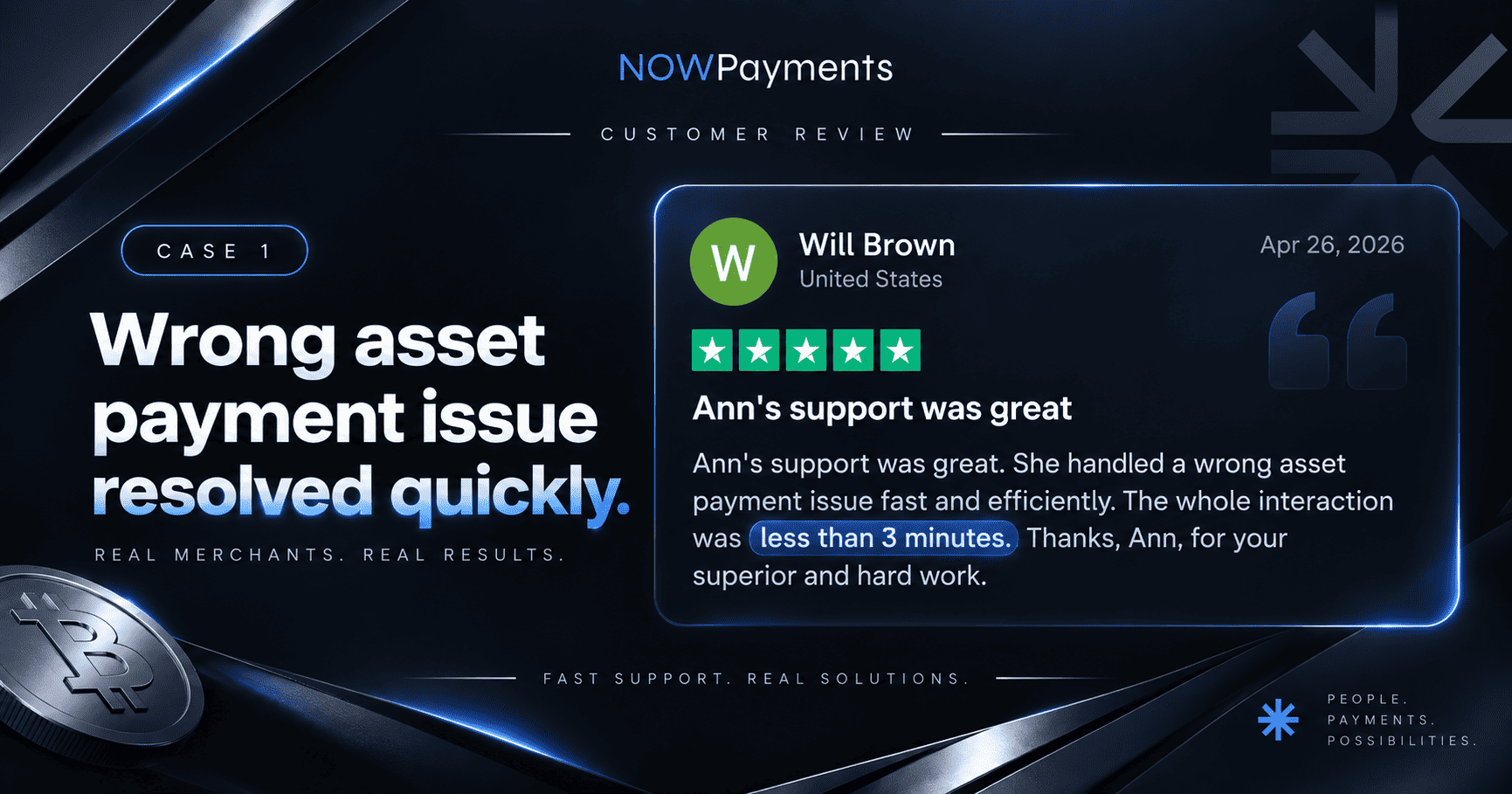
View the original Trustpilot review →
Challenge
A customer had already sent a $105 ETH payment, but the transaction was identified as a wrong asset payment. The merchant therefore had a customer who had paid, but no payment could be recognized as complete.
Without intervention, the case could have turned into additional reconciliation, a refund request, or a customer dispute instead of a completed sale.
What NOWPayments Support Solved
NOWPayments support investigated the transaction and found that a new payment had been created after the original deposit but had stopped automatically.
The team offered to complete the payment manually and transfer the funds to the seller. Once the customer approved the action, the transaction could move forward without the merchant having to investigate or reconstruct the payment itself.
Outcome
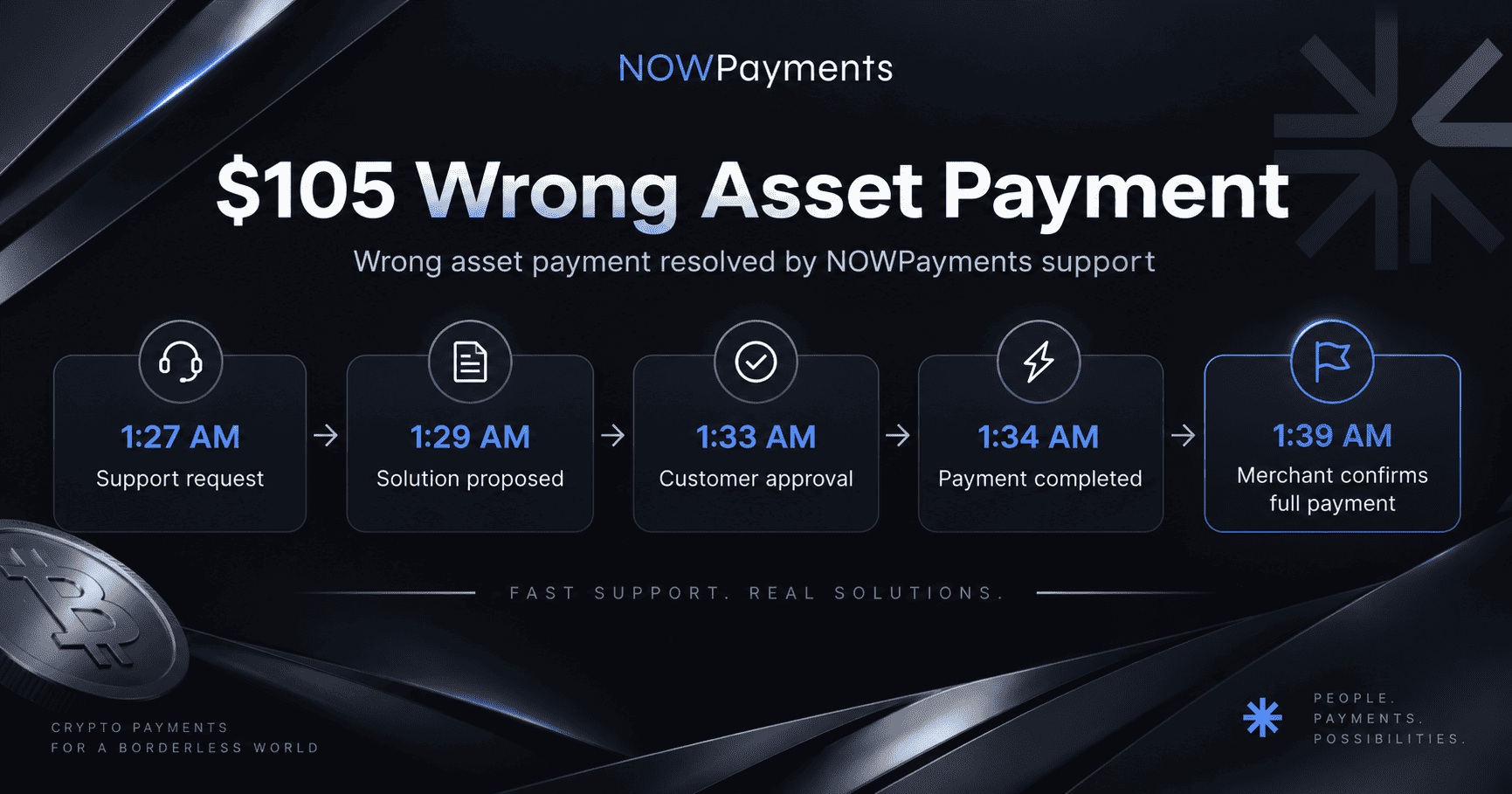
The case moved from payment exception to completed revenue in minutes:
- $105 sale completed;
- payment completed about 1 minute after customer approval;
- the merchant received the full payment.
Why It Matters
The business outcome was not simply that the customer received support.
A transaction that could have become a dispute or refund instead became a completed sale. Support handled the exception while the merchant retained the revenue.
Case 2. A $400+ Failed Payment Exception Was Handled End to End
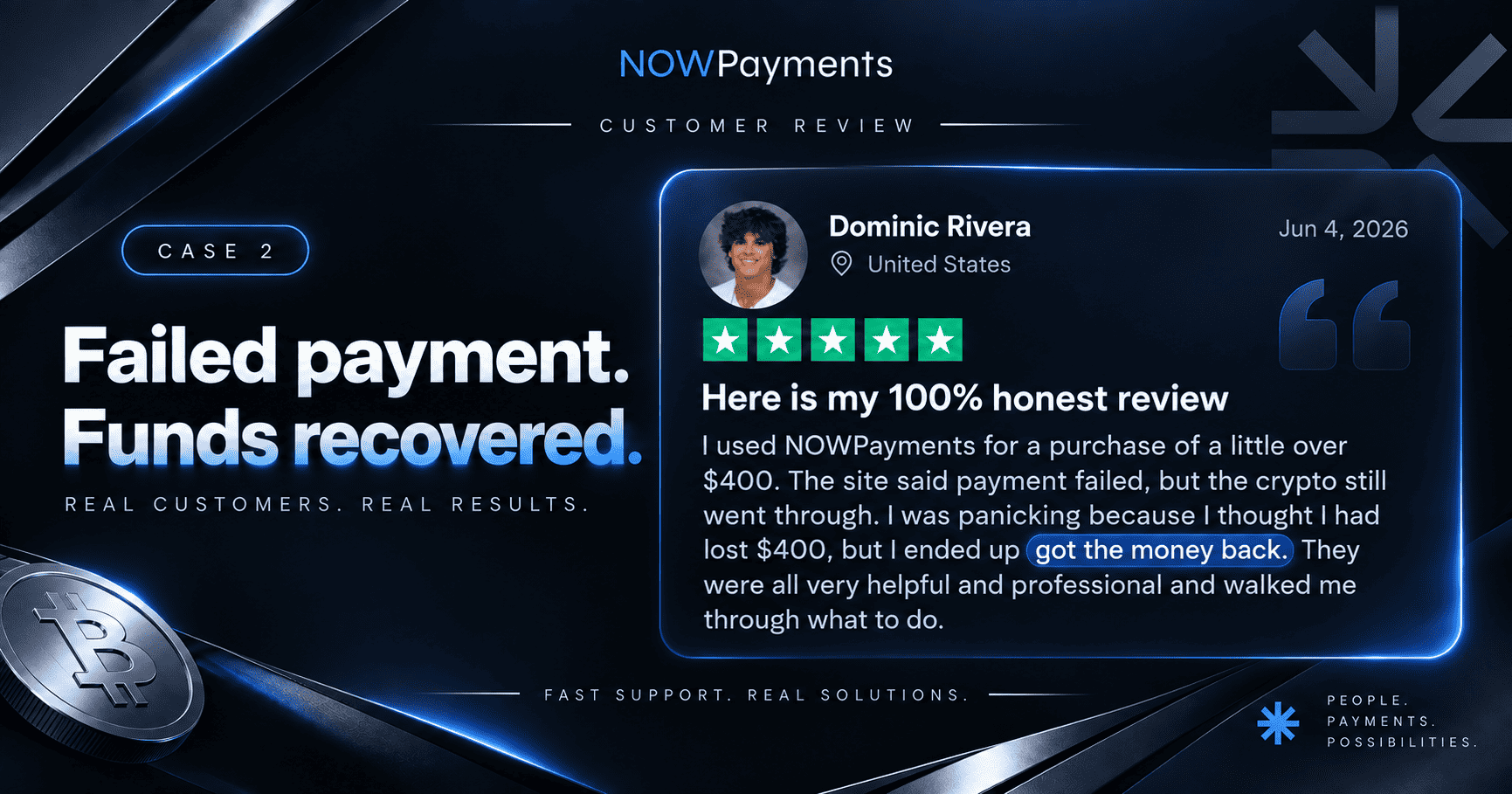
View the original Trustpilot review →
Challenge
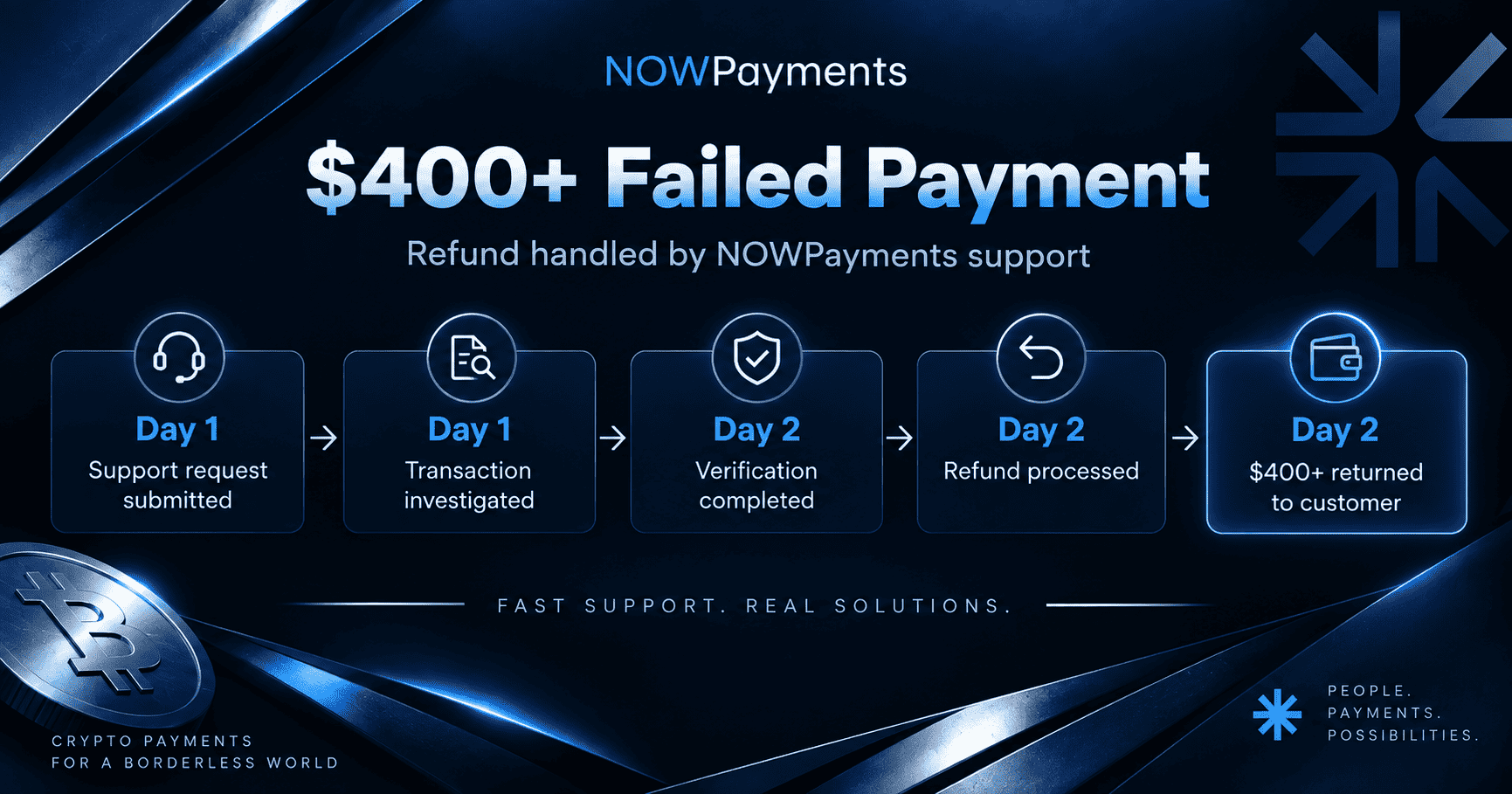
A customer had sent more than $400 in BTC, but the checkout showed the payment as failed.
For the merchant, the problem was no longer only the failed transaction. A refund now required a compatible Bitcoin address, ownership verification, customer communication, and follow-up until the funds were returned.
Without provider support, those exception handling steps would have stayed with the merchant.
What NOWPayments Support Solved
The NOWPayments team took over the payment-specific parts of the refund process:
- confirming a compatible Bitcoin refund address;
- verifying the original transaction before funds could be sent to a different address;
- guiding the customer when the first verification attempt did not contain enough information;
- moving the verified refund into processing.
Outcome
The case ended with a confirmed recovery:
- more than $400 returned;
- approximately two days from the first request to confirmed receipt;
- the customer received the refund.
Why It Matters
This case did not recover a sale. It removed a complex payment exception from the merchant’s operational workload.
Wallet compatibility, transaction verification, refund coordination, and customer guidance stayed with the payment provider instead of becoming a merchant-led recovery process.
Case 3. Support Removed a Blocker Before the Payout Could Start
View the original Trustpilot review →
Challenge
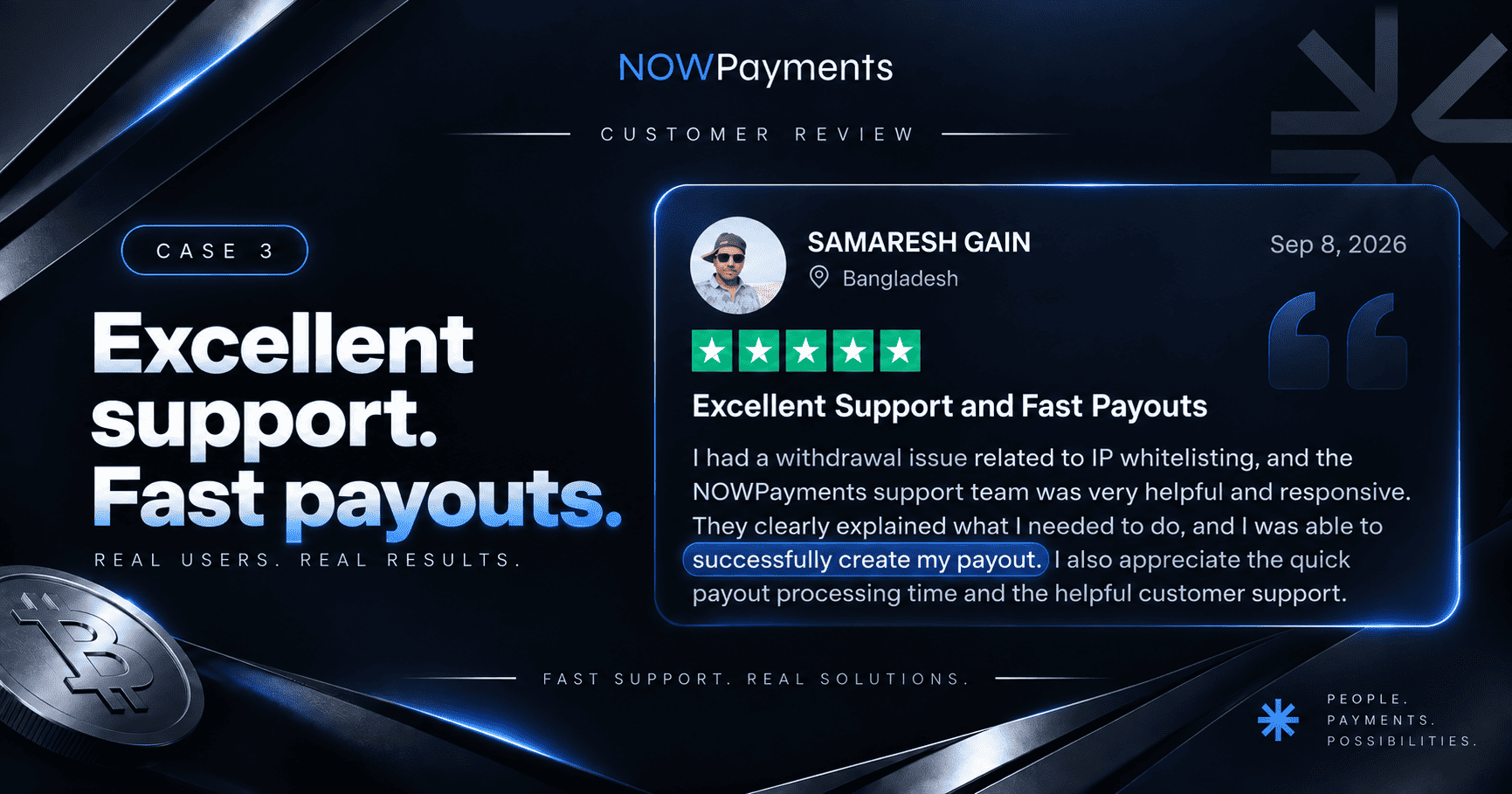
A payout could not move forward because of an IP whitelisting issue.
For the user, this was more than an account setting. Until the blocker was removed, the payout operation itself could not start.
What NOWPayments Support Solved
Support explained what needed to be corrected so the payout flow could continue.
The available conversation begins after the original whitelisting issue had already been resolved, so we should not describe technical steps that are not documented. What is confirmed is that the blocker was removed and the payout could then be created successfully.
Outcome
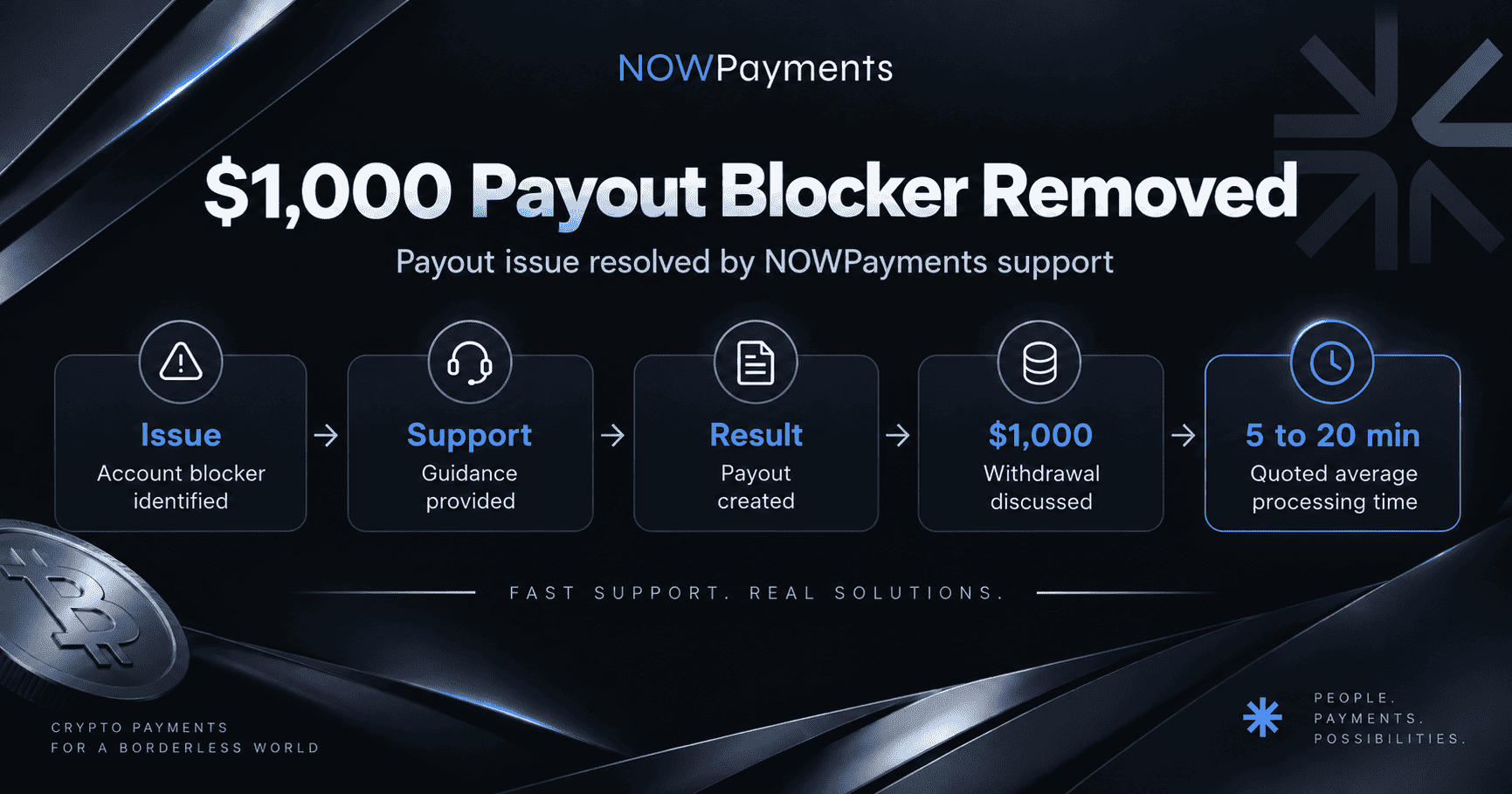
After the account blocker was removed:
- payout was successfully created;
- the user discussed a $1,000 withdrawal with support;
- support quoted an average processing time of 5 to 20 minutes for the payout flow discussed.
Why It Matters
The business value was operational continuity.
A configuration issue had stopped the payout process before funds could move. Support removed the blocker so the payout operation could continue, instead of leaving the user to troubleshoot the payment setup alone.
For a business running regular payouts, removing that type of blocker quickly helps prevent a configuration issue from turning into a wider payout delay.
Case 4. Sellertify moved past a business verification blocker
View the original Trustpilot review →
Challenge
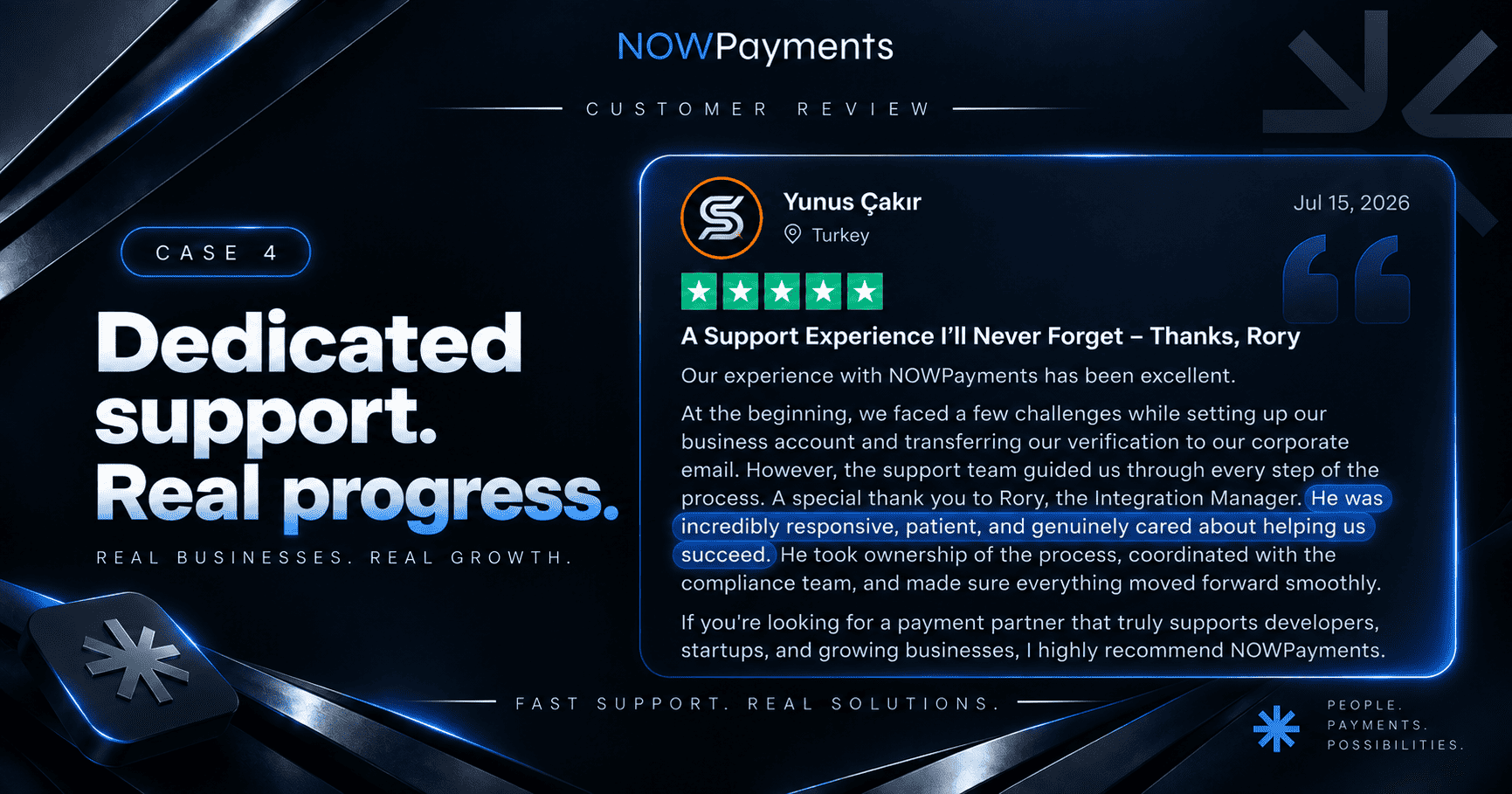
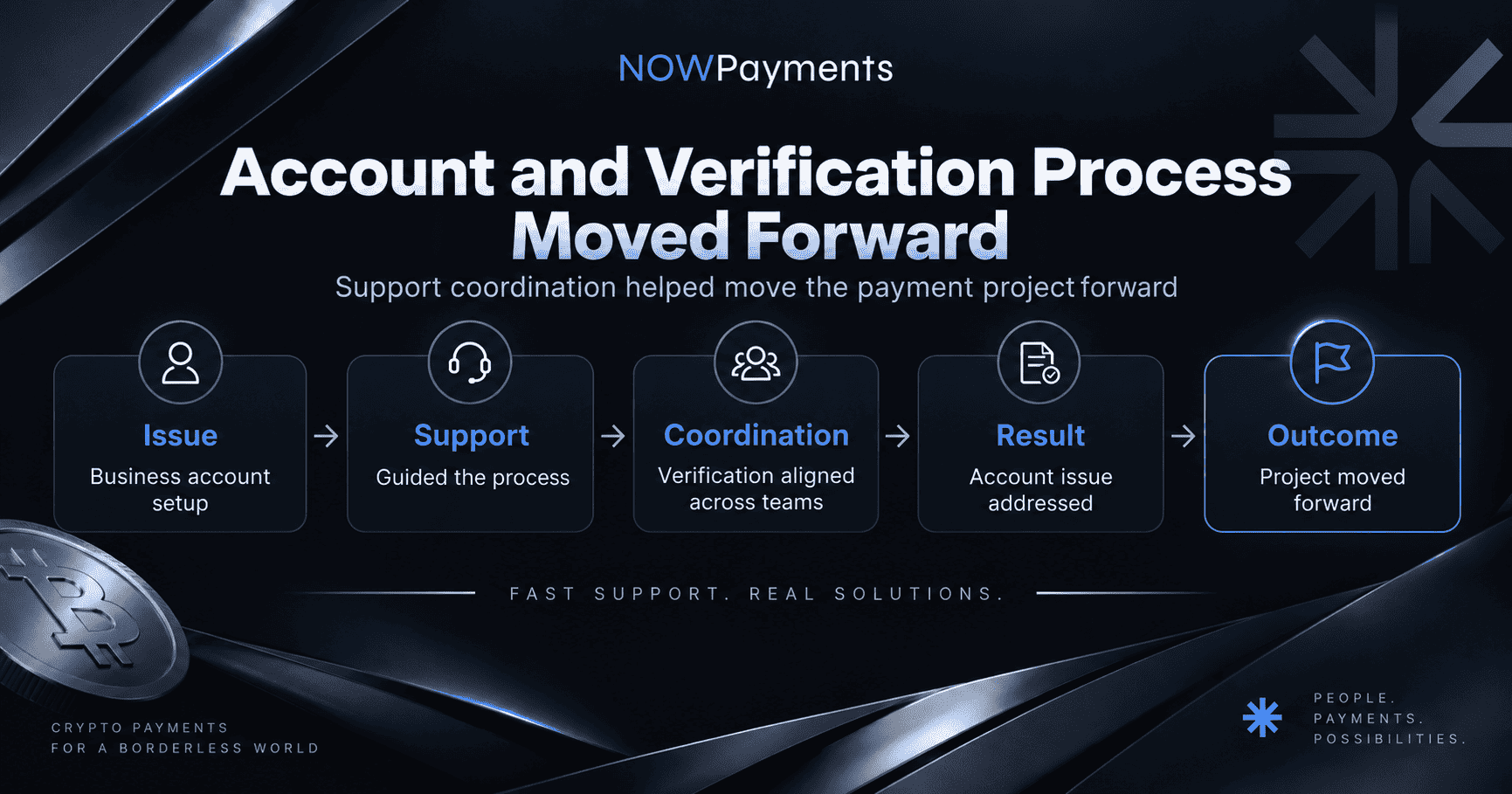
For Sellertify, the problem appeared before payment processing had fully started. The company faced challenges while setting up its business account and transferring verification to its corporate email. An account process was holding up the wider payment project.
For a growing business, this situation creates a different form of payment friction. The integration may be ready to move forward, but another part of the setup still needs to be coordinated.
What NOWPayments Support Solved
Rory did more than answer a setup question. He took ownership of the process, coordinated with the compliance team, and followed up until Sellertify could move forward.
That meant the partner did not have to manage the handoffs between different internal functions.
Outcome
The practical outcome was progress across the account and verification process:
- business account issue addressed;
- verification process coordinated across teams;
- payment project moved forward.
Why It Matters
The value here was process ownership.
When payment setup depends on several internal teams, a one-off answer does not necessarily remove the blocker. Someone still has to coordinate the process.
In this case, NOWPayments took that coordination on itself and carried the partner through the next stage instead of returning the problem to the business after each individual response.
Case 5. Support Took Ownership When the Customer Could Not Reach the Seller
View the original Trustpilot review →
Challenge
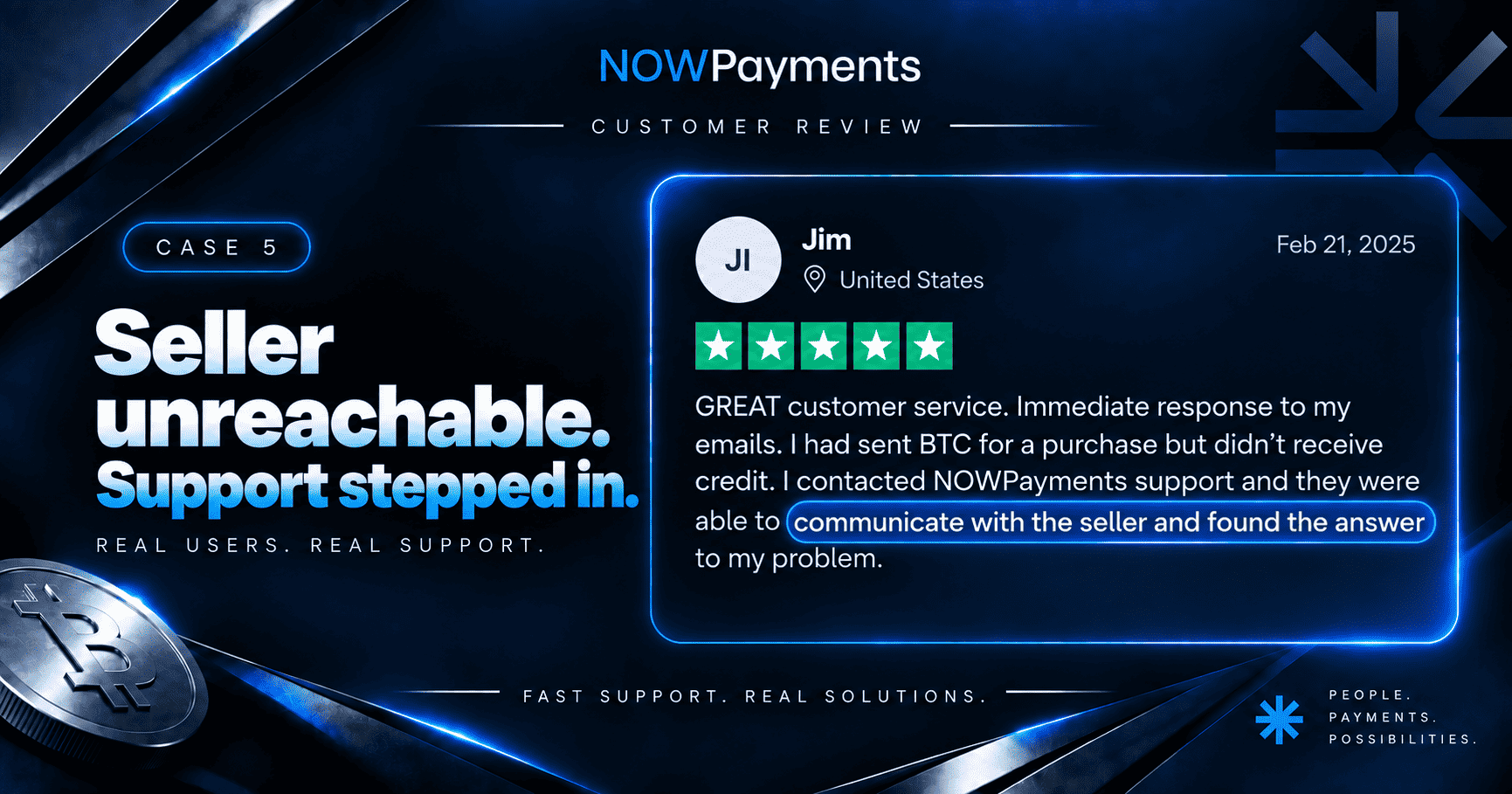
The payment itself had been processed successfully, but the customer still had no access to the purchase and could not get a response from the seller.
For the merchant, this created a post-payment exception. The transaction had technically succeeded, yet the customer experience had not. If left unresolved, a completed payment could still turn into a refund request, repeated support contacts, or a payment complaint.
The customer had already tried to contact the seller without success, so the usual customer to merchant resolution path was no longer working.
What NOWPayments Support Solved
NOWPayments support did not stop at confirming that the funds had reached the recipient.
The team reviewed the customer’s attempts to contact the seller and offered to involve the accounts team directly. From there, support kept ownership of the case:
- collected evidence of the customer’s communication attempts;
- passed the case to the team that could contact the merchant;
- requested additional transaction details where needed;
- coordinated with the merchant until the reason for the missing credit was identified.
The investigation showed that the purchase had been completed under a different account email. Once that information was shared, the customer logged into the correct account and confirmed that the issue was resolved.
Outcome
The payment did not need to be reversed. Instead, the support team traced the issue through to the merchant side and helped connect the successful payment with the correct customer account.
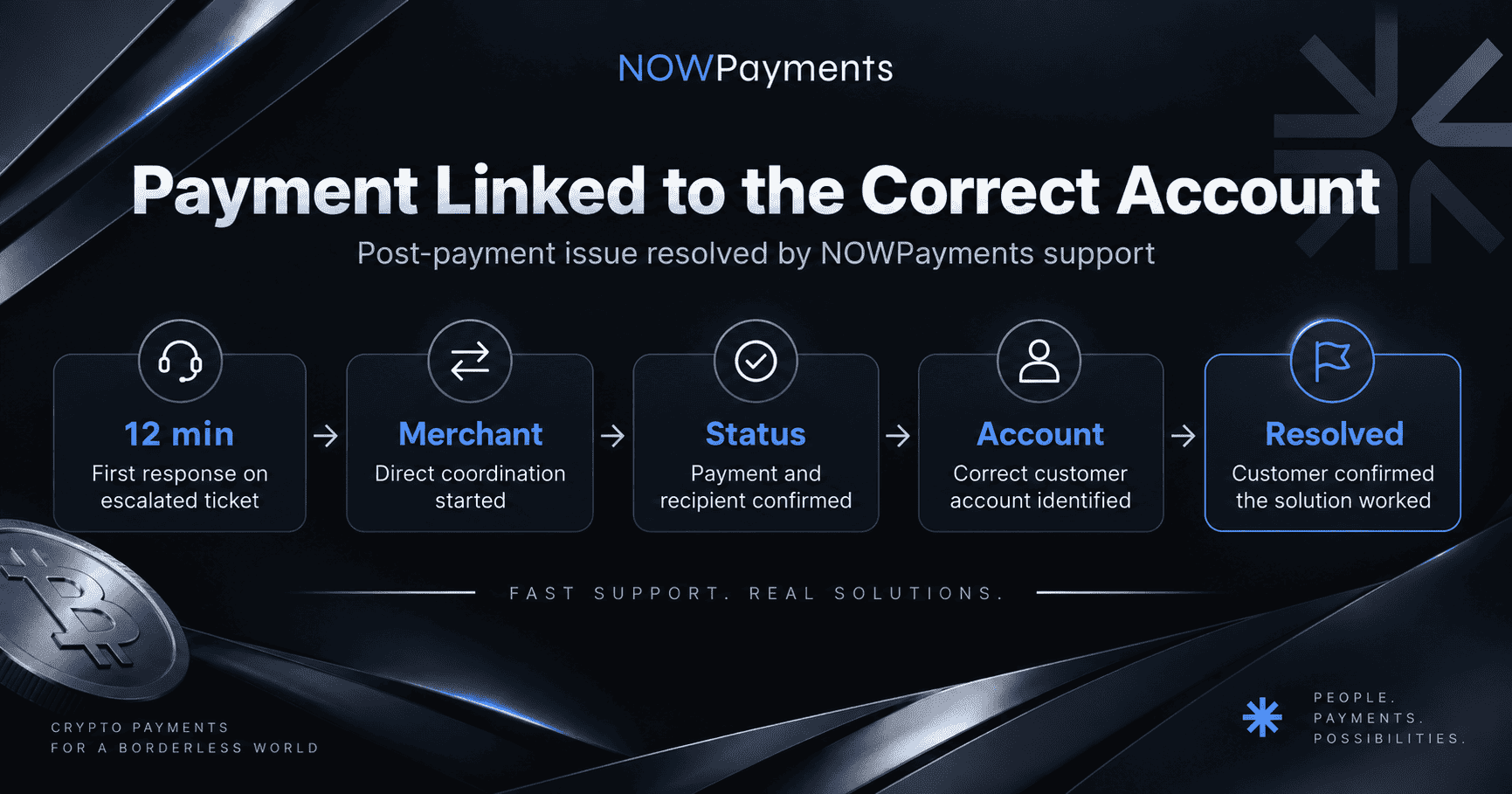
The case resulted in:
- first response on the escalated ticket within 12 minutes;
- direct coordination between NOWPayments and the merchant;
- payment and recipient status confirmed;
- correct customer account identified;
- customer confirmed that the solution worked.
Why It Matters
The business value was not payment recovery. The payment had already succeeded.
The value was preventing a successful transaction from becoming an unresolved customer problem.
NOWPayments acted as the escalation layer when direct communication between the customer and merchant had broken down. The merchant did not have to handle the payment investigation alone, and the customer received a clear resolution without the case automatically turning into a refund.
This is where support becomes part of payment infrastructure: the automated transaction may be complete, but someone still needs to own the exception when the customer journey around that transaction breaks.
Results at a Glance
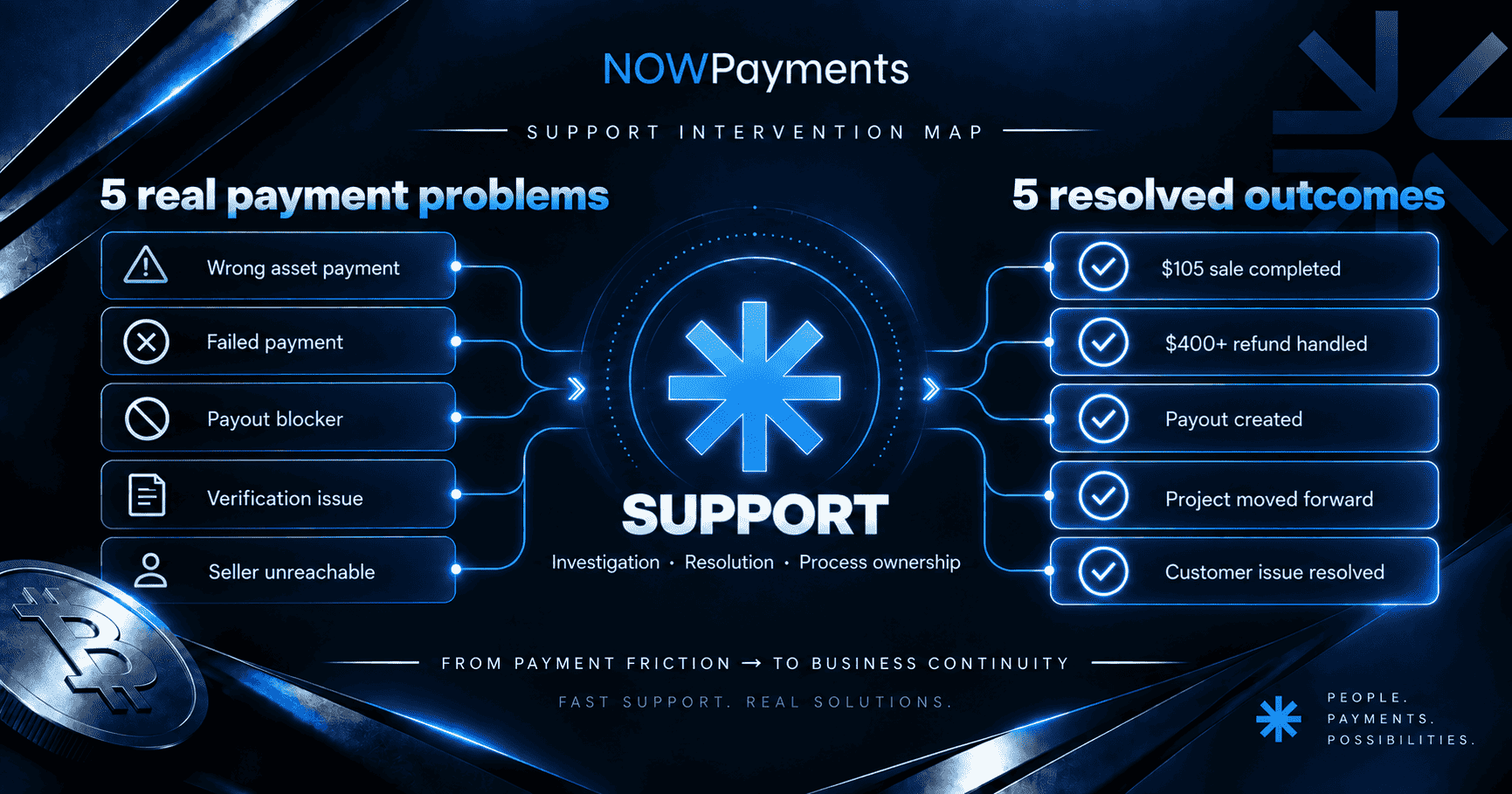
The five cases happened at different stages of the payment lifecycle, but each involved a point where the standard flow had stopped or become difficult to navigate.
| Case | Payment exception | Support role | Business outcome |
| Will Brown | Wrong asset payment | Investigated and completed stopped payment | $105 sale completed |
| Dominic Rivera | Failed BTC payment and refund | Managed verification and refund exception | $400+ returned without merchant-led recovery |
| SAMARESH GAIN | Payout blocker | Removed account-level blocker | Payout successfully created |
| Sellertify | Verification and account setup | Took ownership across teams | Payment project moved forward |
| Jim Garrettt | Successful payment but customer could not reach seller | Coordinated with merchant and traced the issue through resolution | Completed purchase connected to the correct customer account |
What Support Changed Across the Five Cases
The five cases show that support creates value in two ways.
1. It protects payment outcomes.
In one case, a wrong asset payment still became a completed $105 sale instead of remaining stuck. In another, more than $400 was returned after a failed BTC payment instead of leaving the merchant to manage the recovery process alone.
These are the clearest examples of support protecting transaction outcomes directly. The payment issue did not simply remain open. It was investigated, resolved, and moved toward a clear financial result.
2. It keeps operations moving when the standard flow breaks.
The other cases show a broader type of value. Support removed a payout blocker, took ownership of a verification process that depended on coordination across teams, and stepped in when a completed payment turned into a customer issue because the seller could not be reached.
Across all five stories, the common result is the same: less exception handling stays with the merchant, while payment operations continue moving.
Why This Matters as Payment Volume Grows
Payment automation handles the standard flow. Support handles what happens when that flow breaks.
At low volume, a merchant may be able to investigate an unusual transaction manually. At scale, wrong assets, failed payments, payout blockers, verification issues, and post payment communication problems become a recurring operational workload.
If the merchant has to own every exception, it pays for that workload in staff time, slower customer resolution, and potentially interrupted revenue.
When the payment provider investigates the issue, coordinates the next step, and stays with the case until there is an outcome, support becomes part of the payment infrastructure itself.
The value is not that exceptions disappear. The value is that the merchant does not have to build an internal payment operations process around every exception that occurs.
Need Payment Infrastructure That Handles the Exceptions Too?
NOWPayments helps businesses manage not only the standard payment flow but also the payment exceptions that come with operating at scale.
From transaction investigation and refunds to payout blockers, verification issues, and merchant-side coordination, businesses have a team to turn to when the automated flow stops working.
Explore NOWPayments and build payment operations that keep moving beyond the happy path.
About NOWPayments
NOWPayments is a crypto business ecosystem for companies operating with digital assets. Businesses can accept cryptocurrency and stablecoin payments, send payouts, manage conversions, and integrate payment infrastructure into existing financial workflows through APIs and business tools, with operational support across the payment lifecycle.
FAQ
Is NOWPayments Support available 24/7?
Yes. NOWPayments provides 24/7 business support for operational, compliance, and integration questions. Businesses can also work with a personal account manager for issues that need closer coordination. This gives merchants a team to contact when a payment, payout, or account process falls outside the standard automated flow.
What can NOWPayments Support help businesses with?
NOWPayments Support helps investigate payment exceptions and determine what should happen next.
Depending on the case, the team can help with:
- incorrect deposits and failed payments;
- refund review and recovery;
- wrong asset or wrong network transactions;
- payout blockers;
- verification and account issues;
- cases that require coordination with another team or the merchant.
For incorrect or stuck payments, Support can determine whether the transaction can still be processed, pushed to the merchant, or refunded.
What should I send to NOWPayments Support if there is a payment problem?
For an incorrect deposit, merchants should provide:
- Payment ID;
- transaction hash.
For a failed customer payment, support may also ask for the amount, asset sent, and other transaction details needed to investigate the case.
These details help the team determine whether the payment can still be processed, pushed to the merchant, or refunded.
Can NOWPayments Support help with wrong asset or wrong network payments?
Yes, depending on the transaction.
Some wrong asset or wrong network deposits can be processed automatically if the relevant option is enabled and the coin or network is supported by NOWPayments. If manual review is needed, Support can check whether the payment can be processed, pushed to the merchant, or refunded.
The available solution depends on the transaction details and whether the funds can be technically recovered.
What happens if a crypto payment fails after the customer has already sent funds?
A failed payment does not automatically mean that the funds are lost.
NOWPayments Support can review the transaction details and check whether the payment can still be completed or whether recoverable funds can be returned. If additional validation is needed, the team may request further evidence before processing the refund.
The exact outcome depends on the asset, network, payment status, and transaction details.
How does NOWPayments Support reduce the work of payment operations for businesses?
NOWPayments Support can take ownership of payment exceptions that would otherwise require work from the merchant’s own support, finance, or operations teams. NOWPayments can investigate unusual payments, refunds, payout blockers, or verification issues, coordinate the next steps, and stay with the case until there is an outcome, instead of leaving these matters to the merchant’s own team.