
Choosing a payment provider is only the start. Before a payment flow can go live, teams may still need to settle network choices, custody logic, callbacks, security settings, payout rules, account requirements, and dependencies between several systems.
Until the first production transaction happens, the business is still spending time on implementation without processing live transaction volume.
That makes time to launch a business issue, not only a technical one.
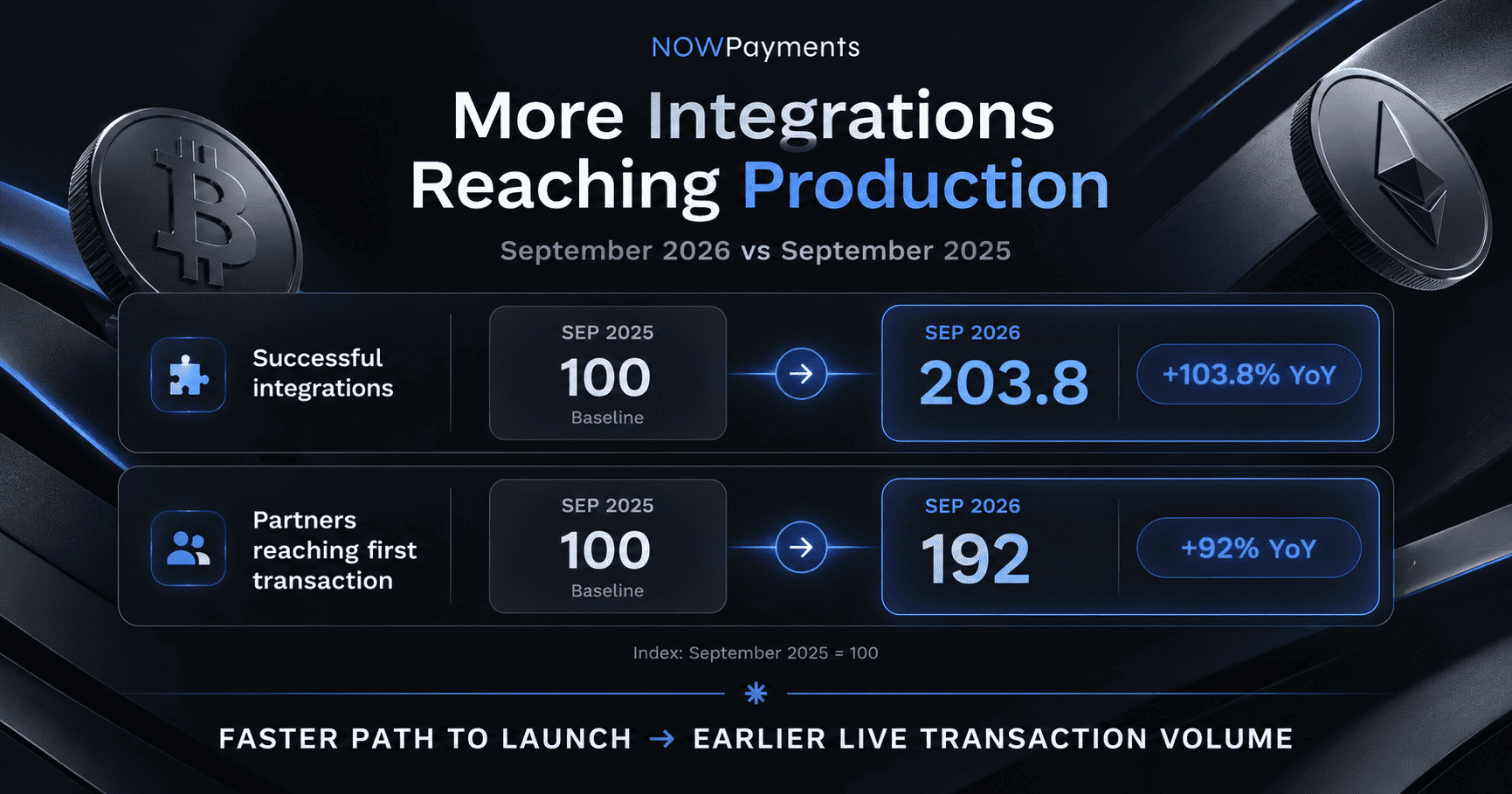
In September 2026, during a period when NOWPayments Integration specialists were actively working with partner launches:
- successful integrations increased 103.8% compared with September 2025;
- partners completing their first transaction on NOWPayments increased 92% year over year.
The comparison does not attribute all of that growth to one team. What it does show is that substantially more partners were getting through integration and reaching the point where their payment flow could actually start operating.
Why Time to First Transaction Matters
A payment integration starts creating business value when it reaches production.
Every additional round of testing, debugging, onboarding, or internal coordination can push that point further away. The blocker may sit in the API, account configuration, security setup, frontend, or another internal process.
That means launch speed affects more than developer convenience. A delayed integration means more implementation work before the business can start processing customer transactions.
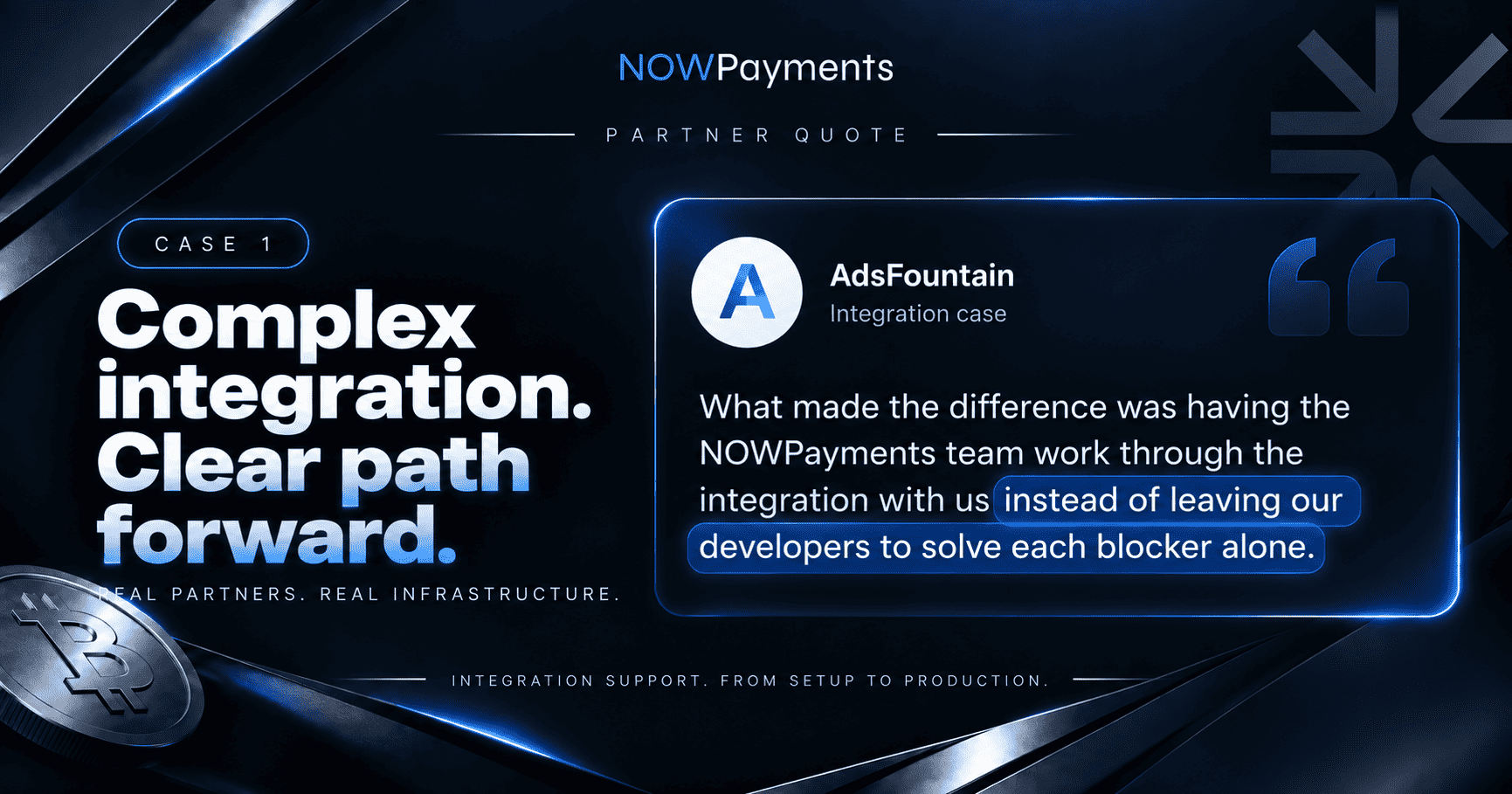
Integration support helps reduce that distance by identifying where the blocker sits and getting the right people involved.
Case 1. AdsFountain Built an Automated Payment and Payout Flow
Challenge
AdsFountain wanted users to pay for packages in different cryptocurrencies, automatically convert incoming funds into one stablecoin, hold those funds in a central balance, and use that balance for automated participant payouts.
The original plan used USDT TRC20. That did not work well for smaller amounts: the minimum payment was close to the platform’s smallest invoice, while network fees of roughly $2 to $3 were high relative to payouts around €7.50.
There was also an architecture mismatch. AdsFountain expected to receive funds in an external wallet and then use NOWPayments Mass Payouts, while automated payouts are needed to run from the Custody balance.
What the NOWPayments Integration Team Changed
NOWPayments worked with AdsFountain and its technical integrator, IOSS, to redesign the flow:
Customer payment → automatic conversion to USDT BSC → Custody balance → AdsFountain approval → Mass Payouts API
User validation remained inside AdsFountain. Once a payout passed the platform’s own checks, its backend could send the approved request through the Mass Payouts API.
Because payout addresses were dynamic, wallet address whitelisting was disabled for this flow while the server IP whitelist remained in place for API withdrawals.
What Testing Uncovered
Testing exposed several blockers:
- IPN and callback settings prevented payments from reaching the expected Finished status;
- 2FA and wallet address whitelisting conflicted with automated payouts;
- the Custody balance initially held BTC instead of USDT BSC;
- the white label checkout did not display currencies because of frontend logic on the integrator side.
NOWPayments worked with IOSS to identify which layer needed to change instead of treating every failed test as an API issue.
Outcome
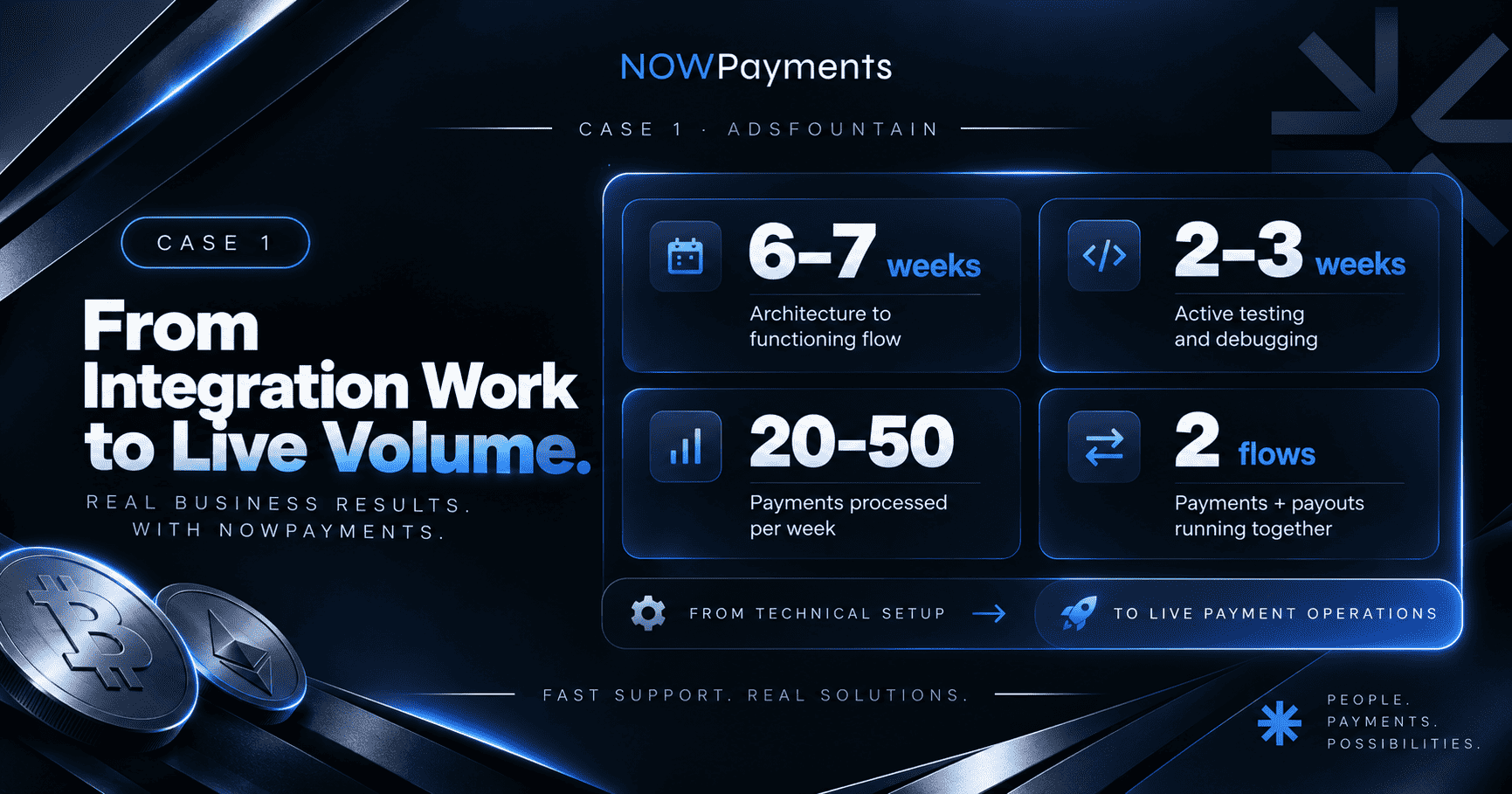
The project moved from detailed architecture work to a functioning payment and payout flow in approximately 6 to 7 weeks, including around 2 to 3 weeks of active testing and debugging.
Today, the setup processes approximately 20 to 50 payments per week, with payouts also actively used.
Why It Matters
The risk was not simply that individual API requests could fail. AdsFountain could have spent more development time building around a payment architecture that did not fit its transaction sizes or operating model.
Resolving those decisions during integration reduced the risk of later rework and helped move the project from technical setup to live payment activity.
Case 2. Wesource Brands Got Clear Guidance Through Fiat and Crypto Onboarding
Challenge
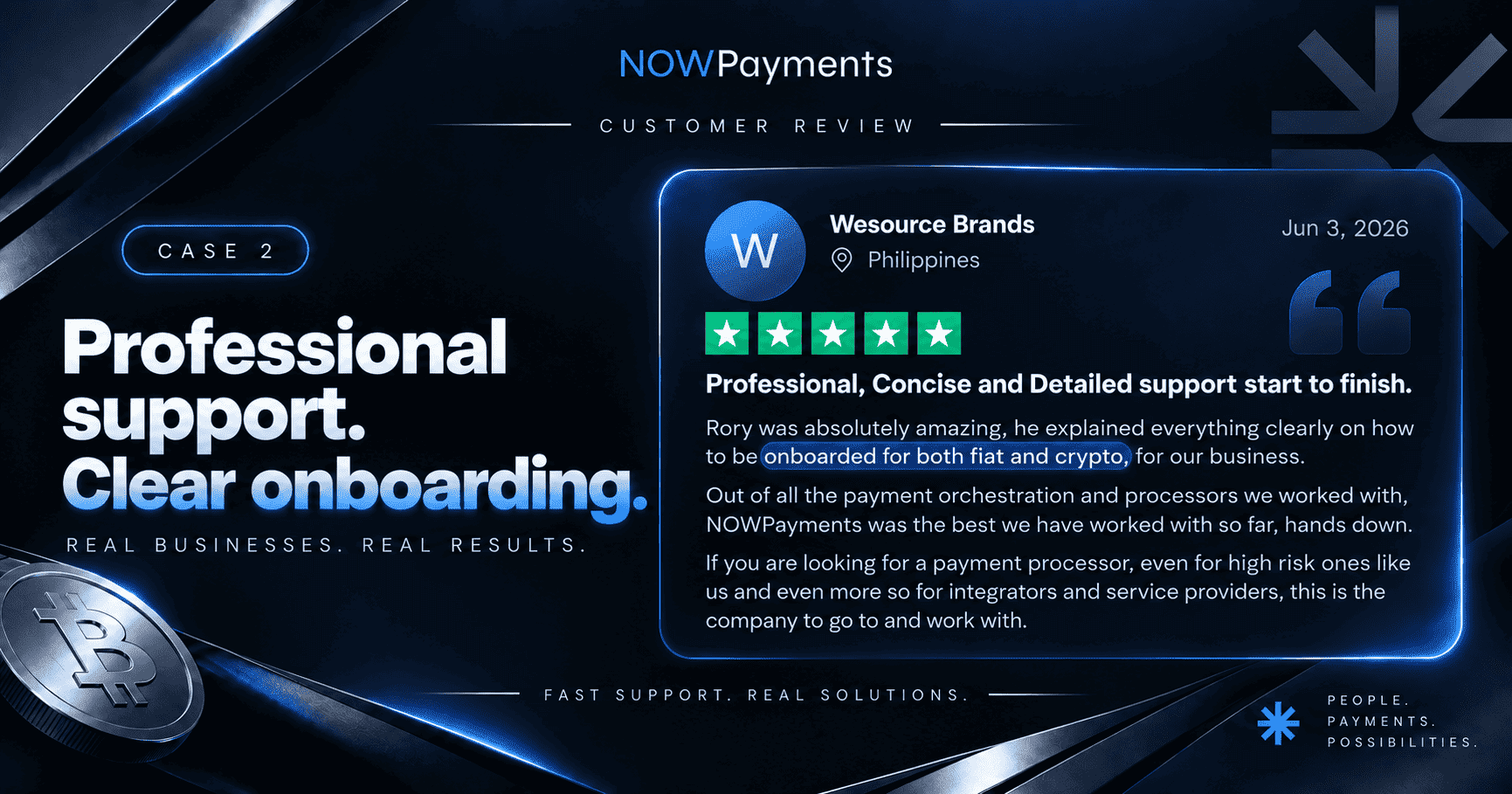
Wesource Brands needed a clear onboarding path for both fiat and crypto.
The company had already worked with payment orchestration companies and processors. The challenge was understanding how the NOWPayments setup should work without having to piece the process together independently.
What the Integration Team Solved
Rory guided the company through the onboarding process and clarified how the fiat and crypto setup would work.
Instead of leaving the partner to navigate separate requirements and next steps on its own, the Integration Team provided one clear route through the setup.
Outcome
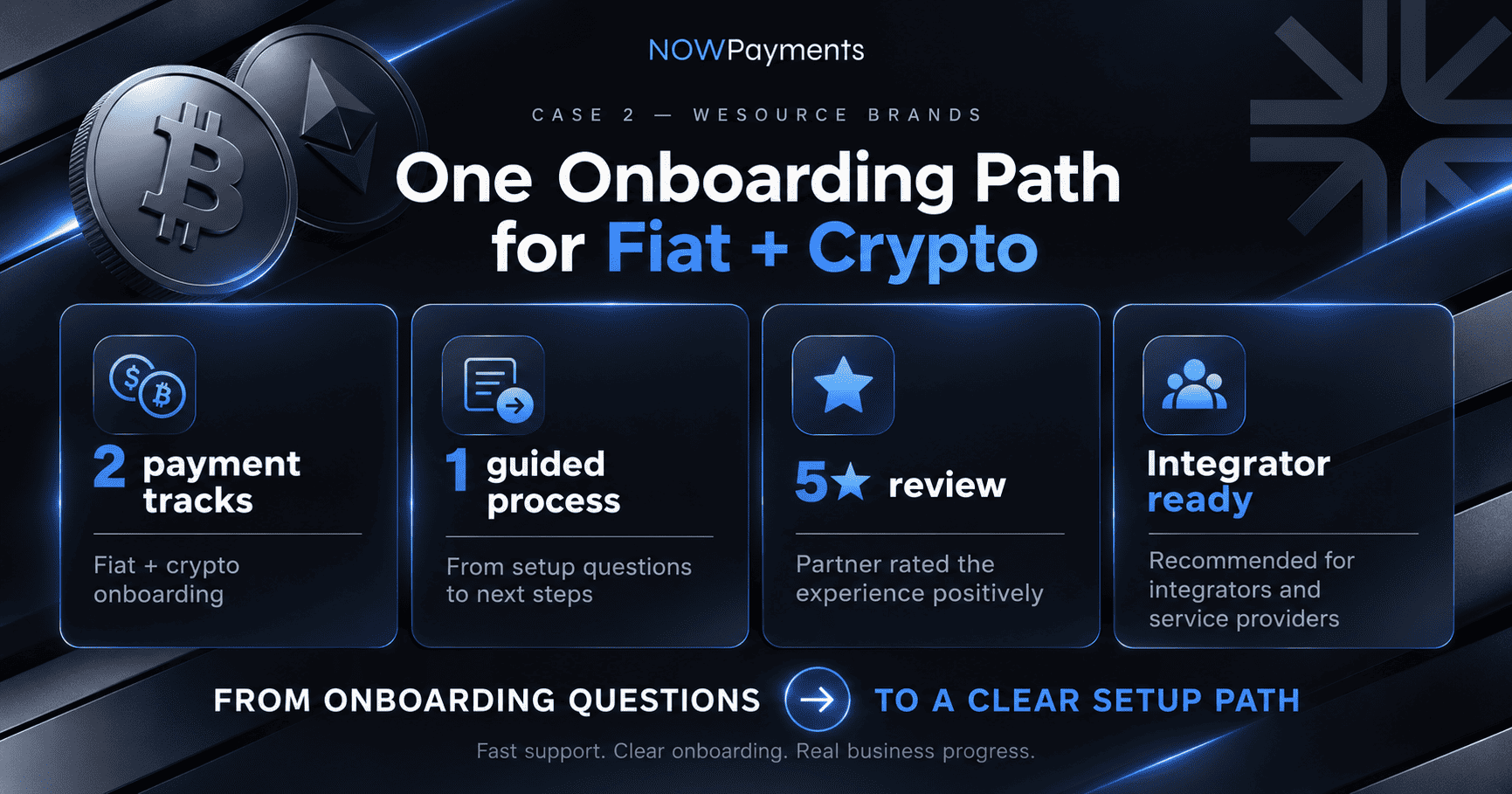
Wesource moved through both fiat and crypto onboarding with one clear route through the setup.
The partner also compared the experience positively with other payment processors and orchestration providers it had worked with.
Why It Matters
Onboarding is part of the time to market.
A business can have developers ready and still be unable to move forward if requirements, available flows, or next steps are unclear. Giving Wesource one route through fiat and crypto onboarding removed that nontechnical friction and kept implementation moving toward launch.
Case 3. Sellertify Moved Past an Account and Verification Blocker
Challenge
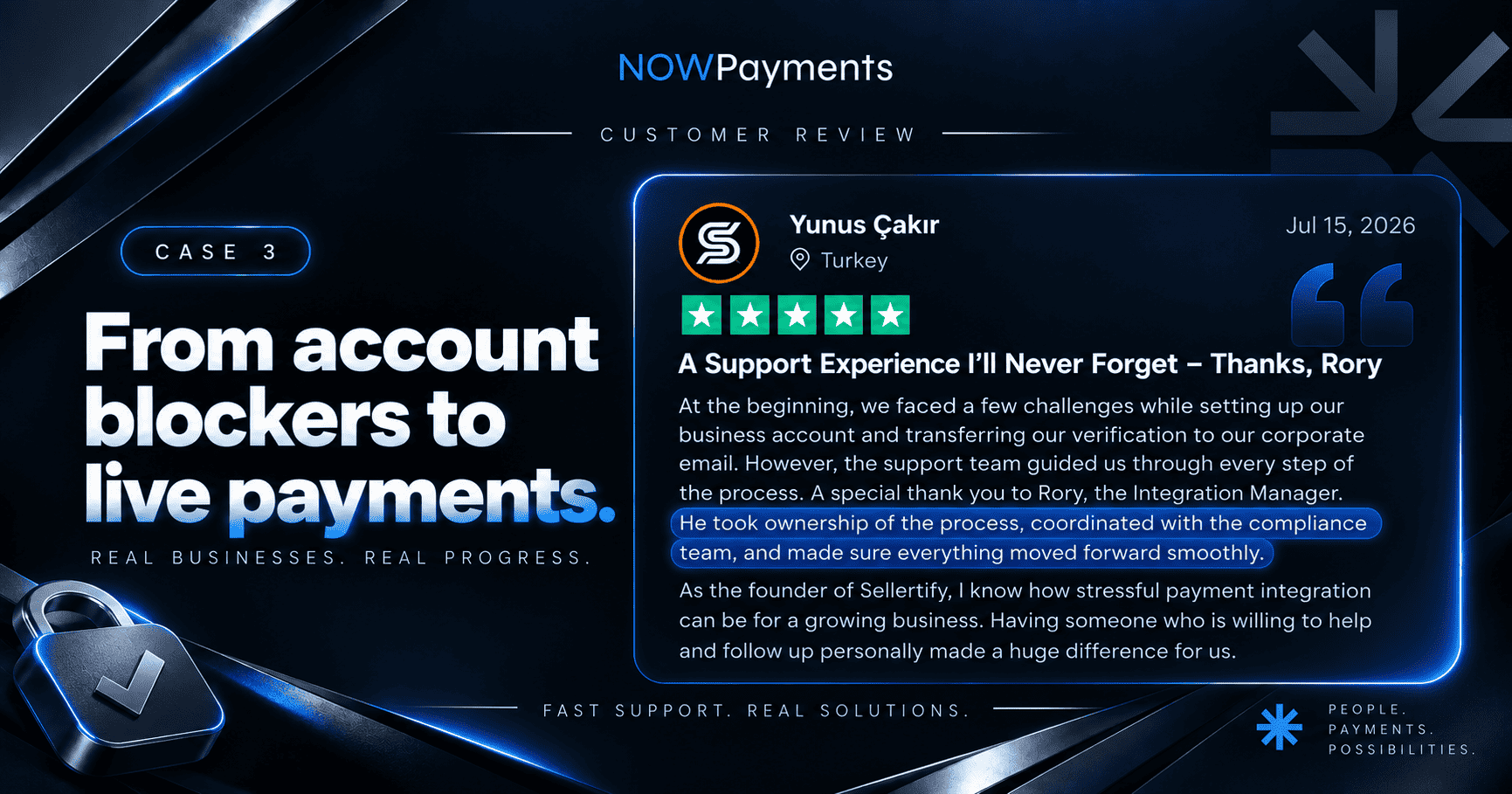
Sellertify was setting up its business account and needed to move verification to its corporate email. The wider payment project could not move forward until that process was sorted out.
This was not an API problem. It was an account and verification dependency sitting in the middle of the integration.
What the Integration Team Solved
Rory took ownership of the account process and coordinated directly with the compliance team.
The Integration team stayed involved across the handoff, so Sellertify did not have to identify the right internal team, pass the issue between departments, and manage the follow-up itself.
Outcome
The process resulted in:
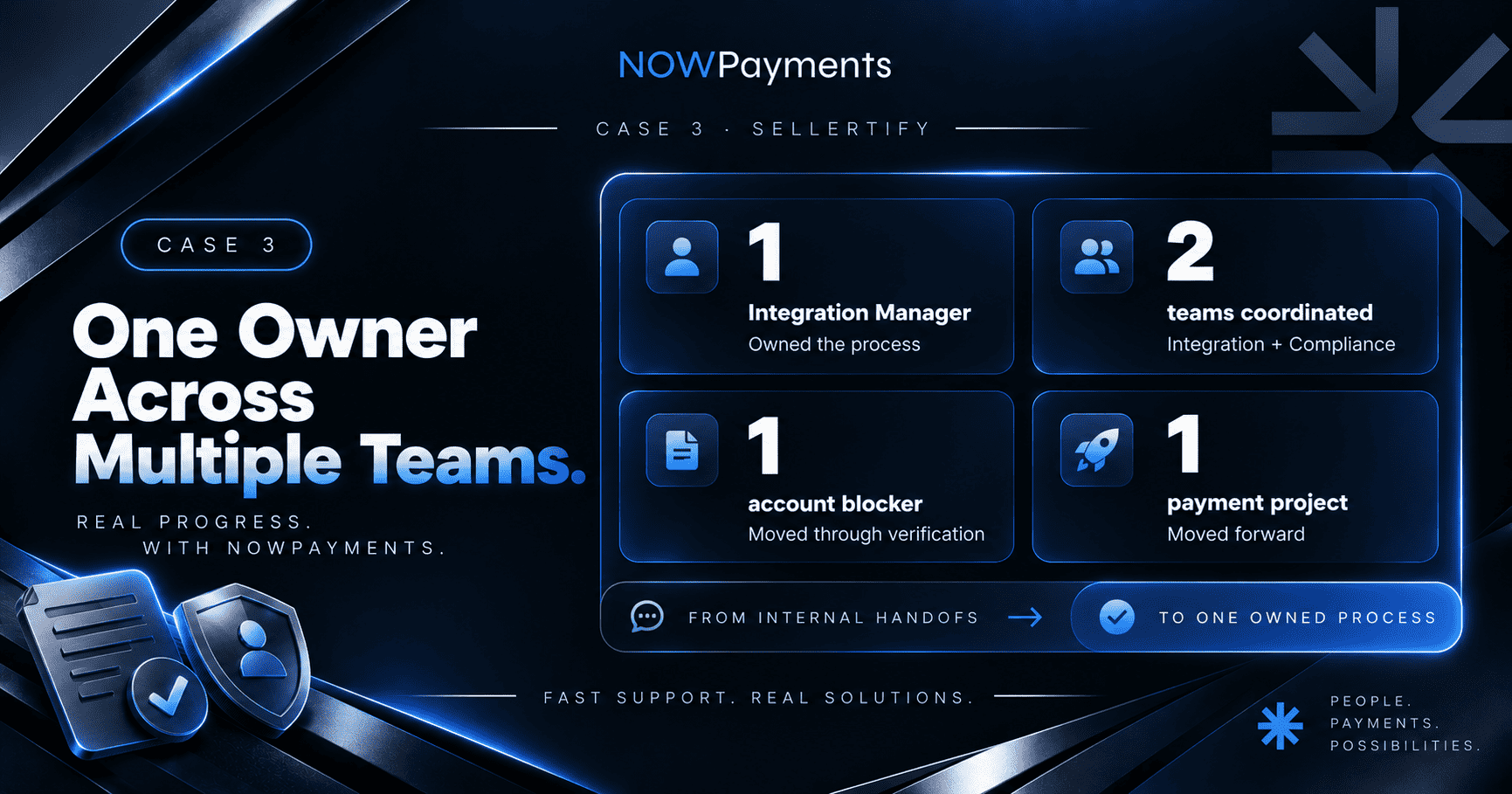
- the business account issue being addressed;
- verification coordinated across teams;
- the payment project moving forward.
Why It Matters
A technically viable integration can still be delayed by account, verification, or compliance dependencies.
By owning the handoff between Integration and Compliance, NOWPayments kept Sellertify from having to manage that process itself and prevented an internal dependency from leaving the wider payment project stuck.
Results at a Glance
The three cases show different blockers between the decision to integrate and the point where a payment project can move toward production.
| Partner | Integration blocker | Integration Team role | Launch outcome |
| AdsFountain | Architecture and technical blockers | Designed the flow and supported testing | Working payments and payouts, ~20–50 payments/week |
| Wesource Brands | Fiat and crypto onboarding | Guided onboarding | Clear route through setup |
| Sellertify | Account and verification process | Coordinated across teams | Payment project moved forward |
Where Integration Support Saves Time
Integration delays can appear at several stages of a project:
- Before development is locked in: network, custody, payout, and architecture decisions;
- During implementation: callbacks, security settings, account configuration, and frontend issues;
- Around the integration: onboarding, verification, compliance, and handoffs between teams.
Without clear ownership, each of these can create another round of investigation or coordination for the merchant.
The value of integration support is not simply getting questions answered faster. It is reducing the amount of time a partner spends between starting the integration and having a payment flow it can actually use. The current cases show that this can involve architecture decisions, technical debugging, onboarding guidance, or ownership across teams.
From Integration to First Transaction
The first transaction is a simple milestone, but an important one.
Before it happens, the payment integration is still being built, tested, or configured. Once it happens, the business has a live payment flow that can begin processing transaction volume.
That is why speed to launch has commercial value. The sooner avoidable blockers are removed, the sooner a partner can move from implementation work to live payment operations.
The September 2026 results reflect that shift at a broader level: more successful integrations and more partners reaching their first NOWPayments transaction than a year earlier.
The objective of the Integration Team is therefore not to replace a merchant’s developers or promise the same launch time for every project. It is to reduce avoidable friction between integration started and transactions started.
Ready to Get From Integration to First Transaction?
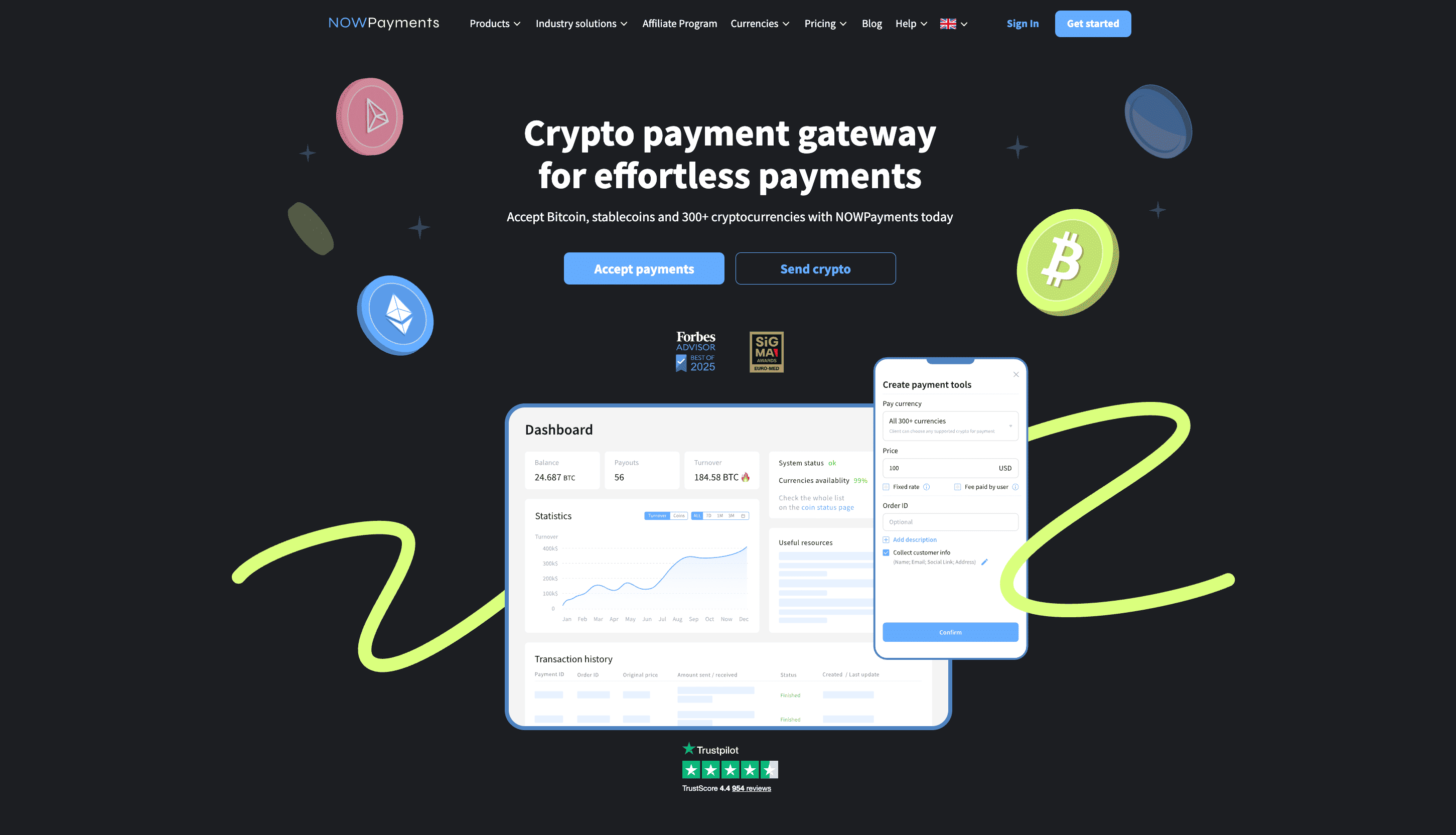
NOWPayments works with businesses on payment APIs, Custody, automatic conversion, payouts, white label flows, testing, and the technical or operational dependencies that can hold an integration back.
When a setup involves several systems or teams, the Integration and Business Development teams can help clarify the architecture, investigate blockers, and coordinate the next step.
Explore NOWPayments and move your payment flow from setup to live transactions.
About NOWPayments
NOWPayments is a crypto business ecosystem for companies operating with digital assets. Businesses can accept cryptocurrency and stablecoin payments, send payouts, manage conversions, and connect payment infrastructure to existing financial and operational workflows through APIs and business tools.
FAQ
Does NOWPayments provide integration support?
Yes. NOWPayments works with businesses during payment setup and implementation, including projects that involve architecture decisions, technical testing, account configuration, onboarding, and coordination with other teams.
The Integration Team helps move a planned payment flow toward a setup that is ready to run in production.
What can the NOWPayments Integration Team help with?
The Integration Team can support both payment architecture and technical implementation.
Depending on the setup, this may include:
- Payments API and payout flows;
- Custody and automatic conversion;
- Mass Payouts;
- IPN and callback configuration;
- IP or wallet whitelisting;
- white label payment flows;
- testing and debugging across several systems.
The team can also help identify which part of the payment flow needs to change when several systems are involved.
Can the NOWPayments Integration Team help design a payment and payout architecture?
Yes. Integration support can include planning how payments, conversions, balances, approval logic, and payouts should work together.
This can be useful for businesses building flows that go beyond a basic checkout, such as setups that combine incoming payments, custody, automatic conversion, internal approval, and automated payouts.
What kinds of problems can the Integration Team help troubleshoot?
Integration blockers can appear in several parts of a setup, not only in the API.
Common examples include:
- callback or IPN configuration;
- payout and wallet settings;
- 2FA or whitelisting conflicts;
- Custody configuration;
- account or verification dependencies;
- frontend behaviour;
- coordination between technical and nontechnical teams.
How can NOWPayments Integration Support help businesses go live faster?
Integration support can reduce time spent interpreting requirements, debugging problems in isolation, and coordinating dependencies between teams.
Instead of leaving the merchant to work through every architecture decision or internal handoff independently, the Integration Team can help isolate blockers, clarify the next step, and involve the right team when the issue sits outside the API.
The exact launch time depends on the integration. The goal is to reduce avoidable delays between the planned payment flow and the first live transactions.