
Average daily non-vote transactions on Solana reached a record 112.6 million in the first quarter of 2026, and about 2.2 million fee payers were active each day, according to Messari’s State of Solana Q1 2026 report. Public endpoints are meant for light use, so production apps usually move to a managed service. A Solana node provider runs the validator-grade nodes, exposes them over HTTP, WebSocket, and often gRPC, and bills by request, credit, or bandwidth. The real differences between vendors sit in streaming support, rate limits, and how usage is metered.
“Choosing a primary Solana RPC provider matters as much as choosing a backup, because a business with complex operations always needs a fallback endpoint in place.”
— Kate Liftshits, CBDO of NOWPayments
Below is the ranked list of leading Solana node providers for 2026:
- NOWNodes
- QuickNode
- Helius
- Triton One
- Syndica
How We Ranked the Best Solana RPC Node Providers
This comparison draws on each vendor’s own pricing and product pages, read on September 29, 2026. Figures taken from vendor marketing are labeled as stated by the vendor.
- Network Coverage and Node Types. Solana networks served, shared and dedicated capacity, and the data interfaces on offer.
- Performance and Reliability. Rate limits, published uptime terms, streaming products, and failover design.
- Pricing and Support. Free allowance, entry price, billing unit, and stated support response times.
The table sets the five Solana RPC providers side by side.
| Feature | 1. NOWNodes | 2. QuickNode | 3. Helius | 4. Triton One | 5. Syndica |
|---|---|---|---|---|---|
| Chains supported | 120+ | 79+ | 1 | 3 | 1 |
| Real-time data | WebSocket | Streams, gRPC |
gRPC, WebSocket |
gRPC, WebSocket |
ChainStream |
| Dedicated nodes | Yes | Yes | Yes | Yes | Yes |
| Free access | 100K requests, 1 month |
10M credits, 1 month |
1M credits/month | None | 10M calls/month |
| Entry price | €20/month | $49/month | $49/month | $125 deposit | $199/month |
| Paid RPS | No set limit | 50 to 500 | 50 to 500 | Set per customer |
Up to 300 |
| Support response | 3 minutes stated |
8 to 24 hours |
8 to 24 hours |
Direct engineer channel |
24 hours |
| Best For | Multi-chain stacks |
Compliance reviews |
Solana data products |
Low-latency streaming |
Solana-focused infrastructure |
*Rates, supported chains, and limits change frequently. Verify current terms on each provider’s official site before committing.
NOWNodes
Best for: teams that add Solana to a multi-chain stack.
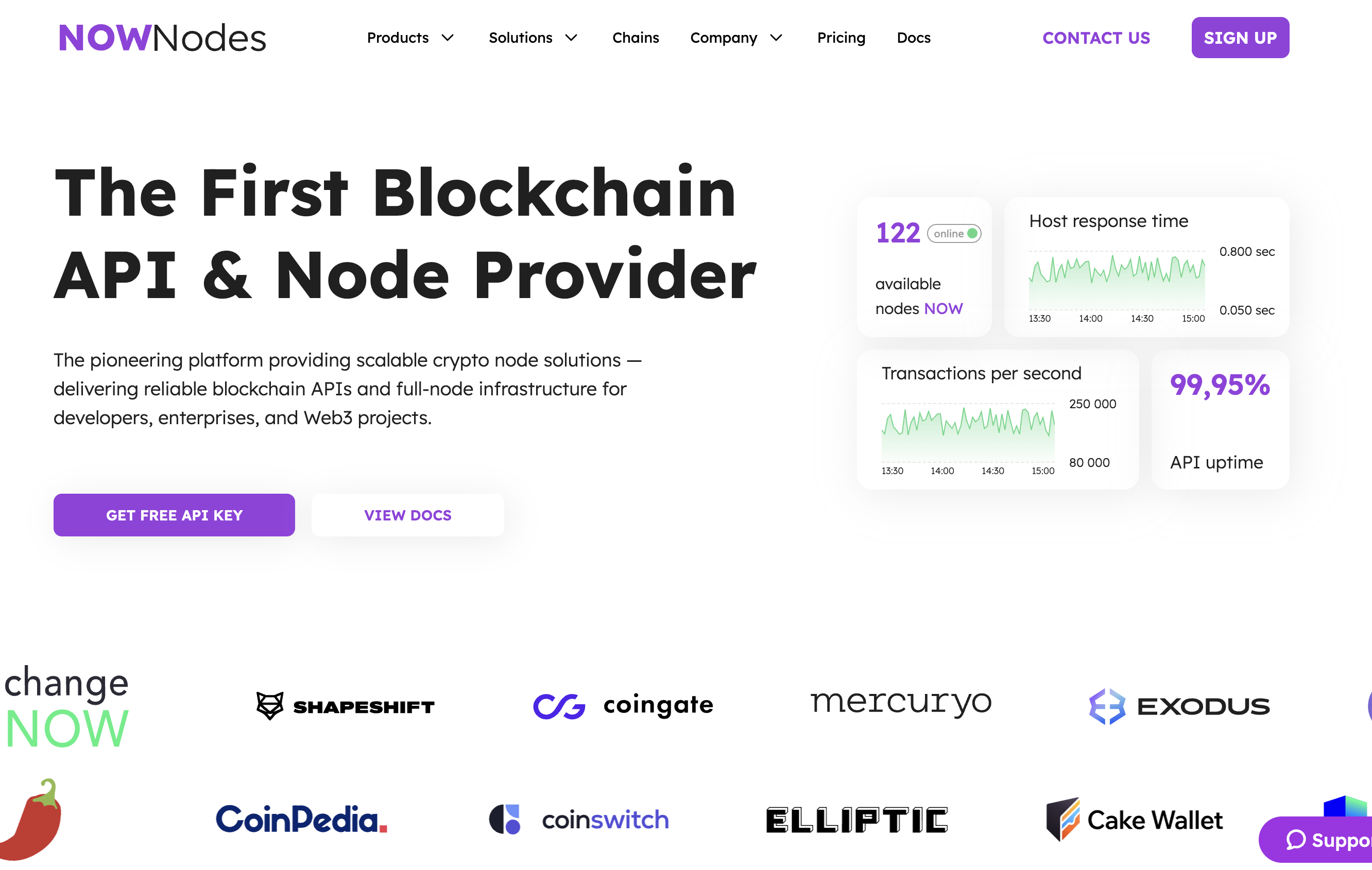
NOWNodes is one of the best RPC providers for teams that run Solana alongside many other chains. It is a blockchain node provider based in Tallinn that covers 120+ networks from one account. Its solana rpc page lists shared and dedicated nodes for Solana mainnet, with RPC and WebSocket access. The service states 99.9% uptime and no predefined RPS limits on paid plans. It suits teams that already send Bitcoin, EVM, and other traffic through one vendor.
Network Coverage and Node Types. The Solana page lists mainnet only, so teams that run integration tests on devnet need another endpoint. Solana-specific data products such as parsed token or NFT APIs are not listed either.
Performance and Reliability. The vendor describes geo-balanced clusters that fail over automatically when a node goes offline. Paid plans state no predefined RPS ceiling, though real throughput depends on the capacity a cluster has at that moment. Solana-specific latency figures are absent, so measure your own p95 before committing.
Pricing and Support. Start is free for 100,000 requests over one month, which makes it a trial. Listed prices are €20 a month for Pro (1 million requests) and €200 for Business (30 million), and Business overage is €1 per 100,000 requests. The pricing page states a three-minute support response on every plan.
QuickNode
Best for: teams that want audit paperwork and a stepped credit plan.
QuickNode is a multi-chain provider covering 79+ chains, and its Solana products include gRPC, Streams, and a Metaplex Digital Asset API. Usage is metered in API credits, and the ladder runs from a trial to negotiated Enterprise contracts. Enterprise lists SOC 1 Type 2, SOC 2 Type 2, ISO 27001, and DORA reports on request. It suits teams that answer to compliance reviewers.
Network Coverage and Node Types. Dedicated Clusters belong to the Enterprise plan, so smaller teams run on shared endpoints. Solana gRPC is a paid add-on on the lower plans, with concurrent streams listed at 10 on Scale and 25 on Business. Paid plans below Enterprise allow 5 active Solana streams.
Performance and Reliability. Limits climb with the plan: 15 RPS on the trial, then 50 on Build, 125 on Accelerate, 250 on Scale, and 500 on Business. Written uptime commitments are listed only under Enterprise.
Pricing and Support. A one-month trial carries 10 million credits and needs no card. Build is $49 monthly or $34 on annual billing, and includes 80 million credits with a 24-hour support SLA. Credit weights differ by method, so a Solana bill depends on the call mix, and there is no permanent free plan.
Helius
Best for: Solana-native products that need streaming and parsed data.
Helius is a Solana-only company that runs RPC nodes, its own validator, and a set of data APIs. Its headline products are LaserStream, a gRPC service described as a drop-in replacement for Geyser gRPC, Sender for transaction landing, and a token and NFT data API. Plans are fixed monthly subscriptions measured in credits. It suits trading, wallet, and token-data products built only on Solana.
Network Coverage and Node Types. LaserStream gRPC runs on devnet from the Developer plan and on mainnet from Business, while standard LaserStream WebSockets come with every plan. Dedicated nodes start at $2,900 a month. Historical, webhook, and token APIs sit alongside the RPC nodes.
Performance and Reliability. Rate limits rise from 10 RPS on Free to 50 on Developer, 200 on Business, and 500 on Professional, with separate caps on sendTransaction. Enterprise adds custom limits, latency and uptime SLAs, and SOC 2 compliance. The uptime comparison on its pricing page is a snapshot from February 2024, which is too old to rely on.
Pricing and Support. Free includes 1 million credits a month at 10 RPS with community support. Developer costs $49 a month for 10 million credits and a 24-hour support SLA, and Business costs $499 for 100 million. Extra credits cost $5 per million, and mainnet gRPC streaming requires the $499 plan.
Triton One
Best for: latency-sensitive DeFi and indexing workloads.
Triton One has run Solana infrastructure since 2021 and maintains the open-source Yellowstone tools, including the Dragon’s Mouth gRPC streaming service. It supports only Solana, Sui, and Monad. All products sit on one account type and are priced by usage, not by plan tier. It fits teams that would rather have direct engineer contact and streaming depth than a long chain list.
Network Coverage and Node Types. Shared clusters span 10+ data centres, routed by GeoDNS with failover between regions. Dedicated bare-metal nodes are available in North America, Europe, and APAC. Beyond RPC, Triton sells Fumarole persistent streams, Cloudbreak indexed account reads, and the Metaplex DAS API.
Performance and Reliability. Triton quotes 99.99% uptime on its pricing page, but no contract terms are published beside it. Rate and connection limits are agreed per customer, not fixed by tier. Teams should test at peak load, since no independent benchmark covers all five vendors here.
Pricing and Support. There is no free plan. An account opens with a $125 stablecoin deposit, which the vendor lists as prepaid, non-refundable, and usable for 12 months. Ordinary RPC and unary gRPC calls run $10 per million plus $0.08 per GB transferred, while streaming pays for bandwidth only. Each endpoint comes with a line to the engineering team around the clock.
Syndica
Best for: small Solana apps that want a large free allowance and request logs.
Syndica is a Solana-only provider that combines RPC endpoints, ChainStream data streaming, and app deployment on one platform. The free plan includes 10 million RPC calls a month at up to 100 RPS. The Scale plan costs $199 a month. It suits early-stage and mid-size Solana apps that want per-call visibility.
Network Coverage and Node Types. Syndica covers Solana only. Dedicated nodes and a 99.99% uptime SLA are offered through custom Hyperscale plans. ChainStream is not included on the free plan, while Scale includes one stream and charges $0.14 an hour for each additional one.
Performance and Reliability. Rate limits reach 100 RPS on Free and 300 on Scale. Log retention is 5 days on Free and 14 on Scale, with detailed logs and multi-filter search on both. Data transfer is capped at 100 GB on Free and 1 TB on Scale, and extra transfer costs $0.10 per GB.
Pricing and Support. Free carries a 48-hour support response and Scale a 24-hour one, with dedicated support on custom plans. Those targets are slower than the three-minute claim NOWNodes makes. The 300 RPS ceiling on Scale also sits below what a high-volume bot or indexer will need.
How to Choose a Solana RPC Node Provider
Start with what the application does all day, then check whose terms match that pattern. Headline specs say little about billing and limits under real load.
- Decide whether Solana is the only chain. A multi-chain vendor keeps one key and one bill, while a Solana-only vendor usually ships deeper data products.
- Pick the streaming interface first. WebSocket covers light subscriptions, and gRPC suits high-volume account and transaction feeds.
- Convert the billing unit. Credits, requests, and bandwidth count the same call differently, so price one real month.
- Check where streaming is gated. Some vendors reserve mainnet gRPC for mid-priced tiers or sell it as an add-on.
- Read the support terms. Confirm whether a response time is a stated target or a contractual term.
On Solana, streaming availability matters more than a headline RPS figure, since a rate cap can be engineered around and a missing feed cannot. Pilot two providers with production-representative traffic before committing.
When a Solana RPC Provider May Not Be the Right Fit
A managed endpoint solves a real problem for most production teams, yet some setups gain little from one. Five situations come up often enough to name, and each one changes what a team should buy.
- Prototypes and low-volume scripts. Solana’s public mainnet endpoint allows 100 requests per 10 seconds per IP and 40 per 10 seconds for any single method. That covers a bot that checks a balance every few seconds, and the free tiers from Syndica and Helius cover small projects on private endpoints. The Solana documentation states that public endpoints are not meant for production applications, so the arrangement suits testing only. Once real users depend on the app, a private endpoint becomes necessary.
- Teams that need control of the validator itself. Custom Geyser plugins, private snapshots, or a modified client sit outside what a shared service exposes. Dedicated nodes narrow the gap, and Helius lists them from $2,900 a month, but the vendor still runs the hardware. Teams with client-level requirements should price their own bare-metal node against a dedicated plan before signing.
- Workloads bound by residency rules or audits. Auditors often ask for signed reports and named data locations. On the pages reviewed, QuickNode lists SOC 1 Type 2, SOC 2 Type 2, ISO 27001, and DORA reports on request at the Enterprise tier, and Helius lists SOC 2 at Enterprise. The other three vendors published no comparable reports there, so a compliance team should ask them directly.
- Ledger-scale analytics and backfills. Per-call billing grows quickly when a job scans years of history. QuickNode charges 30 credits per Solana call and Triton charges $10 per million calls plus bandwidth, so a multi-year backfill becomes a large line item. Bulk data exports or a self-run indexer usually fit these jobs better than metered RPC.
- Products that cannot tolerate one vendor’s outage. A single provider is a single point of failure, whatever uptime figure its pricing page shows. Teams in this position need a second endpoint from a different vendor or their own fallback node. Written uptime commitments are also scarce. QuickNode lists contractual SLAs only at Enterprise, Helius lists latency and uptime SLAs there too, and Syndica offers a 99.99% SLA on custom plans. Buying one managed service alone leaves that gap open.
None of these cases rules out a managed service for every part of a system. A team can run its own node for validator-level work while routing ordinary wallet traffic through a vendor. The decision applies to each workload separately.
Solana RPC Provider Pricing Compared
Sticker prices for a Solana node service say little until they are converted into one usage figure. Credits, requests, and bandwidth count the same call differently, and Solana calls carry heavy weights at some vendors. The table prices a mid-sized production workload of 30 million requests a month, about 12 requests per second on average, at each vendor’s listed monthly rate.
| Provider | Pricing Model | Free Tier | Entry Price | Cost at 30M Requests/Month |
| NOWNodes | Monthly request tiers | 100K requests, 1 month | €20/month | €200/month |
| QuickNode | API credits | 10M credits, 1 month | $49/month | $499/month |
| Helius | Monthly credits | 1M credits/month | $49/month | $149/month |
| Triton One | Prepaid usage | None | $125 deposit | $300 plus bandwidth |
| Syndica | Monthly plans | 10M calls/month | $199/month | $199/month |
The figures assume standard read calls. QuickNode bills 30 credits per Solana call, Helius bills 1 credit per standard call, and Triton’s figure excludes bandwidth at $0.08 per GB. NOWNodes prices in euros and the other four in dollars, and every figure uses the monthly rate, not an annual discount.
Rates, supported chains, and limits change frequently. Verify current terms on each provider’s official site before committing.
Multi-Chain Generalists vs Solana Specialists
The most useful split among these five vendors is chain focus. It predicts what each one ships for Solana, and how much of the surrounding product a Solana team has to build itself.
Multi-chain generalists: NOWNodes and QuickNode. NOWNodes covers 120+ networks and QuickNode 79+, so both let a team keep one account and one invoice across many chains. For a wallet or payment processor that handles Bitcoin, EVM, and Solana traffic side by side, that consolidation removes vendor management work no Solana-only feature replaces. Solana is one product among many on these platforms, and the depth shows in what each lists.
QuickNode lists Solana gRPC, Streams, and a Metaplex Digital Asset API, plus compliance reports at the Enterprise tier. NOWNodes lists RPC and WebSocket on its Solana page, with mainnet only and no parsed token or NFT data. Either can serve as the general endpoint. In the author’s view, teams that need Solana-specific tooling will usually add a specialist next to it.
Solana specialists: Helius, Triton One, and Syndica. These three build around Solana’s data model. Helius sells LaserStream gRPC, the Sender landing service, webhooks, and asset APIs, and it runs its own validator. Triton maintains the open-source Yellowstone tools and sells streaming, indexed account reads, and ledger queries. It supports Solana, Sui, and Monad, so it is Solana-focused and not strictly Solana-only. Syndica combines RPC, ChainStream, and request-level logs in one platform.
The trade-off is coverage. A team that later adds Ethereum or Bitcoin traffic needs a second vendor, a second key model, and a second bill. Specialist pricing also follows Solana’s call mix, as with the 10-credit weight on getProgramAccounts at Helius or Triton’s separate bandwidth charge.
Streaming access shows the split clearly. Helius includes LaserStream WebSocket on every plan and gRPC on mainnet from Business, QuickNode sells Solana gRPC as an add-on below its higher tiers, and Triton includes every product on every account. Syndica’s ChainStream is absent from the free plan and included once on Scale, and NOWNodes lists WebSocket on paid plans with Solana gRPC unconfirmed. A team choosing on streaming alone should price the tier that enables it, not the entry plan.
Switching costs differ inside each group. Standard JSON-RPC calls move between vendors with an endpoint change. Helius describes LaserStream as a drop-in replacement for Geyser gRPC, and Triton’s Yellowstone tools are open source, so streaming code built on that interface has a lower exit cost than code built on a vendor-specific API. Sender at Helius, Fumarole at Triton, and ChainStream at Syndica are examples of products that need code changes to replace.
Support and contract terms differ between the groups as well. QuickNode Enterprise lists a dedicated solutions architect and 24/7 on-call engineering, and Helius Enterprise lists latency and uptime SLAs. Syndica offers a 99.99% uptime SLA and dedicated support engineers on custom Hyperscale plans. NOWNodes states 24/7 support with a three-minute first response, and Triton lists a direct engineering channel on every endpoint.
Many teams do not have to pick a side. One workable pattern pairs a specialist for streaming and indexed reads with a generalist as a fallback endpoint. That arrangement also addresses the single-vendor risk described earlier.
Which Solana RPC Node Provider Should You Choose?
NOWNodes fits teams that run Solana beside many other chains and want no predefined RPS limit on paid plans. Those teams should accept mainnet-only Solana listings and confirm gRPC coverage first. QuickNode fits teams that need compliance reports and a stepped credit plan, and that can move to Enterprise for written SLAs.
Helius suits products built only on Solana that need LaserStream, token data, and Sender, provided they budget for the $499 tier to get mainnet gRPC. Triton One suits latency-focused and indexing workloads for teams comfortable with a prepaid deposit and no free tier. Syndica suits smaller Solana apps that want 10 million free calls and log search, with support times of 24 to 48 hours below custom plans.