
Ethereum daily transactions hit a record 2.8 million in early 2026, according to Etherscan data reported in January, and about 43.46 million ETH was staked on 23 September 2026, roughly 35% of supply. Every wallet, exchange, and analytics service that reads this activity needs a node to ask. An Ethereum RPC node provider hosts full and archive nodes and exposes them over JSON-RPC and WebSocket. Apps then read balances, send transactions, and query logs without syncing a client.
“Picking a primary Ethereum RPC provider matters as much as picking a backup, because any business with real traffic needs a fallback route when one endpoint fails.”
— Kate Liftshits, CBDO of NOWPayments
Below is the ranked list of leading blockchain node providers for Ethereum in 2026:
- NOWNodes
- Infura
- Alchemy
- QuickNode
- Chainstack
How We Ranked the Best Ethereum RPC Providers
The editorial team read each vendor’s public pricing and documentation pages on 29 September 2026. Figures a vendor reports about itself are labeled as stated.
- Network Coverage and Node Types: chains served, shared and dedicated options, archive, Trace, and Debug access.
- Performance and Reliability: written uptime terms, throughput ceilings, and how limits are counted.
- Pricing and Support: free allowance, entry price, billing unit, and support response terms.
The table sets the five Ethereum RPC providers side by side on the limits that shape a bill.
| Feature | 1. NOWNodes | 2. Infura | 3. Alchemy | 4. QuickNode | 5. Chainstack |
|---|---|---|---|---|---|
| Chains | 120+ | 40+ | 100+ | 79+ | 70+ |
| Free tier | 100K requests, 1 month |
3M credits/day | 30M CU/month | 10M credits, 1 month |
3M requests/month |
| Entry paid | Pro, 1M requests/month |
$50/month | $0.525 per 1M CU |
$49/month | $49/month |
| Paid throughput | No fixed RPS | 4K credits/sec | 300 RPS | 50 RPS | 250 RPS |
| Contractual SLA | 99.9% stated | Enterprise | Enterprise | Enterprise | Enterprise |
| Dedicated nodes | ✅ | Not listed | Separate product |
Enterprise | Pro and up |
| Best For | Multi-chain stacks |
Daily-quota planning |
Tooling plus RPC |
Audit reports |
Predictable billing |
Rates, supported chains, and limits change frequently. Verify current terms on each provider’s official site before committing.
NOWNodes
Best for: multi-chain wallets and payment services that add Ethereum to an existing stack.
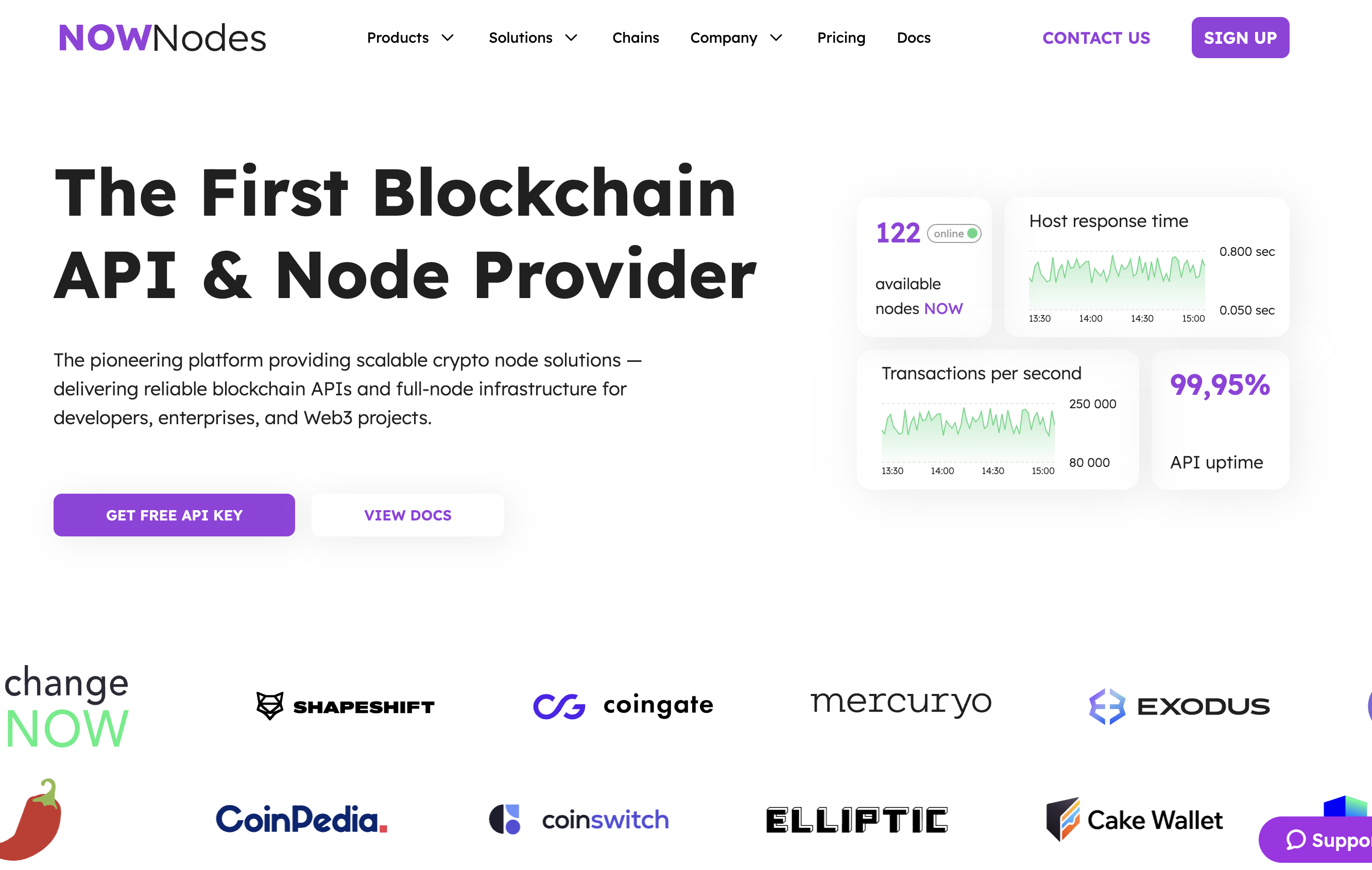
NOWNodes is one of the best RPC providers for teams that need Ethereum alongside many other chains. It is a blockchain infrastructure company based in Tallinn, Estonia, whose eth rpc service covers Ethereum mainnet and testnet through shared and dedicated nodes. The same account reaches more than 120 other networks. The Ethereum page lists 99.9% uptime and no predefined RPS limit on paid plans. It suits teams that already route several chains through one vendor.
Network Coverage and Node Types. The Ethereum page lists RPC and WebSocket access, the Blockbook indexed API, Trace, Debug, and archive mode. Dedicated nodes are isolated for one customer and one chain, with the region chosen at setup. Confirm the exact Trace and Debug methods you need against the documentation before building on them.
Performance and Reliability. Requests run through geo-distributed, load-balanced clusters with automatic failover. On paid plans throughput scales with cluster capacity, which describes a policy and not unlimited hardware. Latency claims are regional: the main site quotes under 200 ms for key US and European locations. Nothing published isolates Ethereum calls, so test your own methods.
Pricing and Support. The free Start plan allows 100,000 requests for one month and excludes WebSocket. Paid shared plans run from Pro at 1 million requests a month through Pro Plus (10 million), Business (30 million), and Business Plus (50 million) to Enterprise at 100 million. Overage billing starts on Pro Plus at €5 per 100,000 requests and falls to €0.50 on Enterprise, while Start and Pro have none. Support is 24/7 with a stated three-minute first response. The trade-offs are a trial-style free plan, monthly request quotas, and no SOC or ISO reports on the pages reviewed.
Infura
Best for: Ethereum-centered teams that want a daily credit quota.
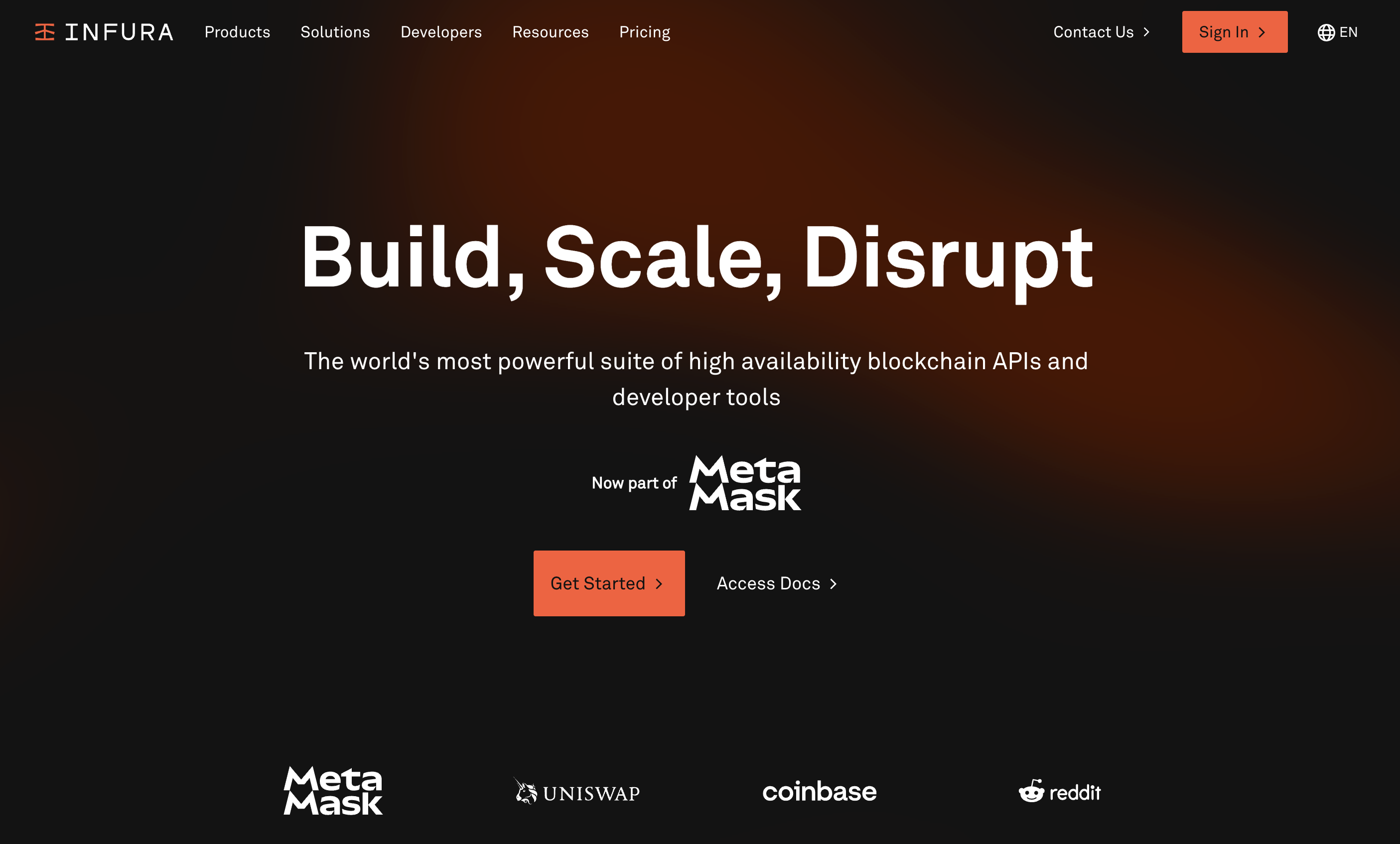
Infura, a Consensys service, lists 40+ supported networks and uses Ethereum as the baseline for its credit pricing. Usage is metered in credits, with a daily quota and a per-second throughput guarantee. The free Core plan includes full archive data. It suits teams whose traffic is steady enough to fit a daily budget.
Network Coverage and Node Types. Debug and Trace API access starts on the $50 Developer plan. The Gas API is included as an expansion API. The pricing page lists no dedicated-node product.
Performance and Reliability. Core guarantees 500 credits a second, Developer 4,000, and Team 40,000. An eth_call costs 80 credits, so Core sustains about six such calls a second. A debug_traceTransaction call costs 1,000 credits, which cuts it to half a call a second. Enterprise adds auto-scaling and an enhanced support SLA.
Pricing and Support. Core is free with 3 million credits a day, about 37,500 eth_call requests. Developer costs $50 a month for 15 million daily credits, and Team $225 for 75 million. Requests over the daily quota return HTTP 402 and are not charged, and add-on credits cost $200 a month per 55 million. Ticket support starts on Developer, and a daily quota handles bursts poorly.
Alchemy
Best for: teams that want developer tooling next to RPC access.
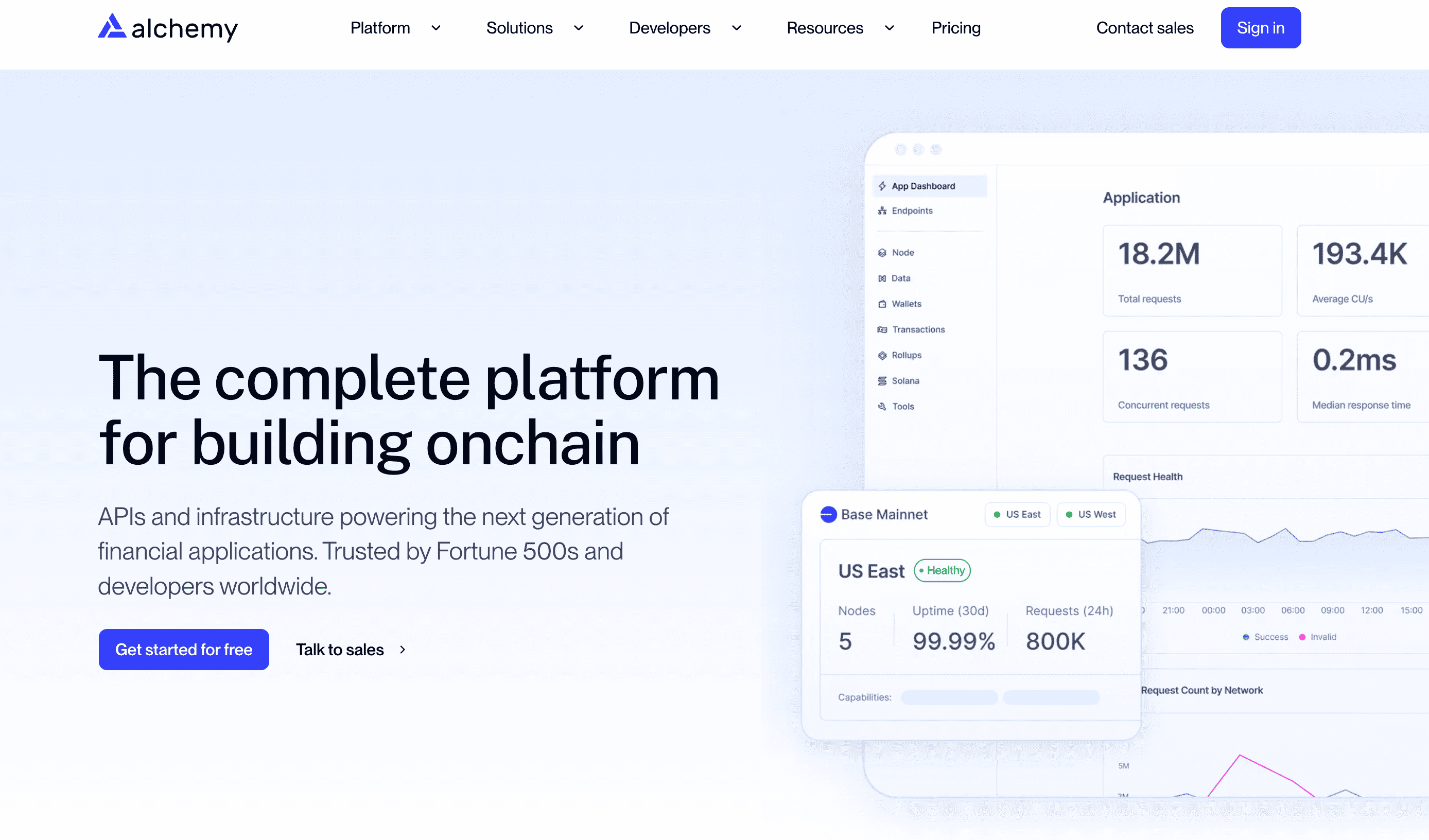
Alchemy describes itself as a developer platform and lists 100+ supported chains. Ethereum access sits beside webhooks, token and NFT APIs, and a smart-WebSocket product. Billing runs on compute units. It suits teams that value bundled tooling and a large free allowance.
Network Coverage and Node Types. The free plan reaches all mainnets and testnets and includes full archive data. Apps and webhooks scale by plan: 5 and 5 free, 30 and 100 on Pay As You Go, 100 and 500 on Enterprise. Single-tenant infrastructure is sold separately as Dedicated Clusters.
Performance and Reliability. The free tier caps at 25 requests per second, while Pay As You Go begins at 300 and Enterprise at 1,000. Signed SLAs appear only at the Enterprise level. Teams that outgrow 300 RPS pay $160 a month for each extra 5,000 CU/s block. Pay As You Go promises enterprise-grade uptime in general terms, with no percentage attached.
Pricing and Support. The free plan grants 30 million compute units a month, about 1.1 million requests at Alchemy’s own 27-unit average. Pay As You Go charges $0.525 per million units. Each method has its own weight, so a log-heavy workload costs more than a balance-reading one. Support targets are 48 hours on Free and 24 on Pay As You Go, with paid packages at 12, 4, or 2 hours.
QuickNode
Best for: buyers who need audit reports and a defined credit ladder.
QuickNode is a managed RPC provider covering 79+ chains, with Ethereum among its featured networks. Usage is metered in API credits, from a one-month trial through Build, Accelerate, Scale, and Business tiers. Enterprise plans add dedicated infrastructure and compliance documents. It suits procurement teams that answer to security review.
Network Coverage and Node Types. Multi-chain endpoints and archive data are listed across plans, and Trace and Debug appear from Build upward. Dedicated Clusters and SAML single sign-on sit on Enterprise. Streams and Webhooks add push delivery of blocks and logs.
Performance and Reliability. Throughput climbs from 50 RPS on Build to 125 on Accelerate, 250 on Scale, and 500 on Business. The pricing page ties contractual uptime SLAs to Enterprise contracts. Audit material sits there too: SOC 1 Type 2, SOC 2 Type 2, ISO 27001, and DORA reports are available on request, alongside round-the-clock on-call engineers.
Pricing and Support. A one-month trial carries 10 million credits and 15 RPS, and it needs no card. After that, Build lists at $49 a month for 80 million credits, Accelerate at $249 for 450 million, and Scale at $499 for 950 million; Business starts at $999. Support response targets shrink from 24 hours on Build to 8 hours on Scale. The drawbacks are the lack of a lasting free plan and per-method credit weights that make bills hard to predict.
Chainstack
Best for: teams that want request-based billing they can forecast.
Chainstack lists 70+ chains and meters usage in request units, where a global node call costs one unit and an archive call two. It shows SOC 2 Type II and ISO 27001 badges on its pricing page. Ethereum runs on shared global nodes, dedicated nodes, or self-hosted deployment. It suits teams that want predictable invoices.
Network Coverage and Node Types. The free Developer plan covers global nodes and WebSockets. Archive data, Trace, and Debug start on Growth at $49. Dedicated nodes start on Pro, with Geth or Erigon clients. An MEV protection add-on for Ethereum is listed as free.
Performance and Reliability. The RPS ceiling is 25 on Developer, 250 on Growth, 400 on Pro, and 600 on Business. Only Enterprise removes it and comes with an uptime SLA. Cheaper tiers carry no written guarantee, although the pricing page shows a 99.99%+ badge that points to Chainstack’s status page.
Pricing and Support. The free Developer plan bundles 3 million requests a month and community help. Growth adds 20 million, Pro 80 million for $199, and Business 200 million for $499. Overage per million requests is $20 on Developer and $10 on Business. Paid plans get a 24-hour standard support target, and tighter targets are sold separately: six hours for $1,000 a year, one hour for $10,000.
How to Choose an Ethereum RPC Node Provider
Start from the calls your app makes, then check how each vendor counts them. Headline quotas say little until traffic spikes.
- Convert quotas to real calls. One eth_call costs 80 Infura credits, and eth_getLogs costs 255, so price one sample month.
- Check archive and trace access. Historical queries and Debug methods sit on different tiers at each vendor.
- Find the written uptime term. Several vendors reserve signed SLAs for Enterprise contracts.
- Test at peak load. Free caps and paid ceilings look alike at idle and diverge during a mint or a liquidation wave.
An outage does more damage than a low throughput cap, since load can be spread across endpoints and lost hours cannot be recovered. Send production-like traffic through two candidates for at least a week before signing.
When an Ethereum RPC Node Provider May Not Be the Right Fit
A hosted endpoint is the wrong tool for some setups, no matter how good the vendor is.
- Validator operations. Staking clients need a local execution client, and a remote endpoint adds latency and a shared point of failure.
- Strict data sovereignty. Teams that must keep every query and key on their own hardware cannot route traffic through a third party.
- Sustained heavy indexing. Scanning full history with log or trace calls can cost more on a metered plan than on a self-run archive node.
- Latency-critical trading. Searchers and MEV bots often colocate a node beside block builders, and no shared endpoint matches that path.
- Tiny hobby projects. A free public endpoint may cover a few calls a day without any account.
Ethereum RPC Node Provider Pricing Compared
Headline prices hide the billing unit, and the unit decides the invoice. The table prices one workload: 10 million eth_call requests a month.
| Provider | Pricing Model | Free Tier | Entry Price | Cost at 10M eth_call/month |
| NOWNodes | Request quota | 100k requests, 1 month | Pro, 1M requests/month | Pro Plus tier, 10M quota |
| Infura | Daily credits | 3M credits/day | $50/month | $225 (Team) |
| Alchemy | Compute units | 30M CU/month | $0.525 per 1M CU | About $142 |
| QuickNode | API credits | 10M credits, 1 month | $49/month | About $123 |
| Chainstack | Request units | 3M requests/month | $49/month | $49 (Growth) |
Rates, supported chains, and limits change frequently. Verify current terms on each provider’s official site before committing.
Total Cost Analysis
NOWNodes. Ten million requests match the Pro Plus quota, and plan prices sit on the vendor’s pricing page. Overage on Pro Plus is €5 per 100,000 requests, or €50 per million, the steepest rate here.
Infura. At 80 credits per call, the workload burns about 26.7 million credits a day, above the Developer plan’s 15 million. That pushes it to Team. A daily quota also stops a busy day borrowing from a quiet one.
Alchemy. Alchemy’s own calculator prices 10 million requests at 27 compute units each at $141.75. Log or trace calls would raise it, and throughput above 300 RPS costs $160 a month per extra block.
QuickNode. Ethereum calls cost 20 credits, so the workload uses 200 million credits against Build’s 80 million. Build plus 120 million extra credits at $0.62 per million comes to about $123, less than Accelerate at $249.
Chainstack. One request unit per call keeps 10 million calls inside Growth’s 20 million units. Archive calls cost two units, and Growth caps at 250 RPS.
Flat Request Billing vs Weighted Credit Billing
The billing unit divides these five providers more sharply than chain count does.
Request-based billing (NOWNodes, Chainstack). Plans count requests against a monthly quota, so the bill follows traffic volume. Forecasting is simple, though a spike can pass the quota and trigger overage.
Weighted credit billing (Infura, Alchemy, QuickNode). Each method carries its own weight, such as 80 credits for eth_call and 1,000 for a debug trace on Infura. A workload heavy on logs or traces costs far more than one that reads balances.
Which Ethereum RPC Provider Should You Choose?
Choose NOWNodes if you run Ethereum next to many other chains, want no predefined RPS limit on paid plans, and can accept monthly request quotas and a one-month free trial. Choose Infura if your Ethereum traffic is steady and a daily credit budget suits you, and Alchemy if bundled webhooks and token APIs matter more than a flat request count.
Choose QuickNode if security review requires SOC and ISO documents and you are ready for Enterprise terms. Choose Chainstack if you want one flat unit per call and a free plan with no expiry, and can pay extra for fast support.