
Accepting crypto on your website is not just about the checkout; businesses also need reliable settlement, treasury management, and payout infrastructure. NOWPayments provides five website integration methods, each with a different level of automation, so you are not locked into a rigid setup. Once the funds arrive, you can convert, store, or distribute them without leaving the dashboard. This guide covers website implementation and the operational flow after a payment.
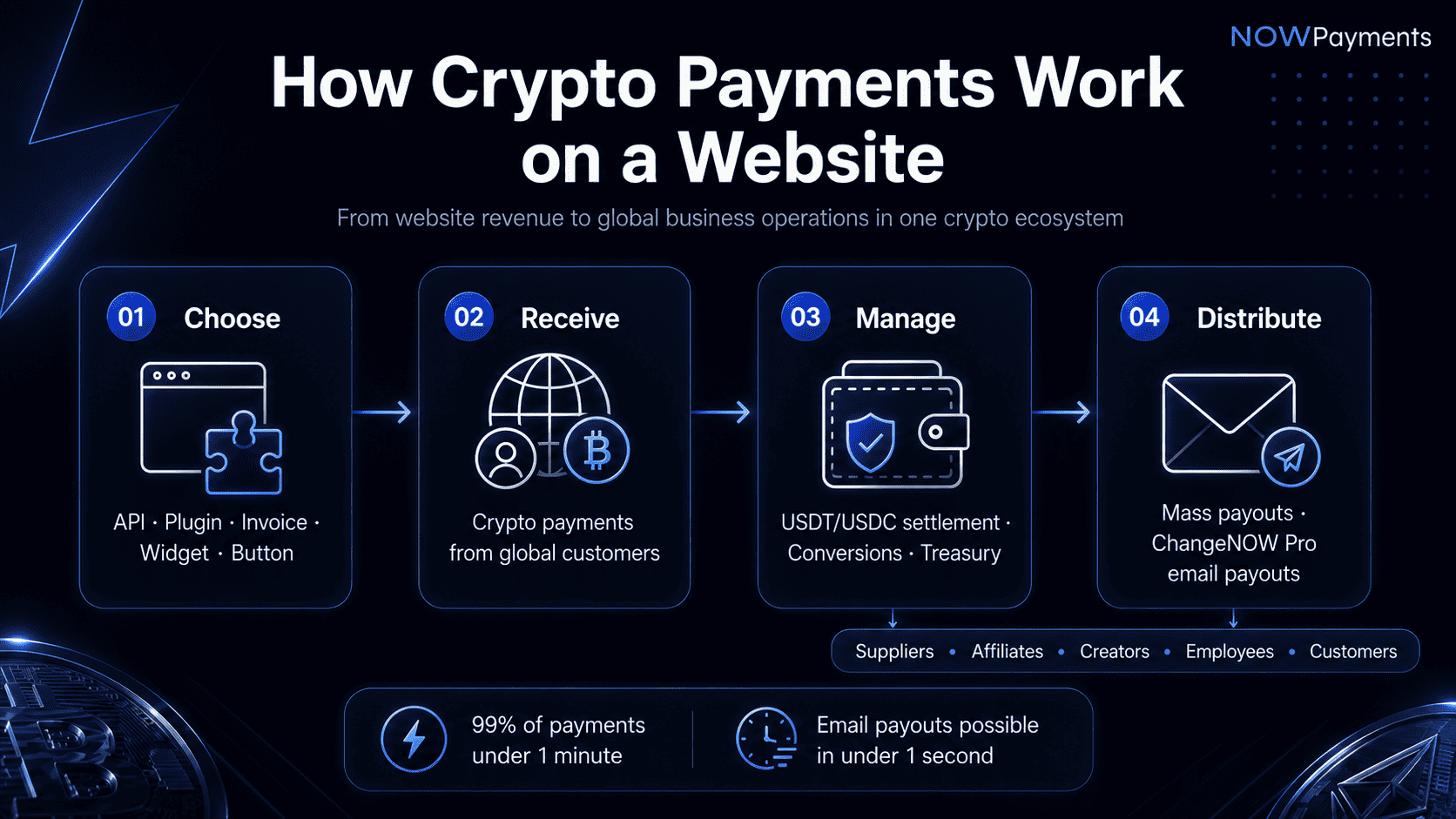
How Crypto Payments Work on a Website
Crypto payments are more than a checkout moment. The real value is in the full cycle that follows.
The business flow in six steps:
- Customer places an order and selects cryptocurrency at checkout.
- NOWPayments generates a payment address and confirms the transaction.
- Funds are settled into your merchant account.
- You convert to stablecoin or hold the balance in treasury.
- Funds are distributed to suppliers, affiliates, employees, or customers.
Ways to Add Crypto Payments to a Website
NOWPayments offers five ways to add crypto payments to your website. Each method suits a different type of business, technical skill level, and automation need.
- Payment API gives you full control over the payment flow through a backend connection.
- Plugins are one-click installations for popular e-commerce systems like WooCommerce and WHMCS.
- Invoices are hosted payment links you can send to customers.
- Payment Widget is an embedded checkout interface that stays on your website.
- Payment Button is a single line of HTML code that generates a clickable button.
| Method | What You Add | Coding Required | Customer Experience | Order Automation | Best For |
| Payment API | Custom backend connection | ✅ | Fully customizable | Full | SaaS, marketplaces, gaming and custom platforms |
| Plugin | CMS payment extension | ❌ | Existing store checkout | Automatic | WooCommerce and WHMCS |
| Invoice | Hosted payment link | ❌ | External invoice page | Limited or webhook-based | Services, B2B and custom orders |
| Payment Widget | Embedded payment interface | Minimal | Starts on the website | Depends on setup | Landing pages and lightweight checkout |
| Payment Button | Generated HTML button | Minimal | Redirect or pop-up | Basic | Fixed-price products and simple services |
Start Accepting Crypto with NOWPayments
Which Method Fits Your Website?
Your choice depends on your website architecture, checkout flow, and automation needs. Custom platforms lean toward API, while CMS stores often prefer plugins or no-code tools.
Beyond the technical setup, these choices can also influence checkout conversion by affecting payment choice, clarity, and friction during the payment flow.
- Use the Payment API if:
- your website has a custom backend
- payments must connect to customer accounts or balances
- order fulfillment must be automated
- you need custom checkout logic or design
- you process high transaction volumes
- payments must connect to treasury, settlement, or payout workflows
The Payment API gives full flexibility for complex payment logic and system integration. It is built for SaaS, marketplaces, gaming, trading platforms, and similar products.
- Use a plugin if:
- your website runs on WooCommerce or WHMCS
- orders already pass through a CMS checkout
- you want payment statuses to update inside the platform
- you do not want to build a checkout from scratch
Plugins integrate crypto payments into your existing checkout and order management. This is the fastest route for supported e-commerce systems.
- Use invoices if:
- you create payment requests manually
- you sell services, custom orders, or B2B work
- your customers do not need a shopping cart
- you want to place payment links in customer portals, emails, or messages
Invoices are designed for individually created payments. Customers pay through a hosted page, no website checkout is required.
Use the Payment Widget if:
- you want the payment interface embedded into a webpage
- your website supports HTML or custom-code blocks
- you need a lightweight checkout without a custom backend
The Payment Widget keeps the checkout on your page and avoids backend complexity. It fits landing pages, digital products, and service sites.
Use the Payment Button if:
- you offer a small number of products or services
- you need a clear Pay with Crypto call to action
- you do not require a dynamic shopping cart
- you want the simplest website integration
The Payment Button is the easiest option for fixed prices, creators, and donations. Generate the code, place it on your page, and customers are ready to pay.
In short: an API for control, plugins for CMS, invoices for manual billing, a widget for embedded checkout, and a button for simplicity.
What You Need Before You Start
To get started, you will need the following:
- an active NOWPayments account
- payment and settlement currencies selected
- access to your website CMS or source code
- product prices and order references
- developer support for API integration
- a strategy for managing or distributing funds once they arrive
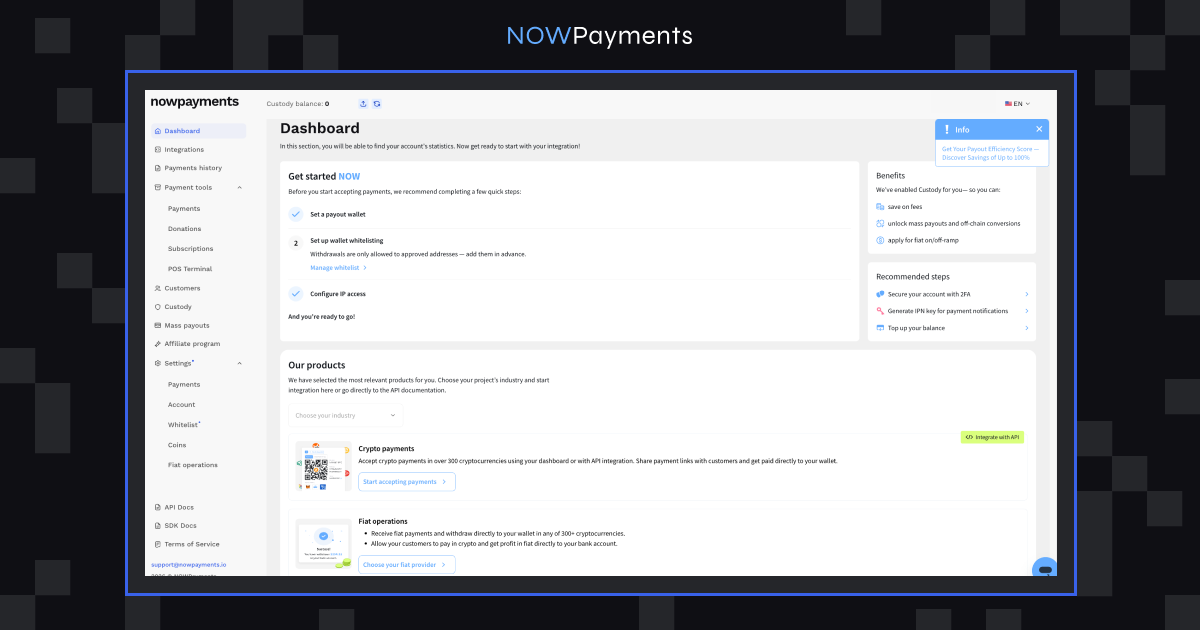
For full onboarding instructions on account creation, coin settings, custody setup, API credentials, 2FA, and whitelisting, see the NOWPayments Integration Guide.
Build Your Payment Flow Around Stablecoin Settlement
Stablecoins are the foundation of a predictable crypto treasury. Settlement in USDT or USDC and 30+ stablecoins removes volatility from your balance sheet.
Your settlement setup can follow one of two main models:
- Same-currency settlement: the customer pays in an asset such as USDT, and your business receives USDT.
- Multi-currency settlement: the customer pays with one cryptocurrency, while the payment is converted into your preferred asset, such as USDC or another supported cryptocurrency.
This flexibility allows a website to offer customers a wider range of payment options without forcing the business to manage every received cryptocurrency separately.
When choosing a settlement flow, consider:
- which currencies your customers are most likely to use
- which USDT or USDC networks your treasury supports
- whether you want to receive the original payment asset
- whether incoming funds should be converted automatically
- how the funds will later be withdrawn or used for payouts
- which network offers the best balance of speed, availability, and operational cost
This approach lets you accept crypto without holding volatile assets, keeping your treasury workflow clean and predictable.
Start Accepting Crypto with NOWPayments
How to Add Each Payment Method to Your Website
Method 1: Build a Custom Crypto Checkout with the Payment API
Best for: marketplaces, SaaS platforms, gaming businesses, trading platforms, custom applications, and high-volume websites that need full control over the payment flow.
The NOWPayments Payment API allows your website to create crypto payments dynamically and connect them to orders, customer accounts, internal balances, or automated fulfillment. It is the most flexible option when a standard plugin, invoice, or payment button cannot support the required business logic.
Follow these steps:
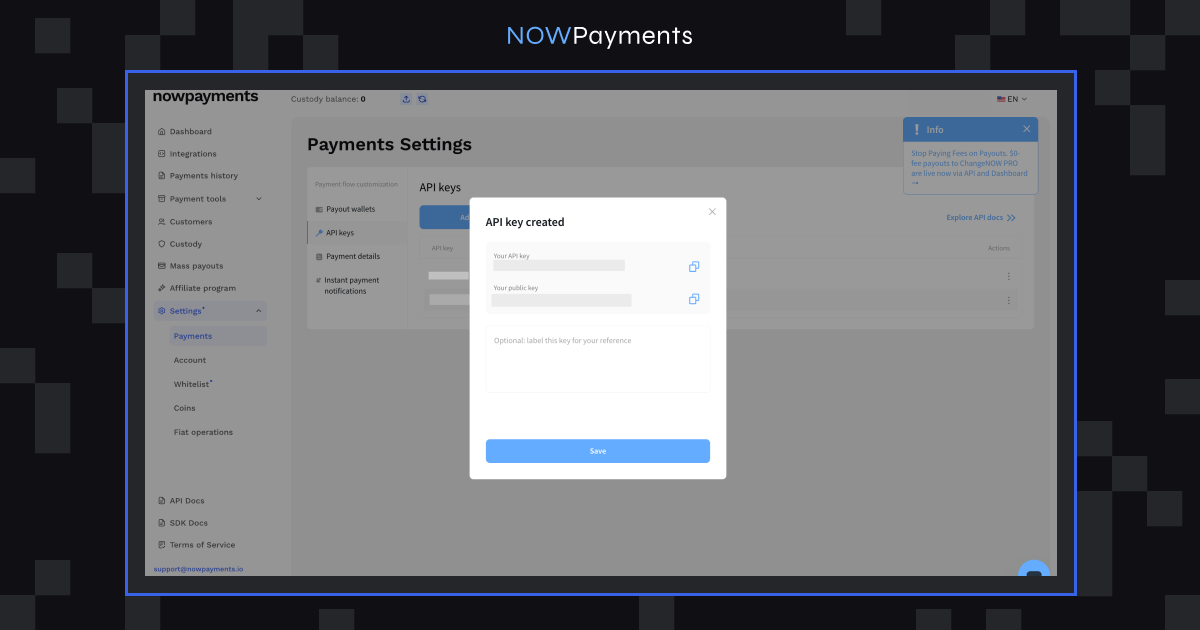
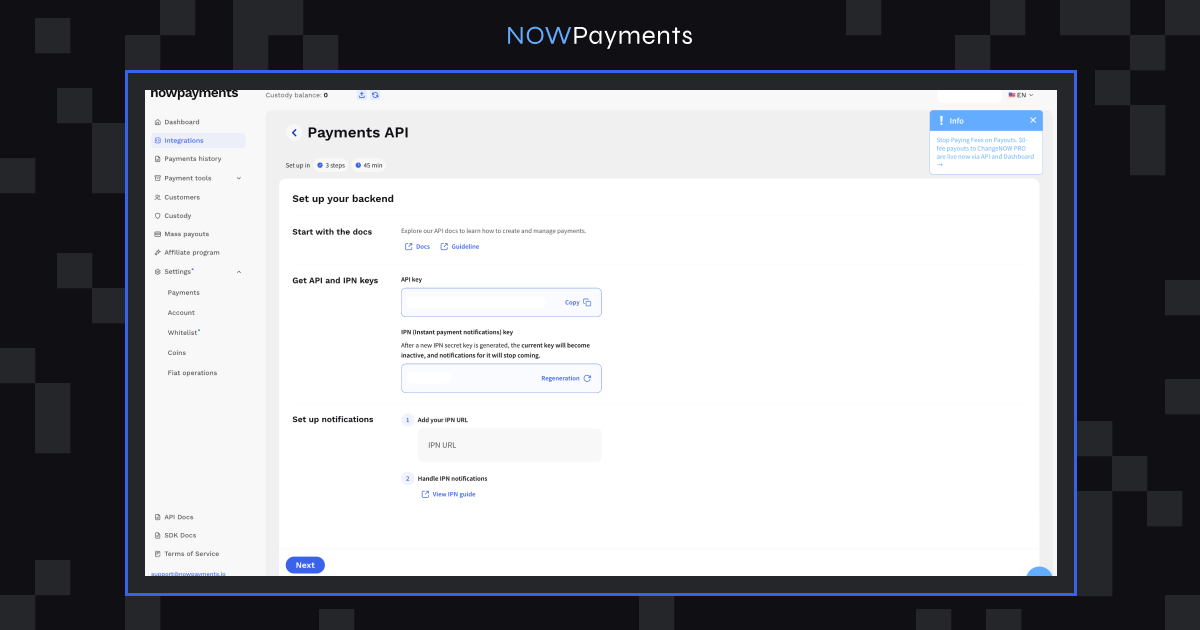
- Generate an API key
- Go to Dashboard → API Settings and store the key securely on your server.
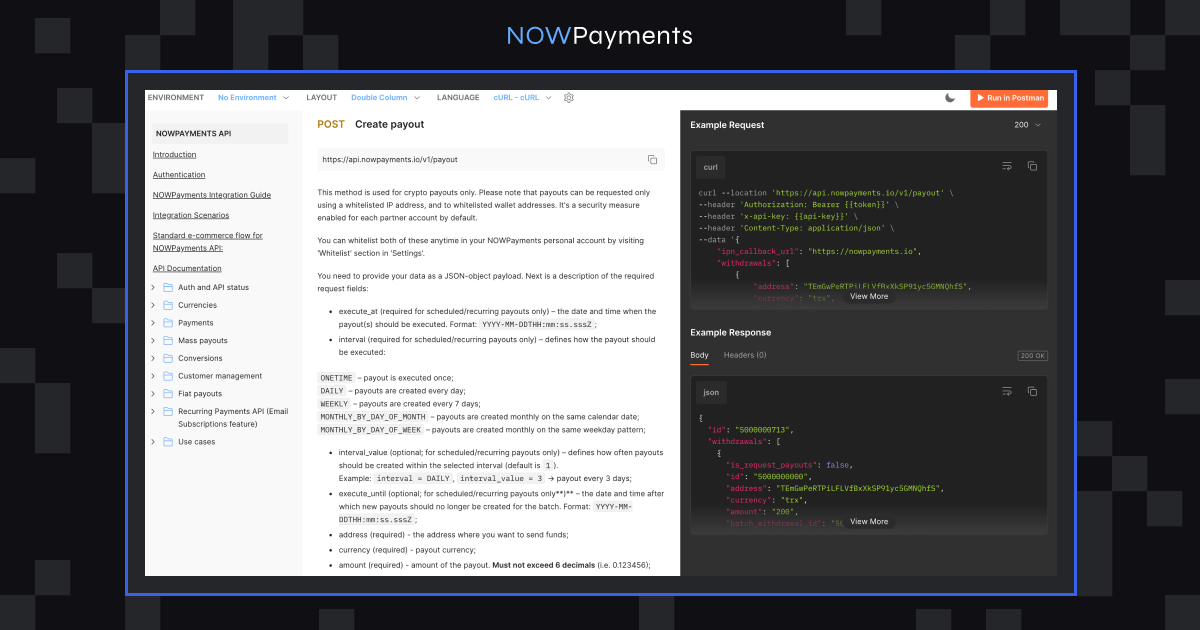
- Create payments
- Connect your backend to the Payment API using the official documentation.
- Display payment details
- Amount
- Asset
- Network
- Address
- QR code
- payment status
- Configure callbacks
- Add an IPN URL to receive and validate payment status updates.
- Map payment statuses
The API gives you full visibility:
- Waiting
- Confirming
- Confirmed
- Sending
- Partially_paid
- Finished
- Failed
- Refunded
- Expired
Find out more about the available statuses for payments in our API documentation.
- Choose settlement
- Receive the same asset, convert to USDT or USDC, use custody, withdraw funds, or send payouts.
- Test and launch
- Complete a small payment, confirm the order update and balance, then enable the integration for customers.
Method 2: Add Crypto Payments with a Plugin
Best for: WooCommerce stores and WHMCS billing websites.
The NOWPayments plugin adds crypto to your existing checkout without a custom backend.
Follow these steps:
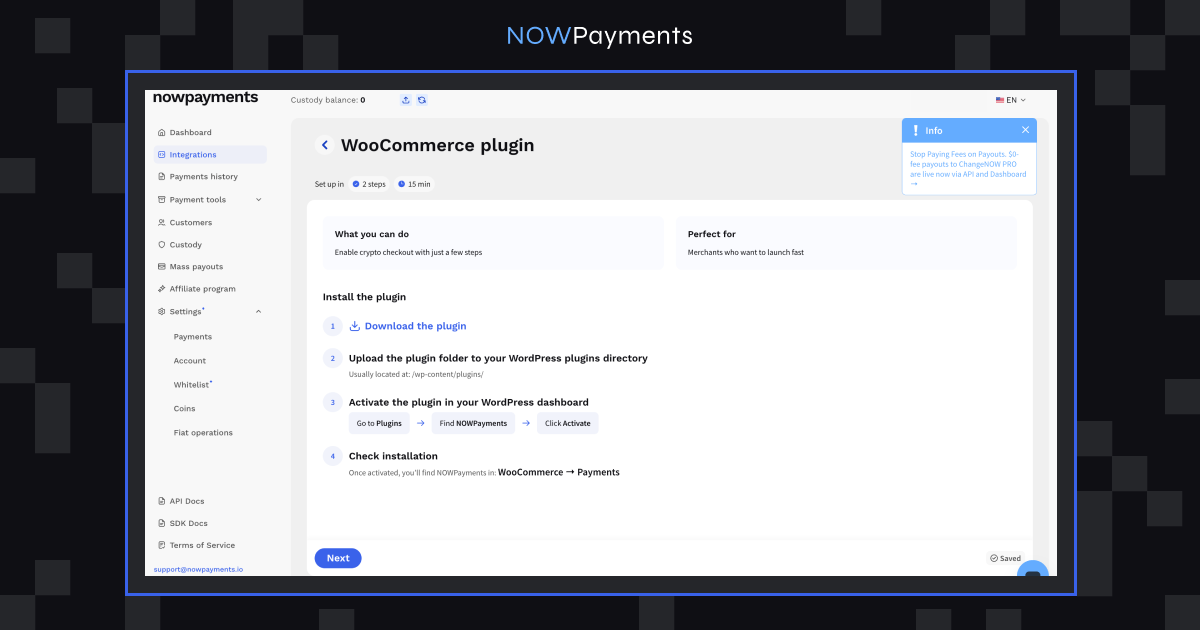
- Install the plugin
Download the plugin, upload it to /wp-content/plugins/, and activate it in WordPress.
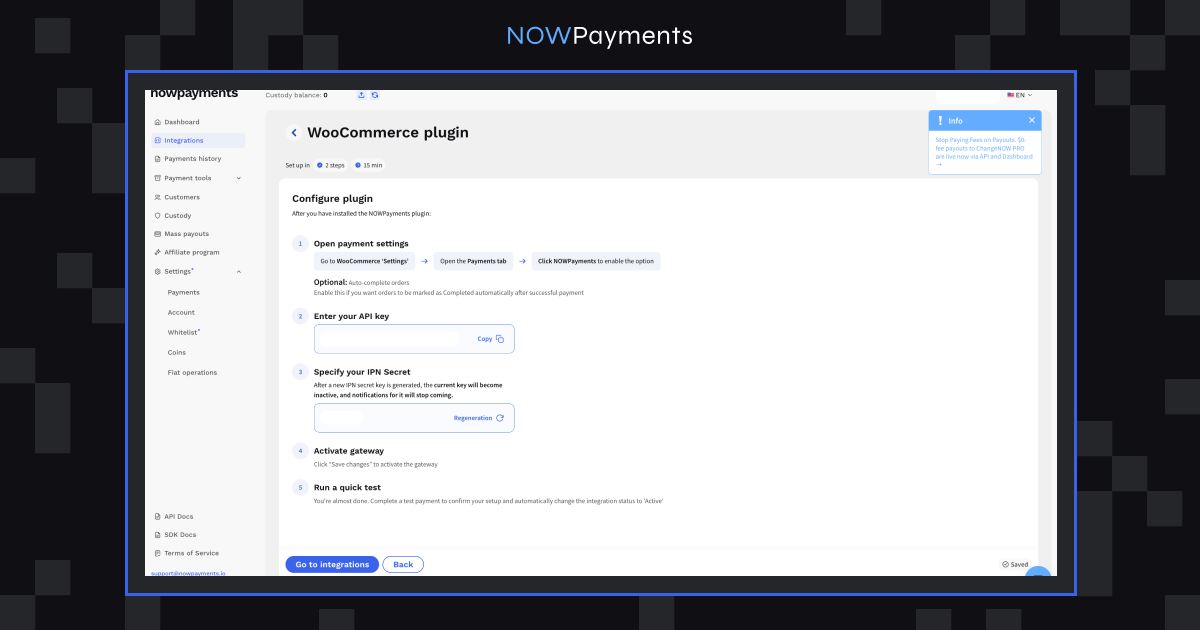
- Configure NOWPayments
Go to WooCommerce → Settings → Payments → NOWPayments.
Add your:
- API key;
- IPN Secret;
- payment title and description.
Enable Auto-complete orders if paid orders should be completed automatically.
- Click Save changes, place a small order, and pay with crypto.
Check that:
- NOWPayments appears at checkout;
- the payment opens correctly;
- the WooCommerce order status updates;
- the funds reach the configured settlement balance.
Method 3: Add a Crypto Invoice Link
Best for: freelancers, agencies, consultants, B2B services, and custom orders.
Follow these steps:
- Create an invoice
Open invoices in the dashboard and enter the amount, pricing currency, and order reference.
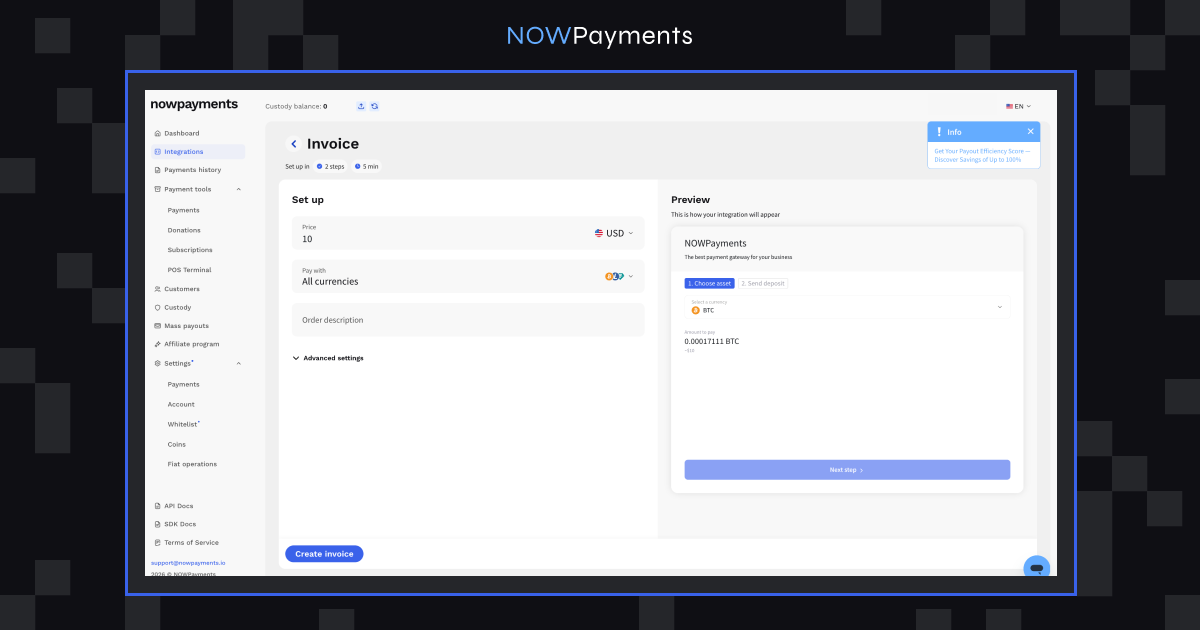
- Configure the payment details
Add the description and review the available invoice settings. - Generate the payment link
Create the invoice and copy the hosted payment URL. - Share it with the customer
Add the link to an email, customer portal, order page, or message. - Track the payment
Monitor the invoice status in the dashboard and match it to the internal order. - Check settlement
Confirm that the funds appear in the expected balance or settlement asset.
Method 4: Embed a Payment Widget & Button
Best for: landing pages, service websites, creators, digital product sellers, donations, and simple fixed-price offers.
The Payment Widget and Payment Button both provide a low-code way to add crypto payments without building a custom checkout backend. Use the widget when you want the payment interface embedded on the page or the button when you need a simple Pay with Crypto CTA.
Follow these steps:
- Choose the format
Select the Payment Widget for an embedded interface or the Payment Button for a simple CTA.
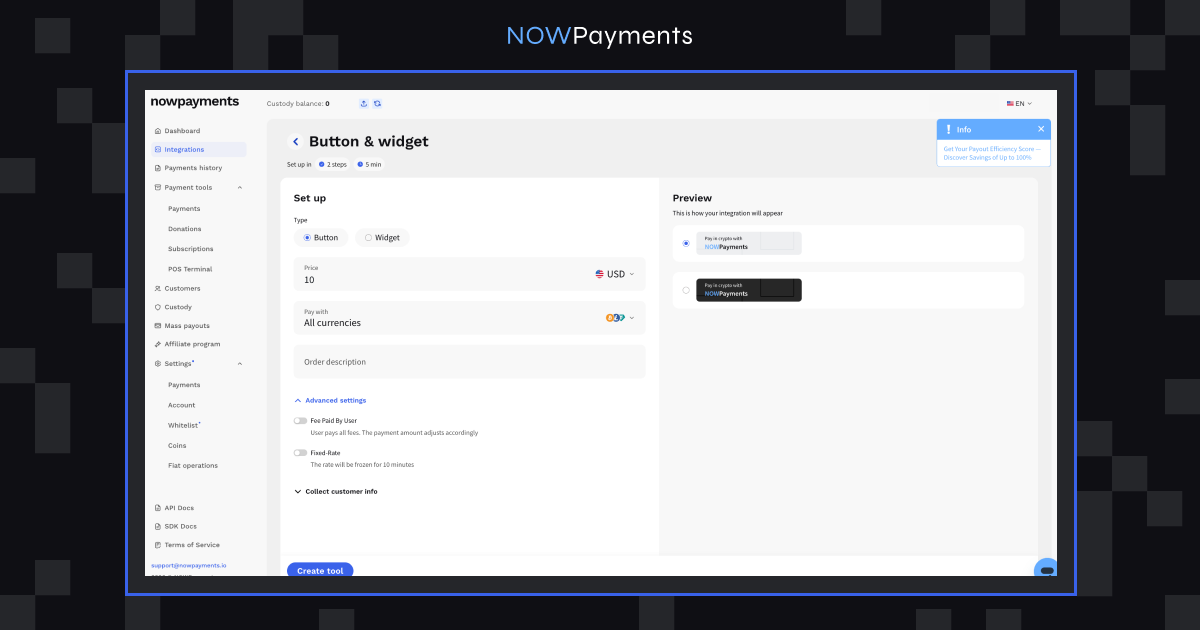
- Configure the payment
Set the amount, pricing currency, description, and available customer fields. - Customize the design
Adjust the Widget layout or Button text to match your website. - Generate the code
Copy the embed or HTML code from NOWPayments. - Add it to your website
Paste the code into an HTML or custom-code block. - Preview and test
Check the setup on desktop and mobile, then complete a small payment. - Verify the transaction
Confirm that the payment status and received balance appear correctly in the dashboard.
Start Accepting Crypto with NOWPayments
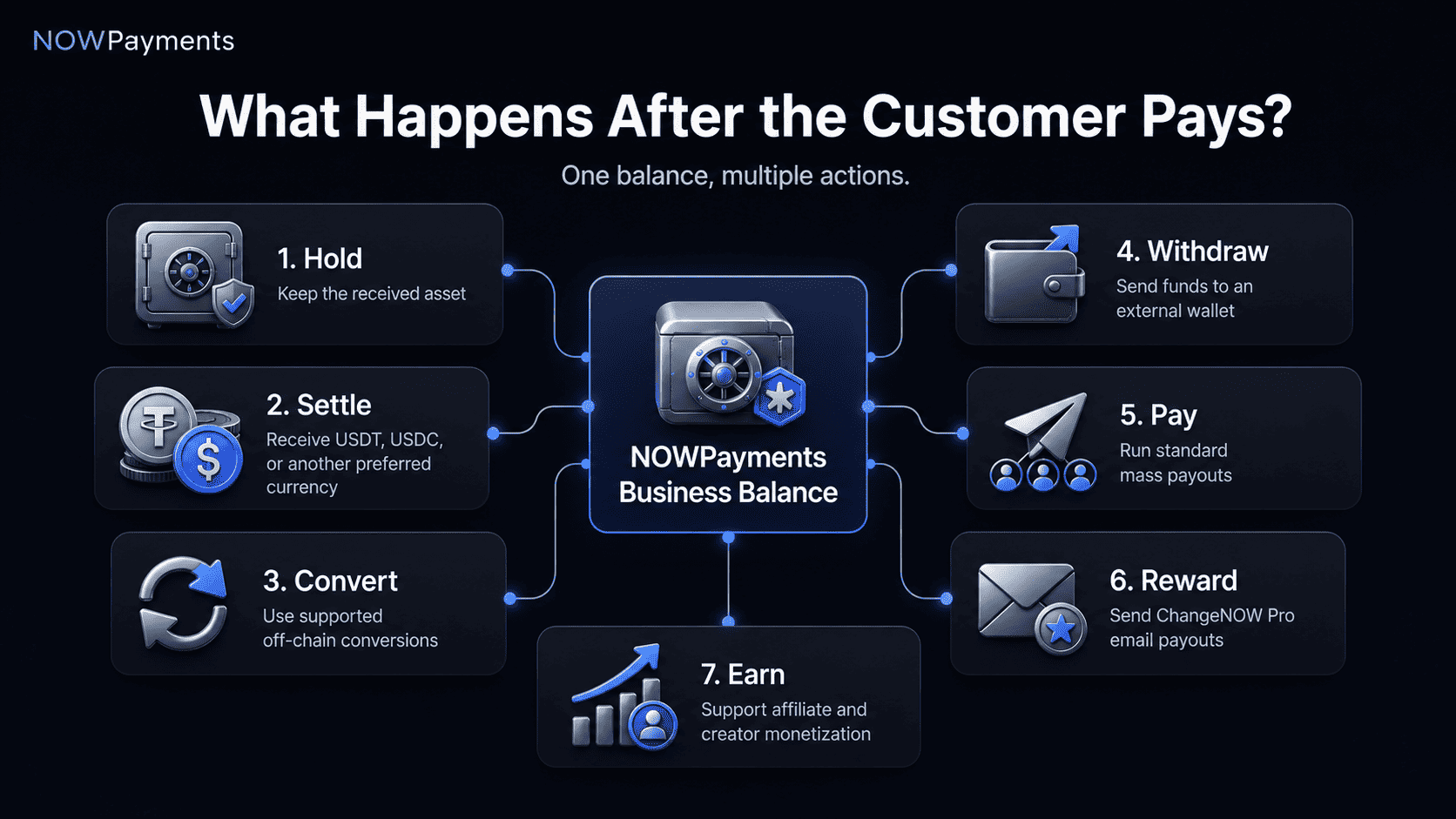
What Happens After the Customer Pays?
Accepting a crypto payment is only the first step in the business flow. Once the funds arrive, the merchant can settle, convert, store, withdraw, or redistribute them through the same infrastructure. This connects website revenue with treasury management, payouts, partner programs, and broader business growth.
Add Mass Payouts to the Business Flow
Collecting wallet addresses, checking networks, and processing large payout batches can create operational friction. NOWPayments provides two payout routes for different recipient needs.
The Challenge
Businesses may need to pay:
- sellers;
- affiliates;
- creators;
- employees;
- contractors;
- suppliers;
- users receiving rewards or refunds.
The Solution
| Payout Method | Recipient Information | Speed | Fees | Best For |
| Standard crypto Mass payouts | Wallet address and blockchain network | Usually around 1–3 minutes, depending on the network | 0% NOWPayments service fee; network fees apply | Crypto-native recipients and external wallets |
| ChangeNOW Pro payout | Email address | Possible in under one second | $0 network and NOWPayments service fees | Affiliates, creators, gaming users, remote teams, and recipients without wallets |
Result
Businesses can combine wallet-based and ecosystem crypto payouts within the same operational flow, reducing manual work and improving recipient experience.
How ChangeNOW Pro Email Payouts Extend the Website Integration
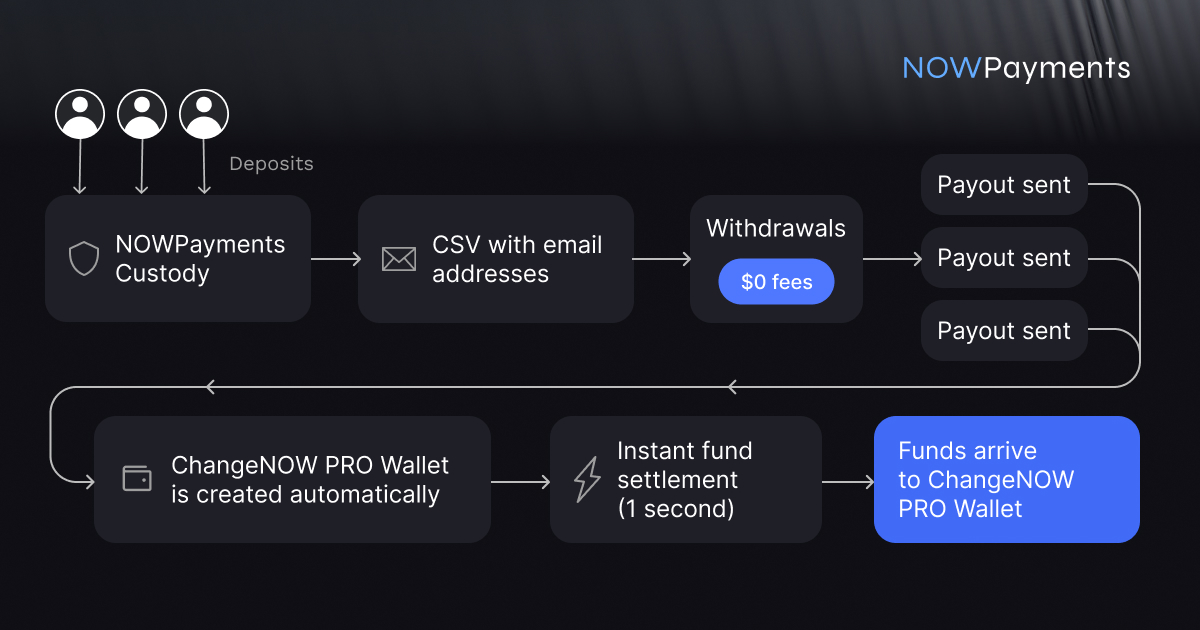
ChangeNOW Pro connects incoming website payments with email-based outgoing payouts. Businesses can send crypto without collecting wallet addresses or asking recipients to select a blockchain network.
New recipients can be onboarded automatically, and payouts can be handled through the dashboard or API. This makes the solution suitable for seller payments, affiliate commissions, creator earnings, rewards, payroll, and refunds.
Key operational benefits
- email replaces wallet collection;
- fewer address and network errors;
- automatic recipient onboarding;
- dashboard and API processing;
- possible delivery in under one second;
- no network or NOWPayments service fee;
- lower support workload;
- easier scaling of partner and monetization programs.
Payments and Payouts as One Business Infrastructure
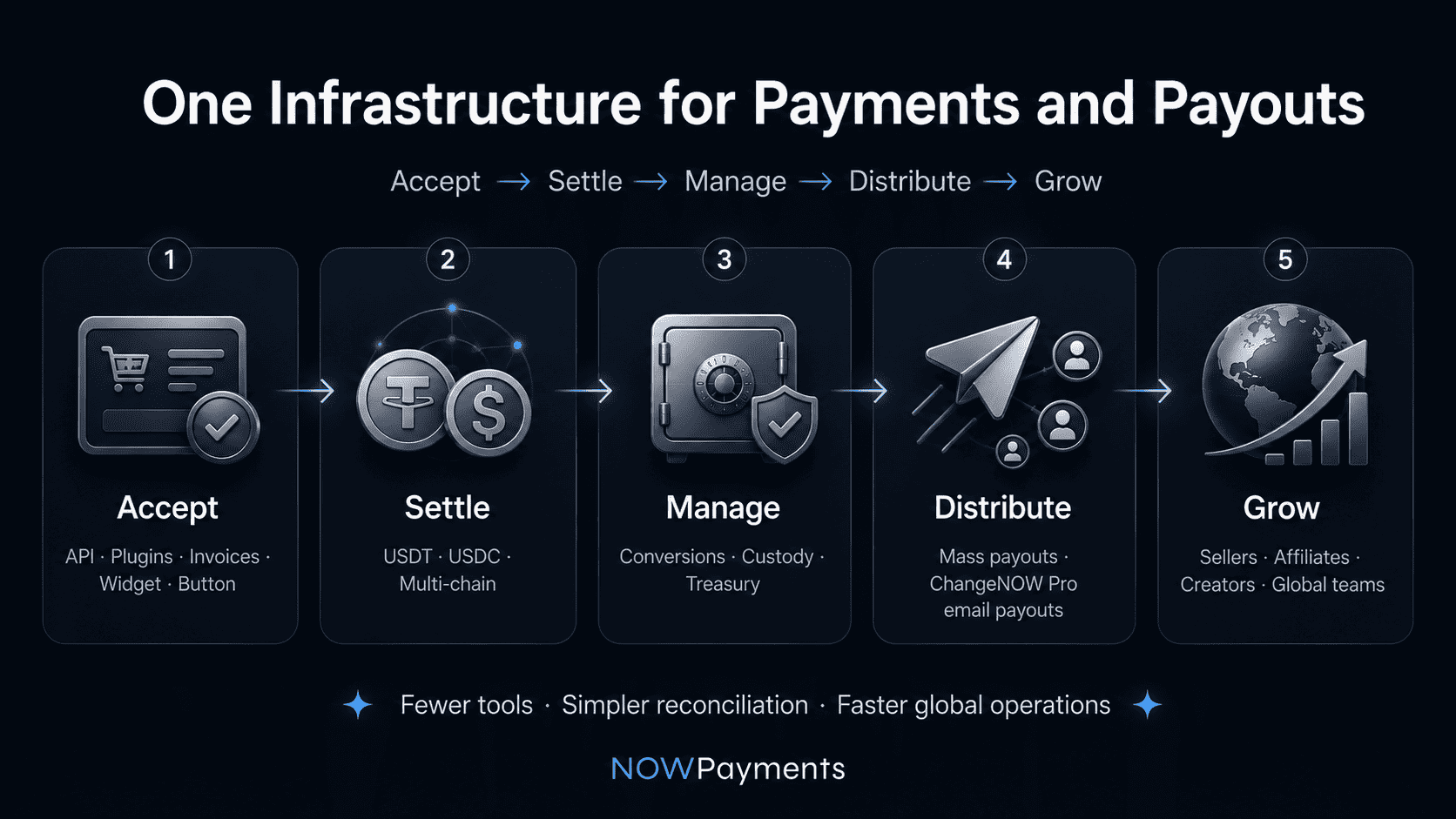
NOWPayments connects payments, stablecoin settlement, conversions, custody, treasury, and mass payouts within one crypto business ecosystem. Businesses can accept revenue, manage funds, and distribute payments without relying on multiple disconnected providers.
This simplifies reconciliation, supports high-volume automation, and enables workflows built around USDT, USDC, wallet payouts, and ChangeNOW Pro email payouts. It also helps scale seller payments, affiliate commissions, creator earnings, and other partner programs.
Operational, compliance, and tax-related guidance may be available depending on the business and jurisdiction, but it does not replace independent professional advice.
Pricing
NOWPayments uses a transparent service fee structure, with pricing that can be optimized based on verification, selected services, transaction volume, and partnership terms.
| Service | Pricing |
| Single-currency payments | 1% standard |
| Multi-currency payments | 1.5% standard |
| Eligible single-currency rates | From 0.3% |
| Conversions | 0.5% |
| Standard payouts | 0% service fee; network fees may apply |
| ChangeNOW Pro payouts | $0 network fee and 0% service fee |
| Integration and setup | Free |
| Dedicated support and account optimization | Free |
| Enterprise pricing | Custom terms available on request |
Eligible businesses may reduce their payment fees through voluntary KYC or KYB, ChangeNOW Pro payout usage, long-term partnership terms, higher transaction volumes, or selected service combinations.
Pricing is designed to support scalable payment, settlement, and payout workflows rather than compete on headline fees alone.