
Before we move on to regulatory information, let us observe the main questions you may be interested in.
Is USDT compliant with MiCA?
Not really, at least not in the formal sense. MiCA has clear requirements for e-money tokens (EMTs) and asset-referenced tokens (ARTs). Tether hasn’t gone through that process the way Circle has with USDC. But let’s be precise: MiCA never says USDT is illegal or banned.
Can I use USDT in Europe?
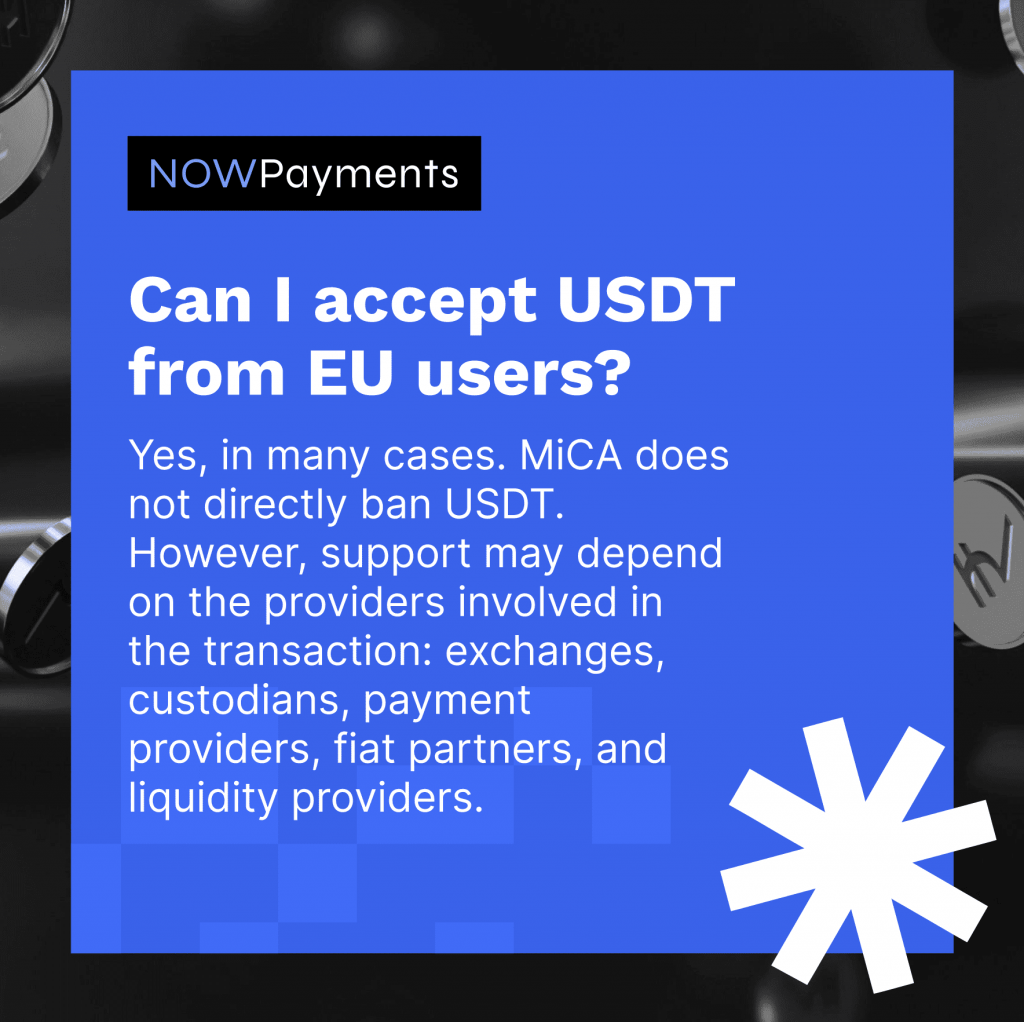
Yes, in many cases. It is still possible to hold USDT and send payments, especially in the case when you are using a non-custodial wallet. The real restrictions don’t come from the law itself, they come from regulated services such as exchanges, custodians, payment processors or fiat off-ramps. That’s where things become complicated.
Stablecoins remain one of the core layers of the crypto economy. They are used for payments, trading, treasury management, settlements, liquidity routing, and cross-border transfers. But in the EU, stablecoins are no longer operating in a regulatory gray zone.
Today, the key framework governing stablecoins in the European Union is the Markets in Crypto-Assets Regulation (MiCA). And while many discussions online reduce the topic to “USDT banned in Europe” or “everyone must move to USDC,” the actual situation is more nuanced.
The main issue under MiCA is not whether a stablecoin technically exists or whether users can hold it. The issue is whether that stablecoin can continue operating smoothly within regulated EU infrastructure.
That distinction matters for exchanges, payment providers, crypto businesses, liquidity providers, and partners working with EU users.
What MiCA Actually Regulates
In the EU, the regulation of stablecoins is governed by Regulation (EU) 2023/1114 (MiCA), which establishes uniform rules for all EU member states and applies directly.
MiCA reference: https://eur-lex.europa.eu/eli/reg/2023/1114/oj
MiCA introduces a classification for stablecoins, in particular the following:
- asset-referenced tokens (ART) (Title III)
- e-money tokens (EMT) (Title IV)
For these categories, uniform requirements are established, including:
- authorisation of the issuer and the right to issue and admit to trading (Articles 16, 48);
- formation and management of reserves (Articles 36–38 for ART and Article 54 for EMT);
- mandatory disclosure of information via a crypto-asset white paper (Articles 19 and 51);
- ongoing supervision by competent authorities.
N.B. It is important that the regulation affects not only issuers but also crypto-asset service providers (CASPs), which, when listing and providing services, must take into account the regulatory status of tokens and compliance with MiCA requirements (Title V). In practice, such regulation means that the key factor for the market is not the mere existence of a token but its usability within the EU’s regulated infrastructure.
This is the point many businesses initially missed when MiCA discussions started gaining momentum. A token does not need to be “illegal” to become operationally difficult to use. If exchanges, custodians, payment processors, fiat providers, or other regulated intermediaries begin restricting support, the practical effect can be significant even without an outright ban.
What Are the Key Differences Between USDT and USDC From a Regulatory Standpoint?
The difference primarily relates to the issuers’ approach to disclosure and engagement with regulated markets.
USDC is issued by Circle Internet Group and has been designed from the outset to operate in a regulated environment, including regular reserve disclosures and interaction with supervisory authorities.
USDT is issued by Tether and has historically taken a less formalized approach to disclosure and regulatory engagement.
In the context of MiCA, this means that USDC is potentially easier to integrate into the requirements for e-money tokens, whereas USDT faces a higher risk of restrictions by regulated services.
From a business perspective, this creates an important distinction:
- USDC is increasingly viewed as infrastructure-compatible within regulated EU environments.
- USDT still dominates liquidity globally in many segments, but its position inside regulated European channels is becoming less predictable.
That does not automatically make one “better” than the other in all contexts. It depends heavily on where the business operates, who its users are, and which providers it depends on.
Can USDT Be Used in Europe?
MiCA does not contain a direct prohibition on the use of specific stablecoins. Users can generally hold and use USDT, including via non-custodial wallets and decentralized solutions.
Restrictions arise at the level of regulated services (CASPs), which are required to take MiCA requirements into account when providing services (Title V, including Article 59 and others). Specifically, when listing and granting access to transactions, services assess whether the token complies with the requirements for e-money tokens or asset-referenced tokens and whether it can be used within the regulated infrastructure.
This is an important distinction.
There is a major difference between the following:
- holding or transferring a token on-chain;
- and having that token fully supported by regulated exchanges and financial infrastructure.
In practice, this means a user may still technically hold USDT in a self-custodial wallet while simultaneously facing restrictions when attempting to:
- trade it on regulated platforms;
- access fiat conversion;
- use certain payment providers;
- interact with regulated custody solutions;
- access specific EEA services.
How the Market Is Already Reacting
In practice, this is already reflected in market actions, for example:
- Kraken restricts the use of certain stablecoins for clients in the EEA, read in more details in their announcement:
https://support.kraken.com/articles/stablecoin-offerings-for-eea-clients - Binance has also published announcements regarding restrictions and delisting of stablecoins for users in the EEA:
https://www.binance.com/en/support/announcement/detail/bcaa1f68d6a6450099056ff694ad6c46
Thus, while USDT can generally be used, regulated channels in the EU are gradually restricting its availability, which has implications for business processes.
This trend matters because infrastructure fragmentation creates operational friction. Businesses may end up in situations where:
- one provider supports USDT;
- another blocks deposits;
- a payment partner restricts settlements;
- an exchange removes specific trading pairs;
- a fiat off-ramp limits conversions.
For companies operating at scale, fragmented infrastructure creates compliance overhead, treasury complexity, and user experience problems.
Are Partners Required to Switch to USDC?
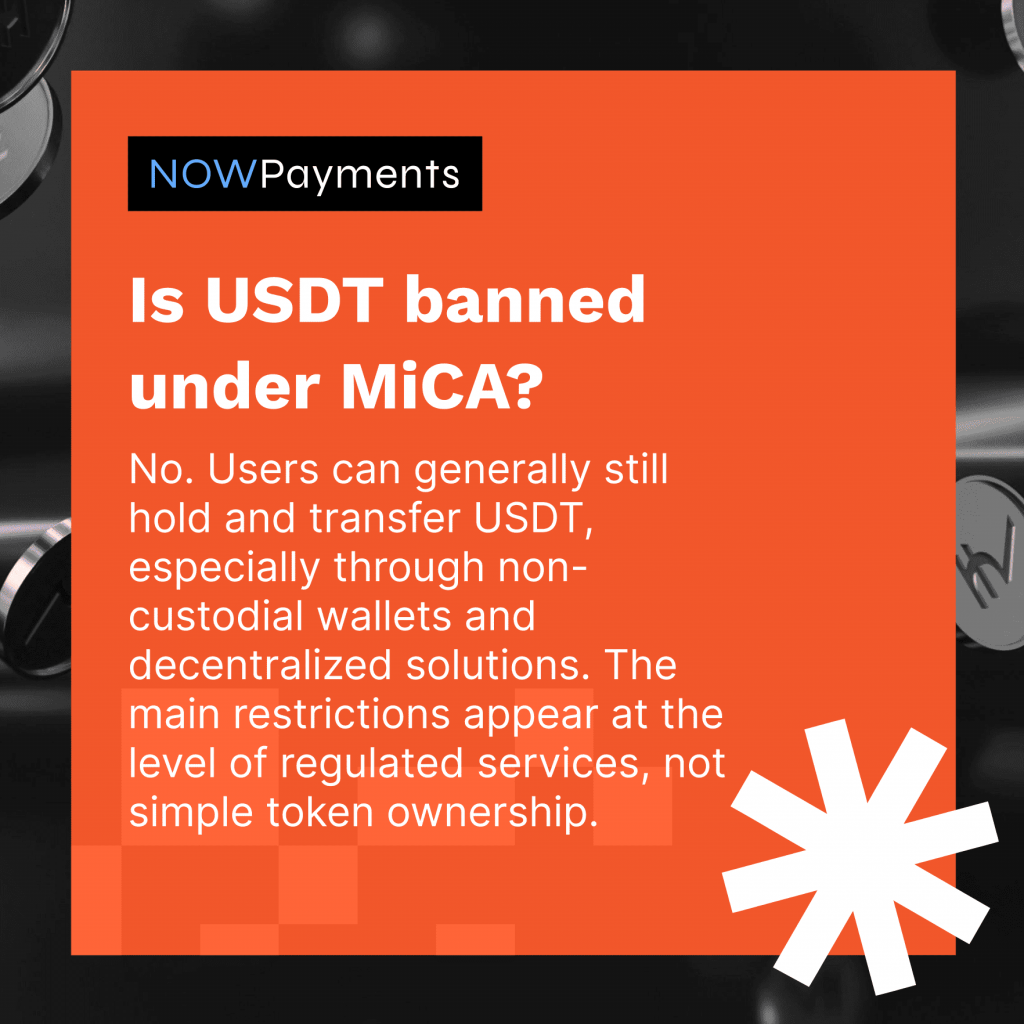
MiCA does not explicitly require a switch to USDC or any other specific stablecoin. However, given the requirements for issuers and CASPs (see above), in practice platforms may restrict the use of tokens that do not align with their regulatory model and compliance requirements.
In such cases, switching to alternative assets, such as USDC, becomes an operational necessity for continuing to operate through regulated infrastructure. The timing of such a switch is not prescribed by law and is determined by individual platforms’ decisions, as reflected in their public announcements (see above).
This is where many headlines become misleading.
There is no line in MiCA that says the following:
“All EU businesses must stop using USDT.”
Instead, the pressure appears indirectly through regulated infrastructure decisions.
That distinction matters because different businesses face very different levels of exposure:
- A DeFi-native business operating primarily through non-custodial infrastructure may continue using USDT with relatively limited impact.
- A company relying heavily on regulated exchanges, fiat providers, payment institutions, or EEA-facing services may face increasing operational limitations.
Risks for Businesses That Continue Using USDT in the EU
The main risk relates to access to regulated infrastructure. Key risks include:
- delisting or restriction of trading pairs;
- restrictions by payment and fiat providers;
- reduced liquidity in regulated segments;
- restricted access for users in the EU.
These risks are not theoretical anymore. They directly affect liquidity management, treasury operations, user onboarding, settlement flows, and provider integrations.
For example, even if a business itself is comfortable using USDT, its counterparties or infrastructure partners may not be.
Over time, this can create additional operational costs such as the following:
- maintaining parallel stablecoin rails;
- managing forced conversions;
- adjusting treasury allocation strategies;
- integrating additional liquidity providers;
- reworking payout and settlement logic.
What This Means for Partners
If a partner works with users in the EU or through regulated services, they need to consider which stablecoins are supported by the infrastructure they use, assess the risk of delisting or transaction restrictions in advance, and plan for alternative assets such as USDC.
If a partner uses non-custodial solutions or operates outside regulated infrastructure, USDT may still be usable, but potential restrictions should be taken into account when scaling or onboarding providers.
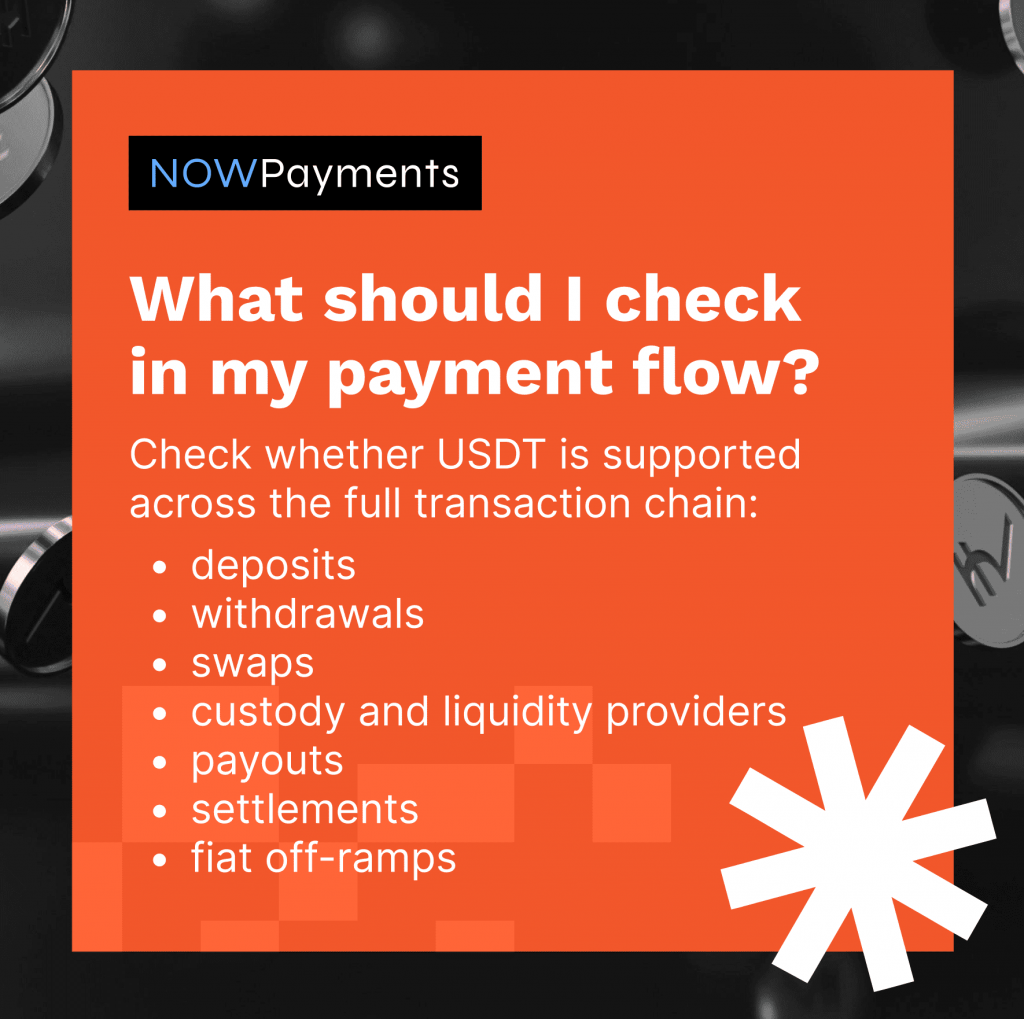
Practically speaking, businesses should evaluate:
- where regulated infrastructure exists in their flow;
- whether providers have announced MiCA-related changes;
- how dependent they are on specific exchanges or fiat partners;
- whether fallback stablecoin routes already exist;
- how exposed EU users are to restrictions.
The biggest mistake is assuming that today’s infrastructure availability will remain unchanged over the next several years.
Conclusion
MiCA changes the stablecoin conversation in Europe from a purely technical issue into an infrastructure and compliance issue.
USDT is not directly prohibited under MiCA, and users can still generally hold and transfer it, especially through non-custodial environments. However, regulated services operating in the EU increasingly need to evaluate whether specific stablecoins fit their compliance framework.
As a result, the main risk for businesses is not necessarily legality in the narrow sense. The larger issue is continued access to regulated infrastructure, including exchanges, payment providers, fiat rails, and liquidity venues.
For many EU-facing businesses, USDC is becoming easier to operate with inside regulated environments. That does not mean USDT disappears overnight. But it does mean businesses should actively evaluate how dependent they are on infrastructure that may gradually reduce support for it.
*This analysis reflects the regulatory landscape and publicly available platform policies in the EU as of May 8, 2026.