
Bitcoin produces a block roughly every 10 minutes and handles about 5 to 7 transactions per second on-chain, according to GetBlock’s network notes. A new full node has to download close to 740 GB of chain data before it can answer a request, per the bitcoin.org full node guide. Most product teams skip that work and rent access instead. A BTC node RPC provider runs synchronized Bitcoin nodes and exposes them through JSON-RPC, REST, or indexed APIs, so wallets, exchanges, and payment tools can read the chain and broadcast transactions.
“Picking the primary BTC node provider matters as much as picking the backup, because any business running Bitcoin at scale needs a fallback path when one endpoint fails.”
— Kate Liftshits, CBDO of NOWPayments
Below is the ranked list of leading Bitcoin node providers for developers in 2026:
- NOWNodes
- QuickNode
- GetBlock
- Chainstack
- Blockstream Explorer API
- mempool.space Enterprise
How We Ranked the Best BTC Node RPC Providers
The editorial team checked each vendor’s Bitcoin page, pricing page, and documentation in September 2026. Two entries are Bitcoin-focused data services and not general node vendors, so the criteria compare what each one exposes for Bitcoin specifically.
- Network Coverage and Node Types: which Bitcoin networks and interfaces are offered, and whether shared and dedicated capacity exist.
- Performance and Reliability: published uptime terms, throughput limits, and infrastructure footprint.
- Pricing and Support: free access, entry price, billing unit, and support response terms.
The table compares the six Bitcoin RPC providers on the points most teams check first. Prices are for monthly billing.
| Feature | 1. NOWNodes | 2. QuickNode | 3. GetBlock | 4. Chainstack | 5. Blockstream Explorer API | 6. mempool.space Enterprise |
|---|---|---|---|---|---|---|
| Scope | 120+ chains | ~80 chains | 130+ chains | 70+ chains | Bitcoin, Liquid |
Bitcoin |
| Interfaces | RPC, Blockbook, WebSocket |
JSON-RPC | JSON-RPC, REST, Blockbook |
JSON-RPC, WebSocket |
REST, Electrum RPC |
REST, Electrum RPC, WebSocket |
| Free access | 100K requests, 1 month |
10M credits, 1 month |
50K CU per day |
3M units per month |
500K requests per month |
Public API, rate-limited |
| Entry paid plan | €20 | $49 | $49 | $49 | $40 | Not listed |
| Paid rate limit | No predefined cap |
50–500 RPS | 250–800 RPS | 250–600 RPS | Plan-based | Unmetered |
| Uptime terms | 99.9% | Enterprise SLA | SLA on paid plans |
Enterprise SLA | 99.9% SLA | 99.9%+ stated |
| Compliance reports | None listed | SOC 2, ISO 27001 |
SOC 2 Type II |
SOC 2 Type II, ISO 27001 |
None listed | None listed |
| Best For | Multi-chain backends |
Audits, credit tiers |
Flat-rate nodes |
Free-tier testing |
Wallet sync data |
High-volume data |
Rates, supported chains, and limits change frequently. Verify current terms on each provider’s official site before committing.
NOWNodes
Best for: multi-chain wallets, explorers, and payment tools that add Bitcoin to an existing stack.
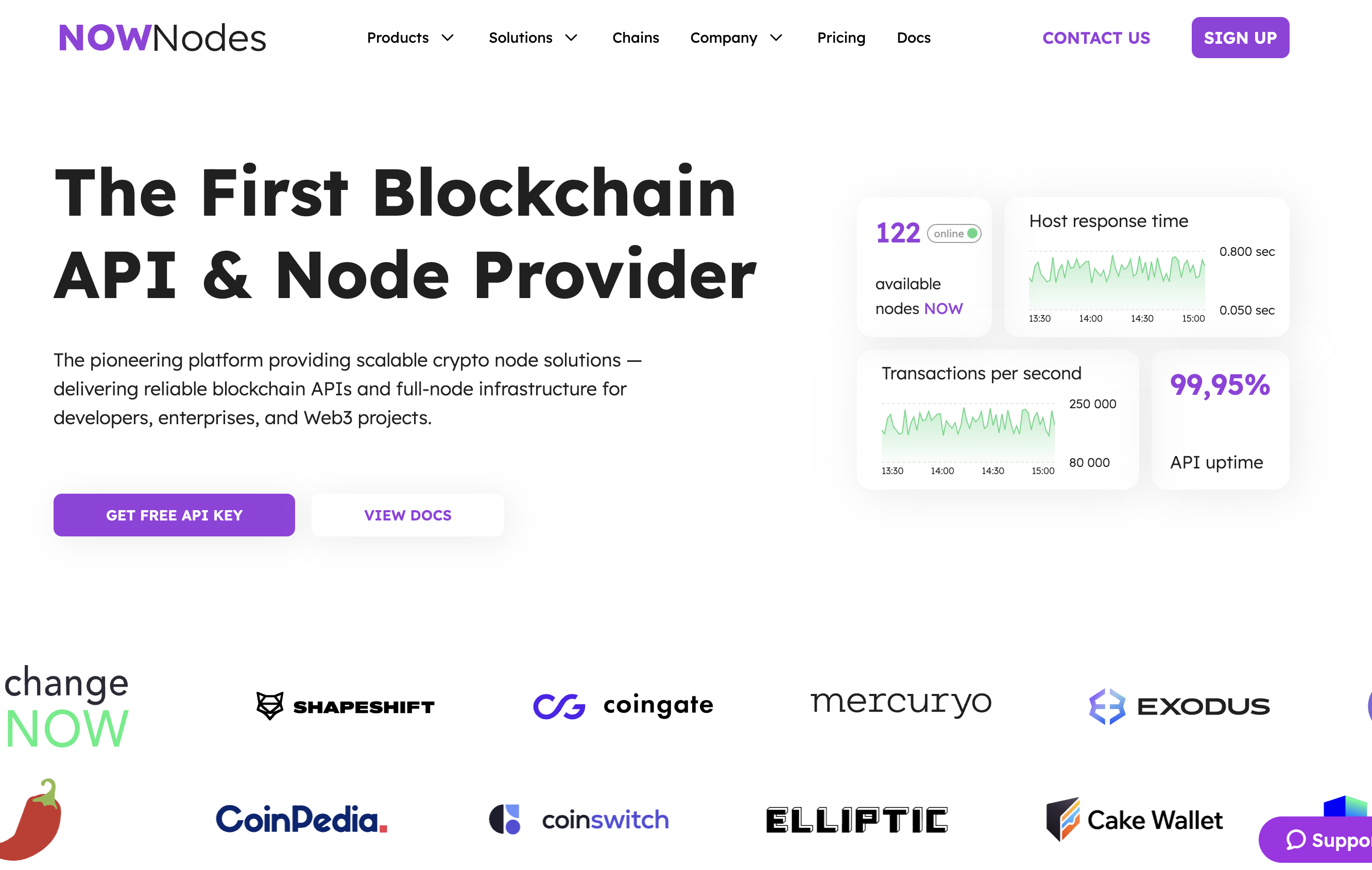
NOWNodes is one of the best RPC providers for teams that add Bitcoin to a multi-chain stack. It is a blockchain node provider registered in Tallinn, Estonia, with access to 120+ networks through one account. Its Bitcoin page lists shared, public, and dedicated nodes plus a block explorer.
Network Coverage and Node Types. BTC rpc is available on mainnet and testnet, with archive mode, Blockbook, and WebSocket listed as tools. Shared nodes run on request quotas, while a dedicated node is isolated for one customer and one chain in a chosen region. Signet is not listed, and the Start plan excludes WebSocket.
Performance and Reliability. Requests go through geo-distributed, load-balanced clusters with automatic failover. Paid plans have no fixed RPS cap, so throughput follows cluster capacity and not a plan setting. The pages reviewed show no Bitcoin-specific latency benchmark and no SOC 2 or ISO report, which some procurement teams require.
Pricing and Support. The free Start plan covers 100,000 requests for one month. Pro costs €20 a month for 1 million requests, Business €200 for 30 million, and Enterprise €500 for 100 million, with overage per 100,000 requests from Pro Plus upward. First-response support is listed at three minutes on every plan.
QuickNode
Best for: teams that want a credit ladder and audit paperwork.
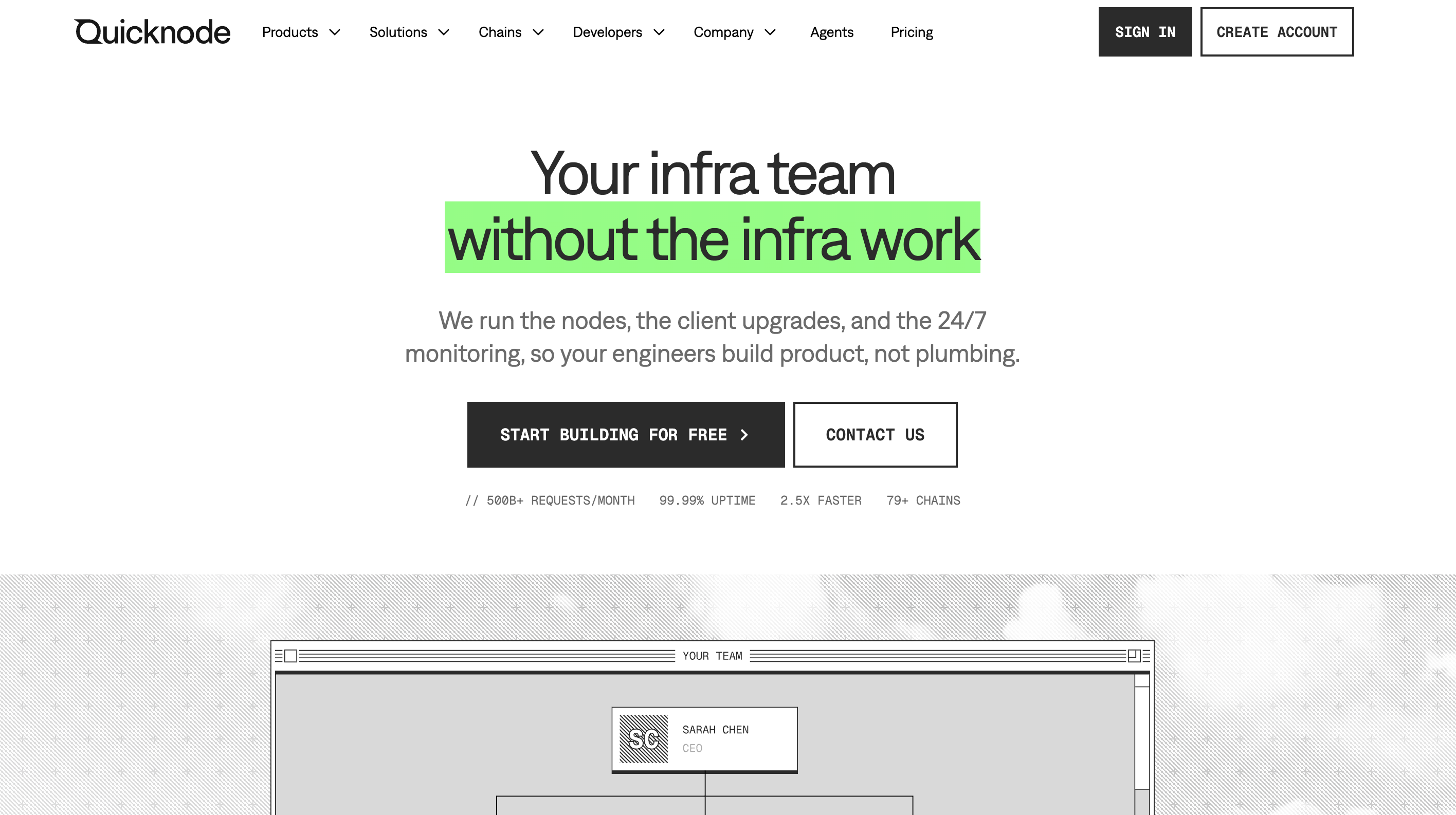
QuickNode is a managed RPC endpoint provider covering about 80 chains, Bitcoin included. Bitcoin methods cost 10 API credits each, half the 20-credit rate charged on many EVM chains. Plans run from a one-month trial to custom enterprise contracts. It suits product teams that need compliance documents and a clear upgrade path.
Network Coverage and Node Types. Multi-chain endpoints come with each plan, and Dedicated Clusters are an enterprise feature. The credit table places Bitcoin, Bitcoin Cash, Litecoin, and Dogecoin at the same 10-credit rate. The Ordinals and Runes API adds inscription data over JSON-RPC.
Performance and Reliability. Throughput scales with price: 50 RPS on Build, 125 on Accelerate, 250 on Scale, and 500 on Business. Contractual uptime SLAs and SOC 1, SOC 2 Type 2, ISO 27001, and DORA reports are listed under Enterprise. Lower tiers state no uptime percentage.
Pricing and Support. The trial gives 10 million credits at 15 RPS for a month, with no card required. Build costs 49 monthly (34 billed annually) for 80 million credits, about 8 million Bitcoin calls, with extra credits at $0.62 per million. Support targets run from 24 hours on Build to 8 hours on Scale and Business, and there is no permanent free plan.
GetBlock
Best for: teams that want a flat-rate Bitcoin node without a dedicated-node bill.
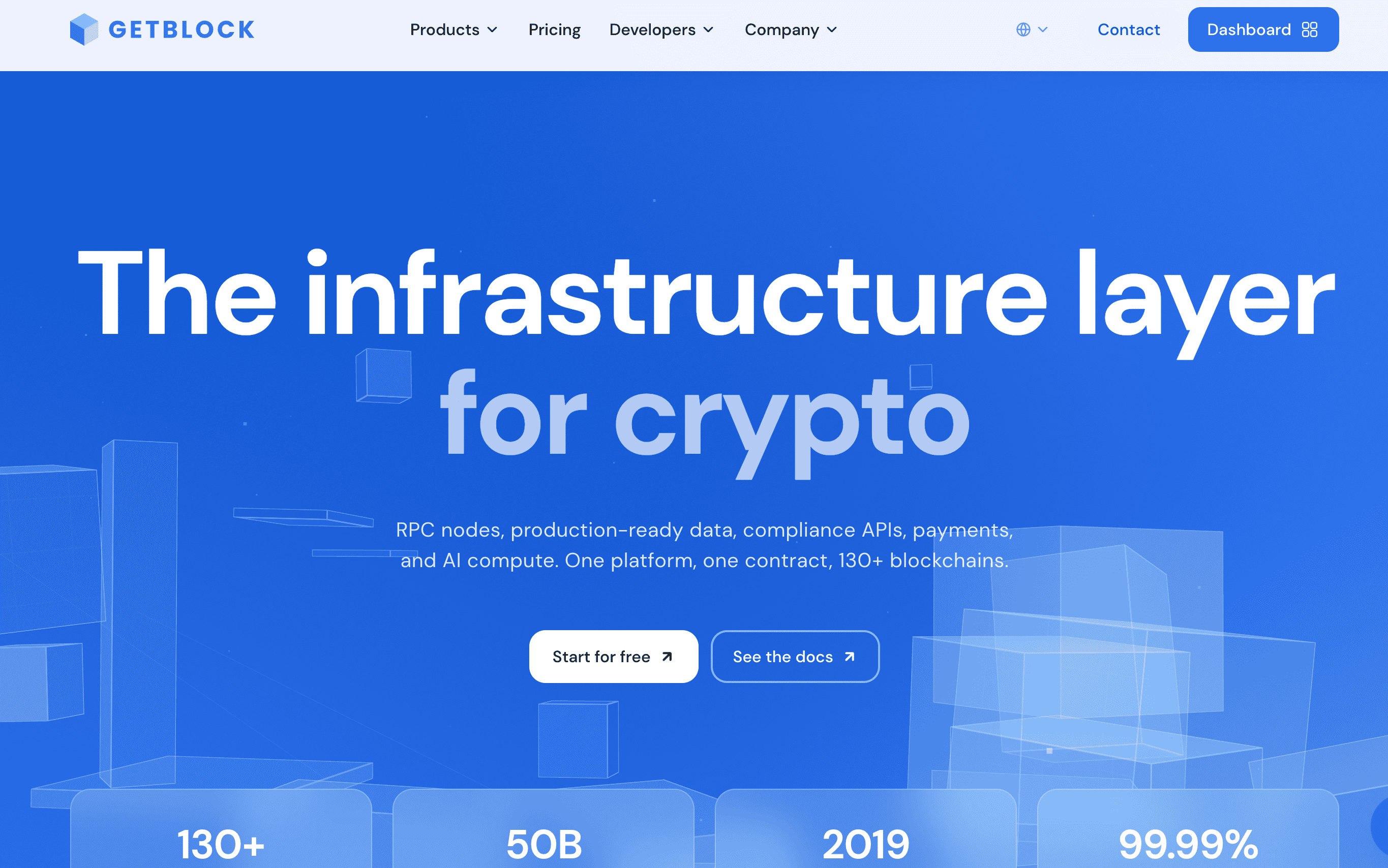
GetBlock is a Singapore-based RPC provider listing 130+ blockchains, and it completed a SOC 2 Type II attestation in Q2 2026. Its Bitcoin page lists JSON-RPC, REST, and Blockbook across shared, dedicated, and Limitless Node products. The vendor advertises response times as low as 14 ms. It fits teams that want predictable Bitcoin capacity.
Network Coverage and Node Types. Bitcoin mainnet and testnet are offered. Limitless Node gives a fixed RPS tier on one chain with no compute-unit metering, but for Bitcoin it is full node only and hosted in Frankfurt. Dedicated Bitcoin nodes run bitcoind with Blockbook included.
Performance and Reliability. Shared plans reach 800 RPS on Pro, and Limitless tiers run from 25 to 300 RPS. Dedicated nodes carry a 99.99% uptime SLA and no RPS cap. Pro and Premium list 24/7 support with a response under five minutes.
Pricing and Support. The free plan gives 50,000 compute units a day at 20 RPS. Starter costs $49 a month for 90 million units and Pro $499 for 1 billion, while Limitless Bitcoin starts at $150 and dedicated nodes at $1,000. Compute the unit weight for each method differently, and the pages reviewed give no Bitcoin-specific weights, so a test month is the safest way to forecast a bill.
Chainstack
Best for: teams that want a free entry plan and enterprise deployment options.
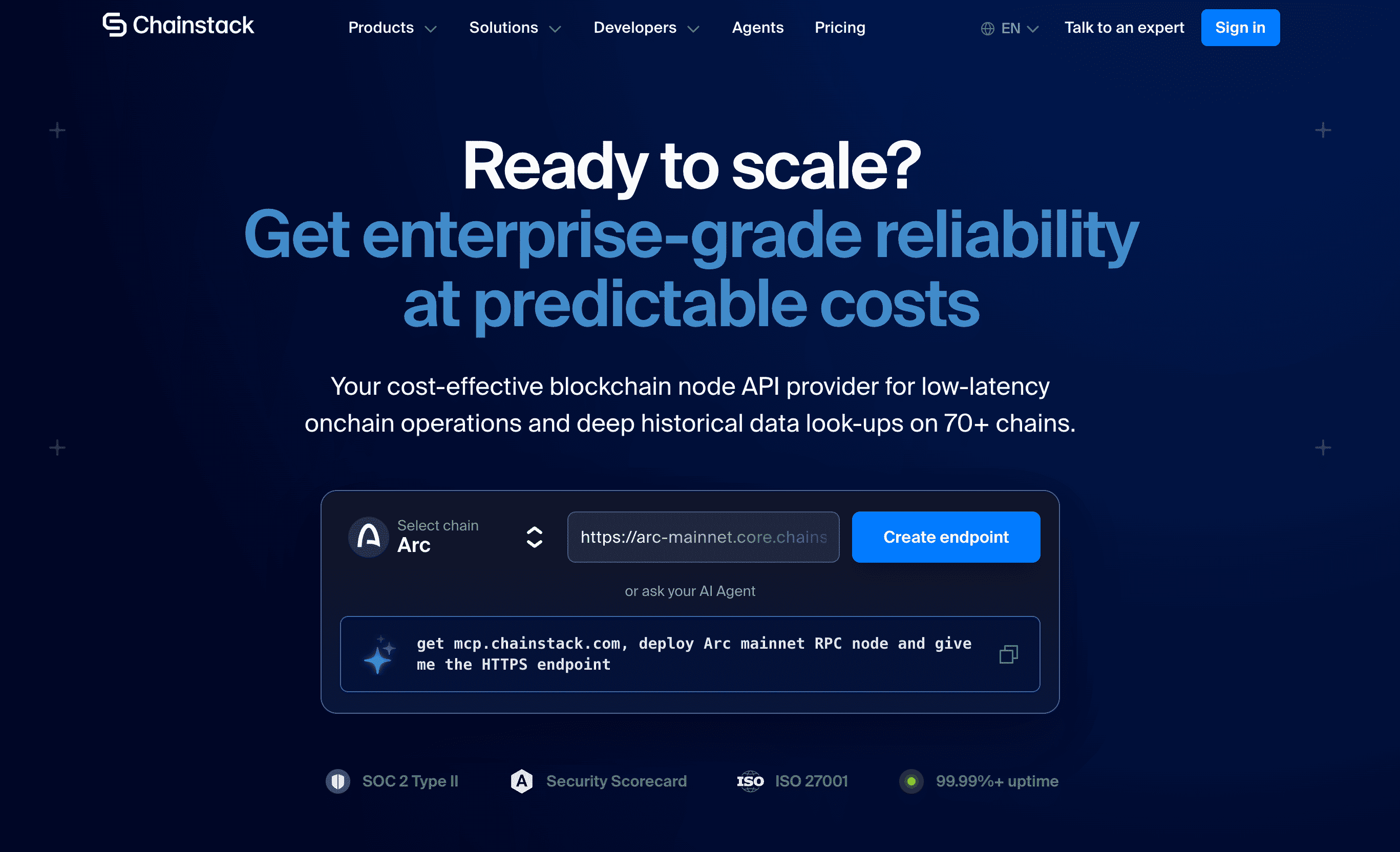
Chainstack covers 70+ chains and lists SOC 2 Type II and ISO 27001 certifications. Its Bitcoin page offers global nodes, dedicated nodes, and a self-hosted option on mainnet and testnet. A full node request costs 1 request unit and an archive request costs 2, which keeps forecasting simple. It suits teams that value flat weighting and compliance coverage.
Network Coverage and Node Types. Bitcoin nodes deploy from the console with HTTPS and WebSocket endpoints. Archive data starts on Growth, and dedicated nodes start on Pro. Chainstack Self-Hosted can also deploy Bitcoin nodes on infrastructure the customer controls.
Performance and Reliability. Ceilings run from 25 RPS on Developer to 250 on Growth, 400 on Pro, and 600 on Business. Enterprise lifts the cap and adds an uptime SLA, which is listed for no other tier. An Unlimited Node add-on sells flat-rate throughput from $149 a month on Growth and above.
Pricing and Support. The Developer plan is free with 3 million request units and 25 RPS. Growth costs $49 a month for 20 million units and Pro $199 for 80 million. Standard support answers within 24 hours on paid plans, faster tiers cost $1,000 or $10,000 a year, and the free plan is community-only.
Blockstream Explorer API
Best for: wallet developers who need indexed Bitcoin and Liquid data.
The Blockstream Explorer API is the commercial version of the data behind Blockstream’s public explorer, a Bitcoin-focused service that also indexes the Liquid sidechain. It serves blocks, transactions, addresses, and UTXOs over REST, with Electrum RPC on paid tiers. A free tier allows 500,000 requests a month. It suits wallets, dashboards, and services that query address history.
Network Coverage and Node Types. Bitcoin mainnet, Bitcoin testnet, and Liquid are covered. The documented interfaces are REST and Electrum RPC and not a Bitcoin Core JSON-RPC proxy, so applications built around Core methods may need another provider. QuickSync, a descriptor-based wallet scan, cuts the requests a wallet needs to sync.
Performance and Reliability. Blockstream announced a 99.9% uptime SLA for the commercial API. Lower tiers stop serving when credits run out unless auto-upgrade is on, while Enterprise removes rate limits and usage caps. Free-tier access is rate-limited, and dedicated servers or custom SLAs are optional Enterprise agreements.
Pricing and Support. Basic costs $40 a month for 500,000 calls, Advanced runs $100 to $2,000 for 1 to 30 million calls, and Enterprise costs $3,000 for unlimited calls. One QuickSync call counts as 10 calls on Basic and 5 on Advanced. Support runs through dashboard tickets, with a dedicated channel on Enterprise.
mempool.space Enterprise
Best for: high-volume Bitcoin data, mempool, and fee workloads.
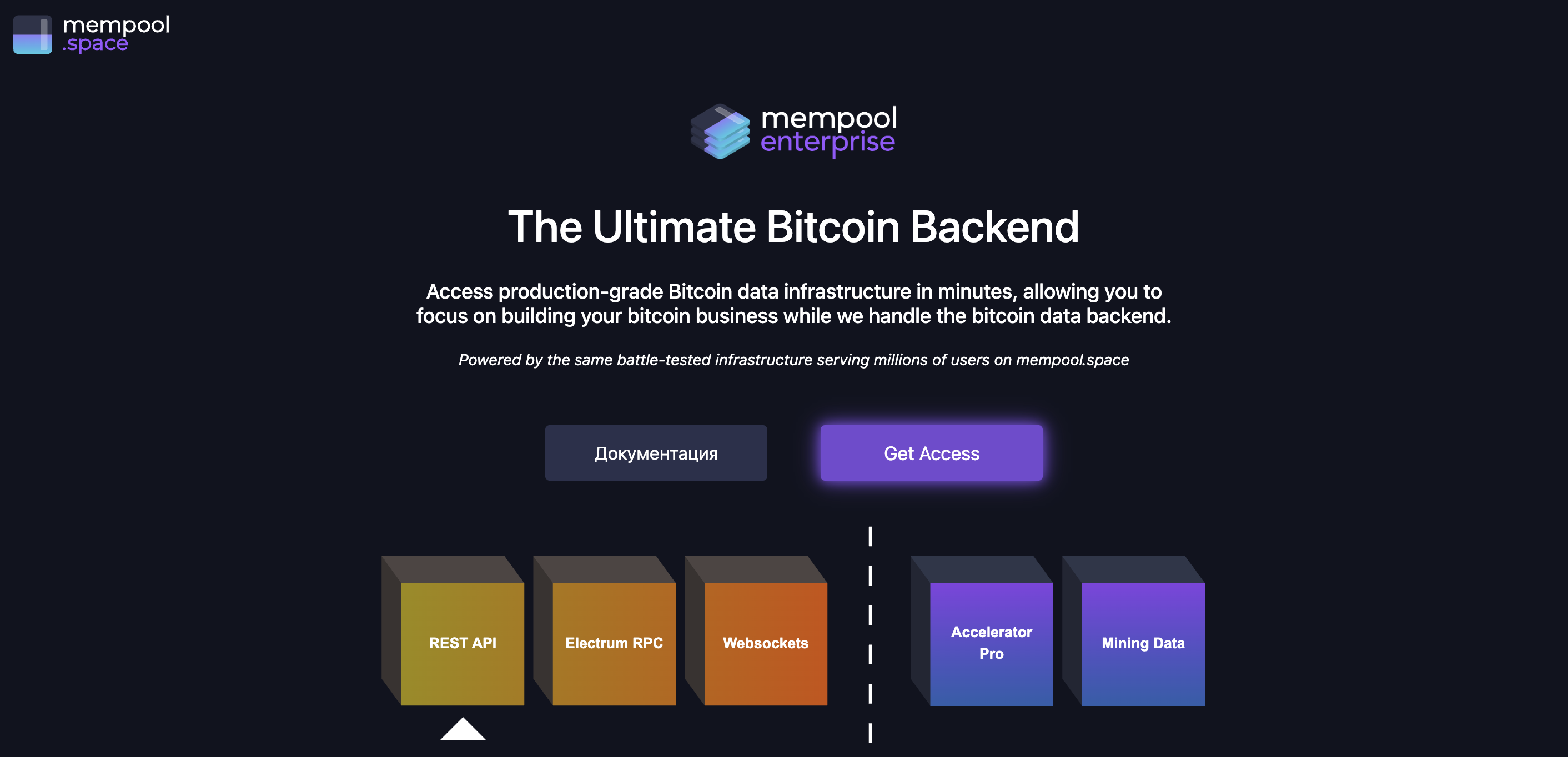
Mempool Enterprise sells the backend of the open-source project behind the mempool.space explorer. Its enterprise page lists an unmetered REST API, Electrum RPC, WebSockets, mining data, and an Accelerator Pro service. The company reports 150 million API calls a day across six data centers. It suits exchanges, wallets, and analytics tools that need fee and mempool data.
Network Coverage and Node Types. The service is Bitcoin-focused and exposes indexed data, so it is not a Bitcoin Core RPC proxy. Options include a co-branded subdomain and an isolated dedicated server. The public explorer also covers testnet and signet, but the enterprise page does not say which networks the paid API includes.
Performance and Reliability. The page advertises a 99.9% uptime guarantee and separately lists a 99.99% SLA, so the contractual figure should be confirmed. Enterprise removes the rate limits that the public API enforces with HTTP 429 errors. Priority support comes through direct engineering contact.
Pricing and Support. The public REST API is free and rate-limited, and the project points teams that need higher limits to an enterprise sponsorship. The pages reviewed state no enterprise prices, so budgeting requires a quote. No support response time is listed.
How to Choose a BTC Node Provider
Begin with what the application asks the chain for every day, then read the terms attached to that pattern. Headline specs say little about how limits and billing feel under load.
- Pick the interface. Bitcoin Core JSON-RPC answers node-level questions. REST and Electrum RPC answer address history and wallet sync. A wrong pick means a rewrite.
- Price a real month. Credits, compute units, request units, and plain quotas count one call differently. QuickNode alone bills 10 credits per Bitcoin method.
- Locate the ceiling. RPS caps, daily quotas, and one-month trials each fail in their own way when traffic spikes.
- Request the audit reports. QuickNode, GetBlock, and Chainstack list SOC 2 attestations. The other three list none.
- Fit support to the stakes. A payment flow needs an answer in minutes. An internal dashboard can wait a day.
For Bitcoin work the interface decides more than the chain count, because an indexed REST service and a full node answer different questions. A week of live traffic through two shortlisted providers settles most doubts.
When a BTC Node Provider May Not Be the Right Fit
A hosted endpoint suits most products, but some setups are better off without one. The situations below push toward running Bitcoin Core directly.
- Your queries are sensitive. A provider sees every address and transaction ID you request. Descriptor-based tools such as QuickSync hand a wallet descriptor to the provider, which exposes the whole address set to the vendor.
- You must verify the chain yourself. A rented node returns data you have to trust. Only a node you operate validates blocks on your own hardware.
- Traffic is heavy and steady. Once monthly bills approach the cost of a server, owning the node can be cheaper. GetBlock’s dedicated nodes start at $1,000 a month, which is the range where a self-run server becomes a fair comparison.
- Data residency rules apply. Some compliance regimes require infrastructure under your own control, which rules out any shared vendor endpoint.
- You only need public lookups. Balance checks and fee estimates for a hobby project run on the free, rate-limited Blockstream and mempool.space public APIs.
BTC Node Provider Pricing Compared
Headline plan prices leave out how each vendor counts a call, so total cost depends on the billing unit. The table prices one benchmark: 10 million Bitcoin JSON-RPC calls a month, at monthly billing.
| Provider | Pricing Model | Free Tier | Entry Price | Cost at 10M Calls |
| NOWNodes | Request quota | 100K requests, 1 month | €20 | Up to €200 |
| QuickNode | API credits | 10M credits, 1 month | $49 | ~$61 |
| GetBlock | Compute units | 50K CU per day | $49 | $150 flat |
| Chainstack | Request units | 3M units per month | $49 | $49 |
| Blockstream Explorer API | Call tiers | 500K requests per month | $40 | Within 100–2,000 |
| mempool.space Enterprise | Quote | Public API, rate-limited | Not listed | Quote needed |
Rates, supported chains, and limits change frequently. Verify current terms on each provider’s official site before committing.
Total Cost Analysis
NOWNodes. Plans are sized by monthly request quota, and Business at €200 covers 30 million requests, so 10 million fits inside it. The sources reviewed do not show the price of the intermediate Pro Plus tier, so the real figure may be lower. The free Start plan is a one-month trial and the smallest allowance in the table.
QuickNode. Ten million calls at 10 credits each use 100 million credits. Build includes 80 million and charges $0.62 per extra million, which lands near $61. Build caps traffic at 50 RPS, so a busy service may need a higher plan.
GetBlock. Shared plans meter compute units, and GetBlock publishes no Bitcoin-specific weights, so a shared-plan estimate is not possible from public pages. Limitless Bitcoin starts at $150 a month with no per-request billing. That flat rate suits steady traffic and wastes money on bursty traffic.
Chainstack. Full-node calls cost one request unit, so 10 million calls fit inside the 20 million included with Growth at $49. The same volume on the free plan would exceed its 3 million units, so the paid tier is the realistic entry point.
Blockstream Explorer API. Advanced spans $100 to $2,000 for 1 to 30 million calls, and the public sources do not say where 10 million falls. QuickSync calls count as 5 to 10 standard calls, which raises the effective cost for wallet sync.
mempool.space Enterprise. The enterprise page publishes no price, so any budget starts with a quote. The public API costs nothing but returns HTTP 429 errors when limits are exceeded.
Multi-Chain Node Providers vs Bitcoin-Only Data Services
The six options split into two groups that solve different problems, and mixing them causes most bad picks.
Multi-chain node providers. NOWNodes, QuickNode, GetBlock, and Chainstack run Bitcoin nodes next to dozens of other networks. They expose Bitcoin Core-style JSON-RPC and, on some plans, Blockbook or WebSocket access. One account and one billing relationship cover every chain, which helps teams that also support Ethereum, Litecoin, or others.
Bitcoin-only data services. Blockstream Explorer API and mempool.space Enterprise serve indexed Bitcoin data over REST and Electrum RPC. They answer address history, UTXO, fee, and mempool questions quickly and offer conveniences such as QuickSync on the Blockstream side. They do not proxy raw Bitcoin Core methods and cover nothing beyond Bitcoin and Liquid, so a second vendor handles any other chain.
Which BTC RPC Provider Should You Choose?
NOWNodes suits teams that carry Bitcoin inside a larger multi-chain stack and want paid plans without RPS caps. The trade-off is a one-month trial and no published compliance reports. GetBlock is the pick for a flat-rate Bitcoin node or SOC 2 Type II coverage, though its Limitless product is full node only and hosted in Frankfurt.
QuickNode makes sense when procurement asks for SOC and ISO paperwork and the team is comfortable paying by credit. Chainstack works for teams that want a free plan without an expiry date, one request unit per full-node call, and dedicated nodes from the Pro plan.
Blockstream Explorer API and mempool.space Enterprise serve wallet and analytics teams that query address history, fees, and mempool data more than raw node methods. Both are Bitcoin-focused data services, so anything beyond Bitcoin needs a second vendor.