
In this article, you’ll learn:
- What x402 is: How it uses HTTP 402 to enable automatic payments for APIs, content, and digital services.
- Why stablecoins fit the model: Their predictable value and programmable settlement make them suitable for software payments.
- How Cloudflare is using x402: What its developer tools and Monetization Gateway could mean for paid online resources.
- What changes for digital businesses: How request level pricing could work alongside subscriptions.
- Where NOWPayments fits: Why businesses will still need payment infrastructure for settlement, conversion, custody, and payouts.
Every day, internet requests fetch pages, call APIs, download files, and access cloud services. Until now, they could not natively handle payment.
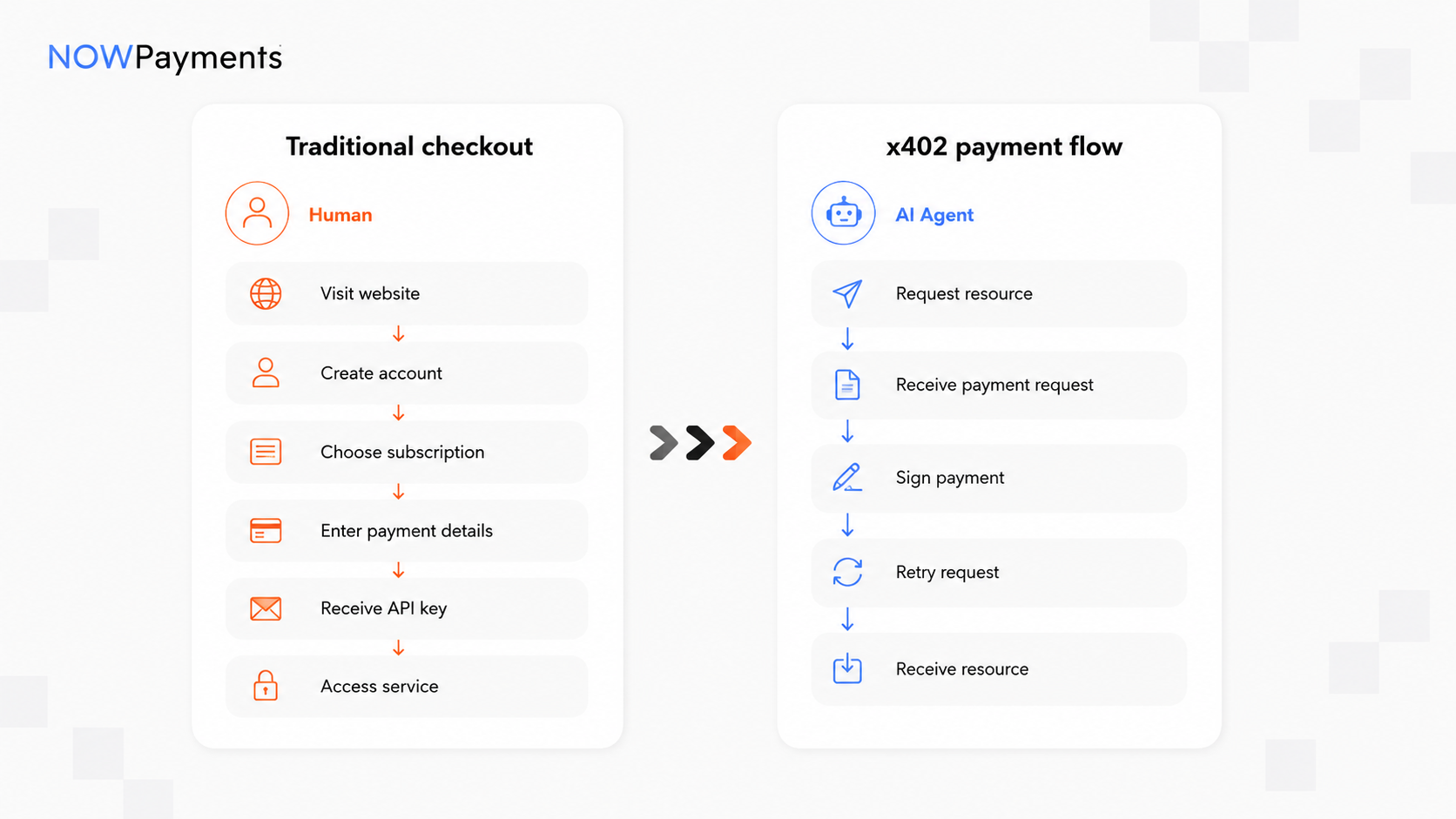
That gap matters more as AI agents begin working independently. They can research, use tools, and access digital services, but traditional checkout flows still expect a human to create an account, enter payment details, and choose a plan.
Backed by Coinbase, supported by Cloudflare’s Monetization Gateway, and now governed by the Linux Foundation through the x402 Foundation, the protocol is becoming one of the most promising building blocks for machine-to-machine payments powered by stablecoins. It allows payment requests to happen directly within an HTTP exchange, creating a new way for software to pay for APIs, content, and other digital resources with stablecoins.
The Payment Problem AI Agents Created
For years, digital businesses have monetized online services in essentially the same way.
If you wanted to use a premium API, you would:
- Create an account.
- Verify your email.
- Choose a pricing plan.
- Enter payment details.
- Generate an API key.
- Start using the service.
This experience works for humans, but not for autonomous software.
Imagine an AI travel assistant that needs premium weather data before booking a flight. Instead of receiving the forecast, it reaches a pricing page that requires an account, billing details, and a subscription.
An agent may only need one paid request before continuing its task. The same problem applies to datasets, search tools, MCP servers, cloud resources, and other digital services.
The question is no longer only how people pay for software but how software pays other software. That is the problem x402 is designed to solve.
What Is x402?
At its simplest, x402 is an open protocol that lets applications request and complete payments through HTTP. Instead of redirecting users to a checkout page, a server can return payment instructions directly within an HTTP response, allowing software to pay for a resource and continue the request automatically.
x402 in one minute
| x402 is | x402 is not |
| A protocol for requesting payments over HTTP | A blockchain |
| A communication standard | A cryptocurrency |
| Compatible with automated application payments | A payment gateway |
| Independent of the underlying payment rail | A replacement for payment infrastructure |
The protocol builds on HTTP 402 Payment Required, a response code that has existed for decades but was never widely used. In 2025, Coinbase introduced x402, giving HTTP 402 a practical payment flow: the server returns payment terms, the client completes the payment, retries the request with proof of payment, and receives the requested resource once the payment is verified.
Although today’s implementations primarily use stablecoins, x402 does not depend on a specific blockchain, wallet, or payment provider. It defines how payment is communicated, while developers remain free to choose the payment infrastructure that best fits their application.
The Evolution of x402
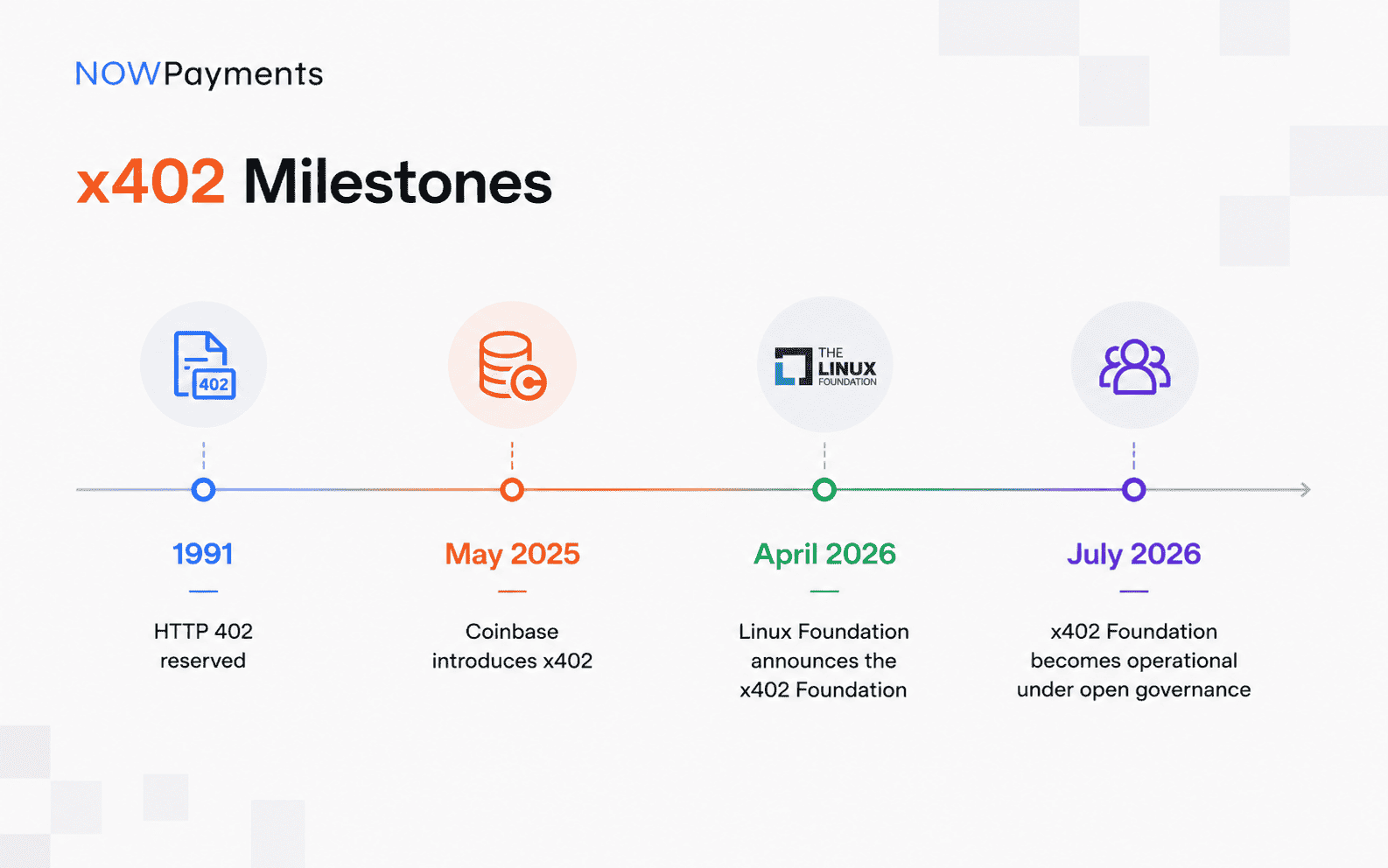
x402 builds on an idea that existed long before the protocol itself. HTTP 402 was reserved for payment use, but it remained largely unused until Coinbase introduced x402 in 2025. In 2026, the x402 Foundation was announced under the Linux Foundation, and the protocol moved toward vendor neutral, open governance.
The timeline below shows the key steps in that evolution.
How an x402 Payment Works
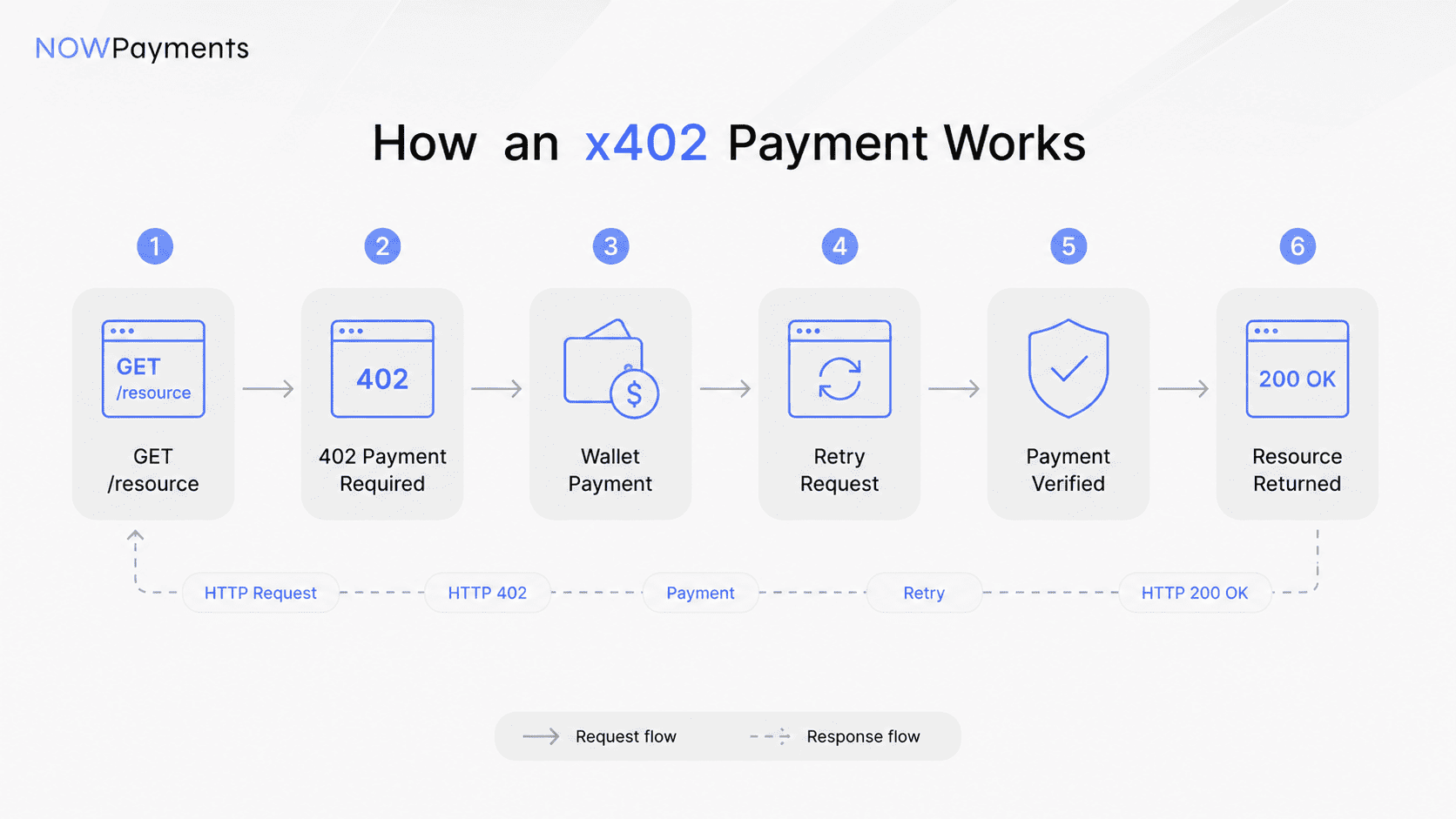
Imagine an AI assistant requesting premium market data.
- Request: The application sends a standard HTTP request.
GET /market-data - Payment required: The server returns HTTP 402 Payment Required with the amount, accepted stablecoin, network, recipient wallet, and payment details.
- Payment: The client signs and submits the payment through its wallet.
- Retry: The client repeats the request with proof of payment.
- Verification: A facilitator, or the server itself, verifies the payment.
- Access: Once confirmed, the server returns the requested resource.
The full process happens within the normal HTTP request and response flow.
Why Stablecoins Fit x402
Stablecoins are not required by the x402 specification, but they are central to the way the protocol is being used today. Coinbase describes x402 as an open protocol for instant, automatic stablecoin payments over HTTP, while Cloudflare plans to settle payments through its Monetization Gateway in stablecoins.
There are three main reasons stablecoins fit the x402 model:
- Predictable pricing: Services can set clear prices, such as 0.01 USDC per request, without major value changes during payment.
- Programmable authorization: Software can review payment terms, sign the transaction, and retry the request without a checkout page or billing account.
- Digital settlement: Stablecoins can move directly across blockchain networks without relying on the same bank, card processor, or billing platform.
Together, these features make stablecoins practical for software-driven payments: checkout helps a person complete a purchase, while x402 helps an application complete a paid request.
Cloudflare Moves x402 From Protocol to Product
Coinbase created x402, while Cloudflare is bringing it into familiar web infrastructure. Developers can already use Cloudflare Workers and the Agents SDK to protect APIs, pages, files, and MCP tools with x402 payments.
On July 1, 2026, Cloudflare also announced the Monetization Gateway. The planned product will let businesses set payment rules for online resources and accept stablecoin payments through x402.
The x402 flow stays the same. The difference is that Cloudflare could handle more of the payment logic, reducing the infrastructure developers need to build themselves.
One Early Use Case: Paid Crawler Access
Website owners have traditionally had three options for automated crawlers: allow them, restrict them, or block them. x402 introduces a fourth option: charge them for access.
A publisher could keep public content open while charging automated clients for:
- premium articles
- structured datasets
- historical archives
- API responses
- other commercially valuable resources
Cloudflare supports this model through Workers and its Agents SDK, which can protect specific routes and return a 402 response when payment is required.
Paid crawler access is not yet a standard publishing model, but it gives resource owners a middle ground between unrestricted access and a complete block.
What Can Be Sold Through an HTTP Request?
x402 is not limited to AI agents or crawler payments. It can support any digital resource that can be requested, priced, paid for, and delivered through software.
| Resource | What the client pays for |
| Documented Cloudflare uses | |
| API | One request |
| Web page | Access to protected content |
| File | One download |
| MCP tool | One tool call |
The same model could later extend to AI inference, market data queries, research datasets, cloud compute, developer tools, software features, and digital media.
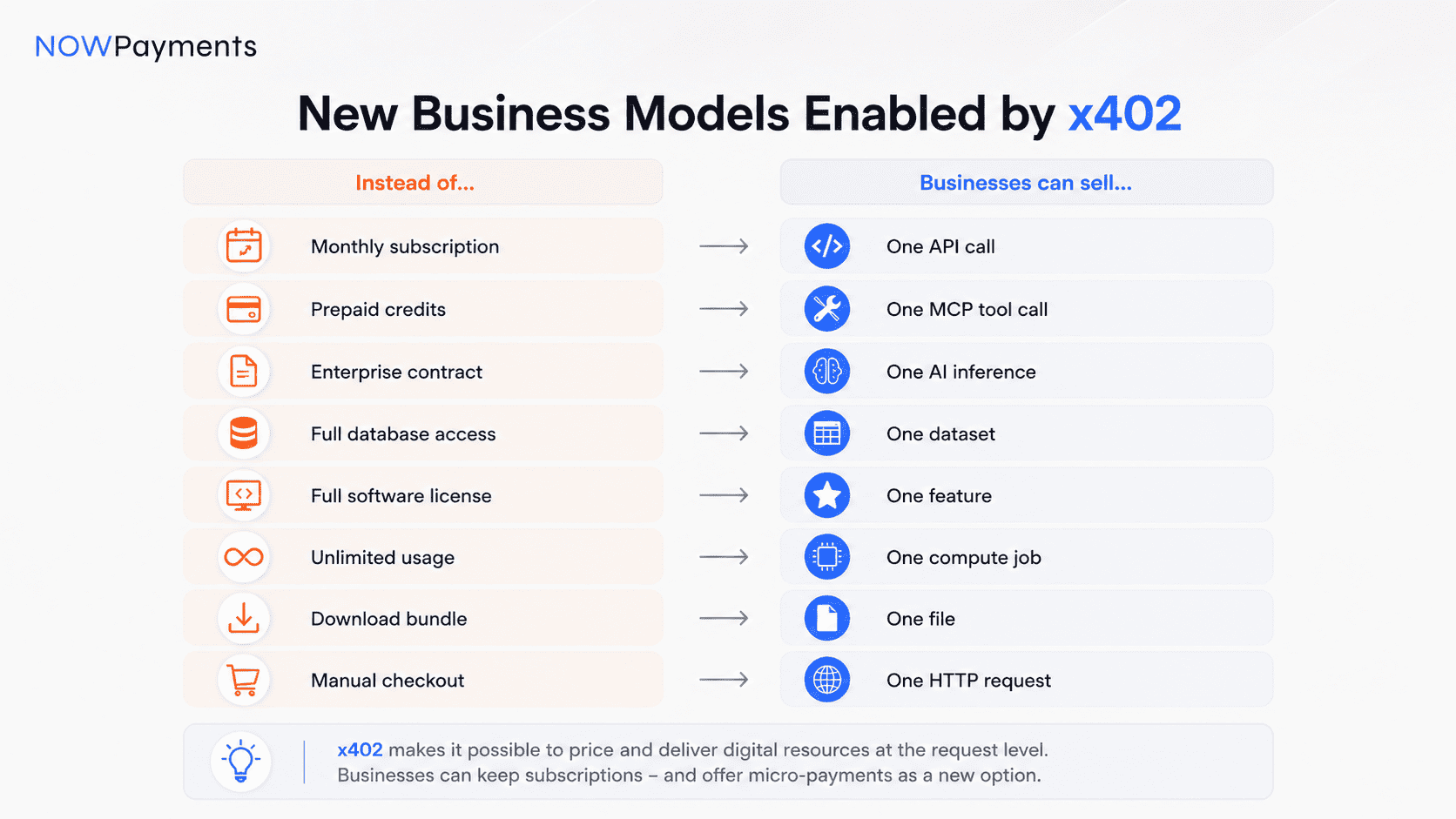
The broader opportunity is flexibility. Businesses could keep subscriptions for regular customers while allowing occasional users or automated clients to pay for a single request.
Beyond Subscriptions: What x402 Makes Possible
The biggest impact of x402 may be commercial rather than technical. It gives businesses more flexibility in how they sell digital products, especially when buyers need only one resource or interaction.
- Pay per request: Charge for a single API call, dataset, article, tool call, or unit of compute.
- No long term commitment: Let clients pay without creating an account or choosing a monthly plan.
- Better access for occasional users: Serve developers and customers who do not need a full subscription.
- Support for AI agents: Allow autonomous applications to purchase resources as part of their workflow.
- Subscriptions can remain: Keep recurring plans for regular customers while adding request level pricing as another option.
While x402 standardizes how software requests and completes payments, businesses still decide how digital commerce should operate.
Payment Infrastructure Still Matters
x402 tells an application when payment is required and how to provide the payment proof. It does not answer every operational question that follows.
The business receiving the funds must still decide:
- Which stablecoins it will accept.
- Which blockchain networks it will support.
- Where incoming funds will be held.
- Whether received assets should be converted.
- How transactions will be reconciled.
- How revenue will be withdrawn or paid to other parties.
- Which security and compliance controls are required.
These are payment infrastructure questions rather than protocol questions.
Turning these infrastructure choices into a production product requires coordinated architecture across AI agents, payment APIs, blockchain networks, wallets, and internal business systems. Pharos Production, a custom software development company, builds AI agent systems and integrates them with FinTech, Web3, and high-load payment infrastructure. This application layer connects agent-driven transactions with verification, accounting, treasury, security, and compliance controls.
How NOWPayments Fits Into an x402 Future
NOWPayments does not currently advertise native x402 support, so it would be inaccurate to describe the platform as an x402 integration. Instead, it complements the business operations that start after an automated payment arrives.
An x402 payment is only one step in the transaction lifecycle. Businesses still need infrastructure to settle funds, manage treasury, move assets across blockchain networks, and send payouts to customers, partners, affiliates, or suppliers.
| Business operation | NOWPayments capability |
| Accept stablecoin payments | Crypto payment infrastructure |
| Settle across multiple blockchains | Multi-chain USDT and USDC support |
| Manage treasury | Custody balances and crypto conversions |
| Automate outbound transfers | Mass payouts and email payouts |
| Scale payment operations | APIs, enterprise infrastructure, and high-volume processing |
x402 defines how software discovers and completes a payment, while NOWPayments provides the infrastructure to receive, manage, convert, and distribute digital assets at scale. As machine-to-machine payments grow, businesses will also need treasury tools, cross-border payouts, operational support, and compliance guidance within one crypto business ecosystem.
Key Takeaways
- x402 enables payments through HTTP.
- Stablecoins support predictable, programmable settlement.
- Cloudflare already supports x402 and plans broader monetization tools.
- Use cases include paid APIs, content, files, and software features.
- Businesses still need treasury, conversion, accounting, and payout infrastructure.
- NOWPayments can support these operations around automated stablecoin payments.
Conclusion: From Human Checkout to Agent Payments
For decades, software has been able to request information and services from other software, but paying for them usually required a human checkout, account, or subscription. x402 introduces a different model by making payment part of the same HTTP request and response flow that already powers the web.
Whether x402 becomes a widely adopted standard remains to be seen, and questions around trust, spending controls, refunds, privacy, and accounting still need practical answers. Even so, the direction is becoming clearer: protocols such as x402 can standardize how applications request payment, while providers such as NOWPayments can support the wider infrastructure for receiving, managing, converting, and moving digital assets. The web learned how to move information. Now it is beginning to learn how to move value between applications.
Sources
This article was prepared using official documentation and announcements from Coinbase, Cloudflare, the Linux Foundation, and NOWPayments.
x402 Protocol
- Coinbase x402 Overview
- How x402 Works
- x402 Facilitators
- Coinbase Developer Platform x402 Documentation
Cloudflare and x402
- Cloudflare Monetization Gateway Announcement
- Cloudflare x402 Payments Documentation
- Cloudflare Agent Payment Tools
- Cloudflare AI Crawler Worker Templates
x402 Foundation
HTTP 402
NOWPayments