
A crypto payment processor gives businesses the infrastructure to accept digital assets without building their own blockchain stack. It detects incoming transactions, monitors confirmations, converts funds when needed, and settles them to the merchant.
For businesses, this means less manual work with wallets, exchange rates, networks, and transaction monitoring. Modern providers can also support balances, payouts, stablecoin settlement, and treasury operations.
This guide explains how these platforms work, how processors differ from gateways, what custodial processing means, and what businesses should consider when choosing a provider.
What is a Crypto Payment Processor?
At its core, a processor connects the customer’s blockchain transaction with the merchant’s checkout and settlement flow. The service automates these steps, eliminating the need for manual monitoring of addresses and confirmations.
A modern crypto payment platform can go further by combining checkout with conversion, balances, withdrawals, and payouts. The exact functionality depends on the provider and the way the merchant wants to manage incoming funds.
Most processors today are custodial by default. In this model, payments are settled to a balance inside the platform, where the merchant can hold, convert, withdraw, or distribute them. This removes much of the operational complexity that comes with running separate wallets, keys, and on-chain monitoring tools.
How Does a Crypto Payment Processor Work?
From the customer’s perspective, the process is simple: choose a supported asset, see the amount and address, and complete the transaction. Someone searching how to pay with crypto will usually encounter this flow through a hosted checkout, invoice, QR code, or merchant integration.
Behind that experience, the crypto payment system detects the blockchain transaction, tracks its status, applies conversion rules when required, and credits the merchant according to the selected settlement setup.
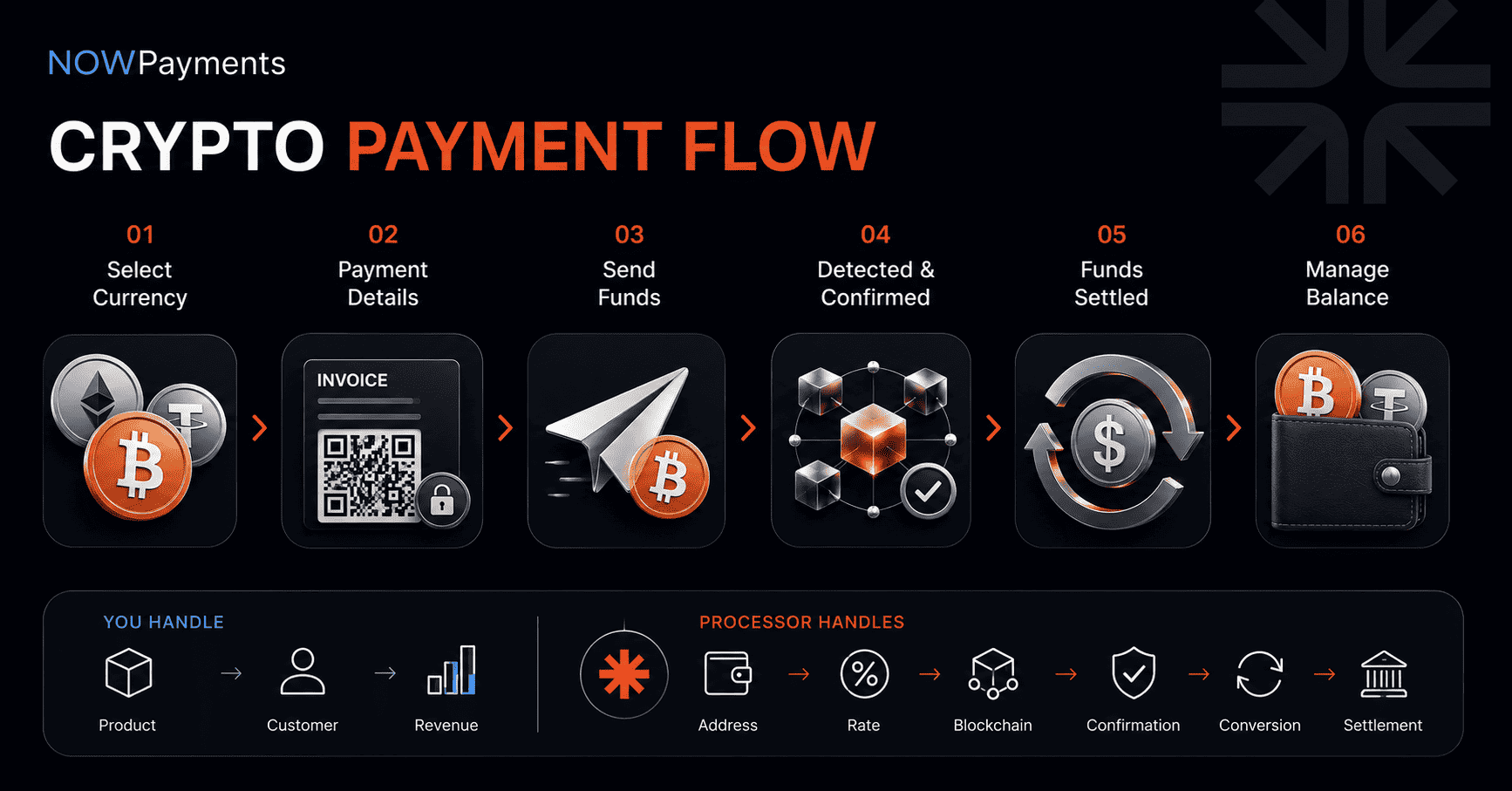
A typical payment flow looks like this:
- Customer selects a currency. The checkout displays supported coins, networks, and the exact amount due.
- Payment details are generated. The processor creates an address, invoice, or QR code and locks the exchange rate for the required time window.
- The customer sends funds. The transaction is broadcast to the blockchain.
- The transaction is detected and confirmed. The processor monitors the network and updates the payment status automatically.
- Funds are settled. The merchant receives the original asset or a converted currency, depending on the setup.
- The merchant manages the balance. Funds can be held, withdrawn, converted, or used for payouts.
Crypto Payment Processor vs Crypto Payment Gateway
The terms are often used interchangeably because both help merchants accept crypto. However, they describe slightly different layers of the stack:
| Crypto payment processor | Crypto payment gateway |
| Processes transactions between customers and merchants | Provides the interface merchants use to accept those payments |
| Handles blockchain detection, confirmation, and settlement | Delivers the checkout page, API, plugin, or QR code |
| May include custody, conversion, and payout features | Often focuses on the payment acceptance layer |
Think of the crypto payment gateway as the customer-facing layer and the processor as the infrastructure that completes the transaction. In practice, modern providers usually combine both.
Custodial vs Non-custodial Crypto Processing
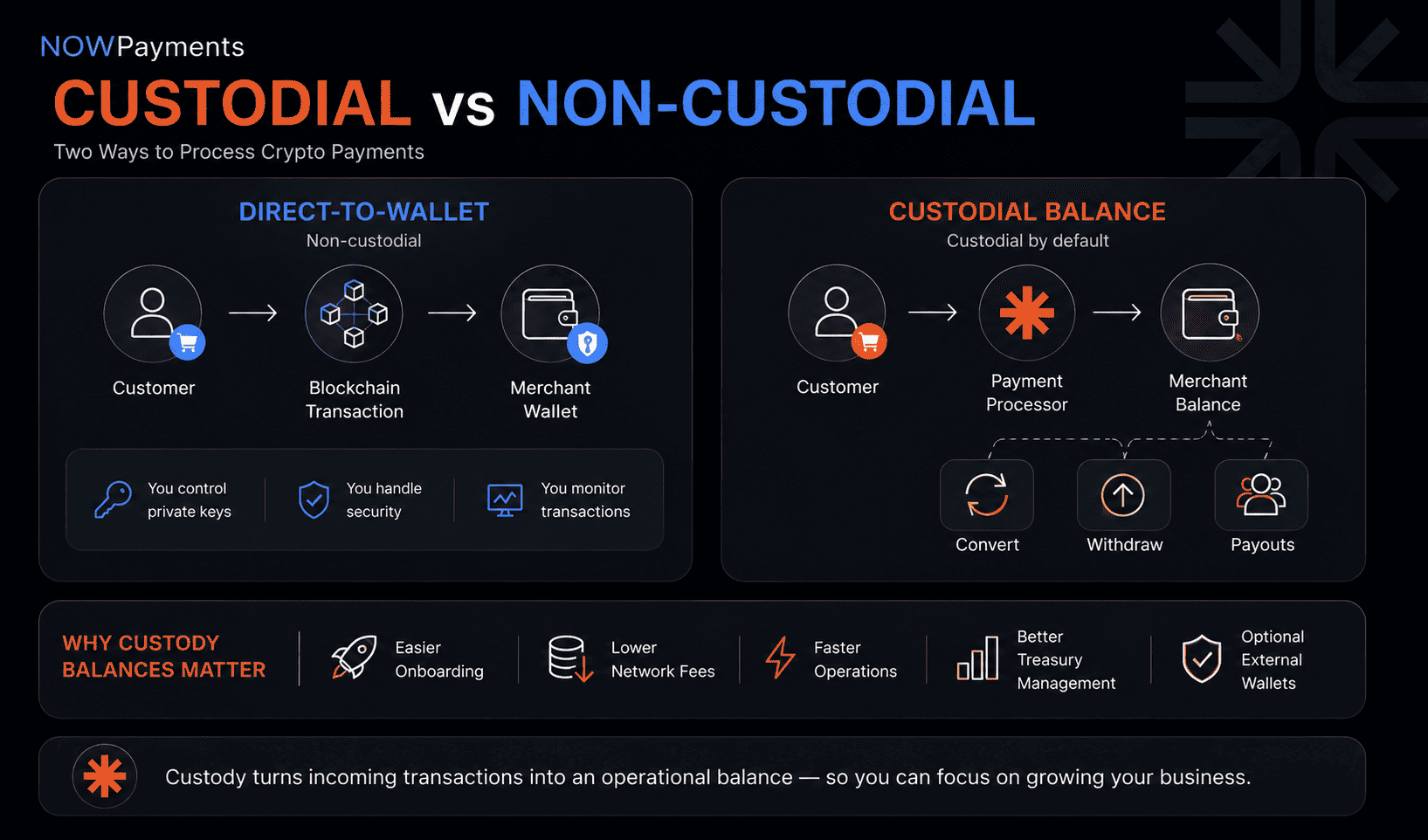
Crypto payment processors generally operate in one of two ways.
- Direct-to-wallet (non-custodial)
Each incoming payment goes straight to an external wallet controlled by the merchant. The merchant keeps full custody of private keys but also handles security, backups, and transaction monitoring themselves.
- Custodial platform balance
Incoming payments are settled to a balance managed inside the processor. The provider handles key security, network monitoring, and balance management, while the merchant controls how funds are converted, withdrawn, or paid out.
Most modern processors, including NOWPayments, use the custodial model by default. It is faster to set up, cheaper to operate at scale, and easier to integrate with conversions and payouts.
Why custody balances matter for business workflows
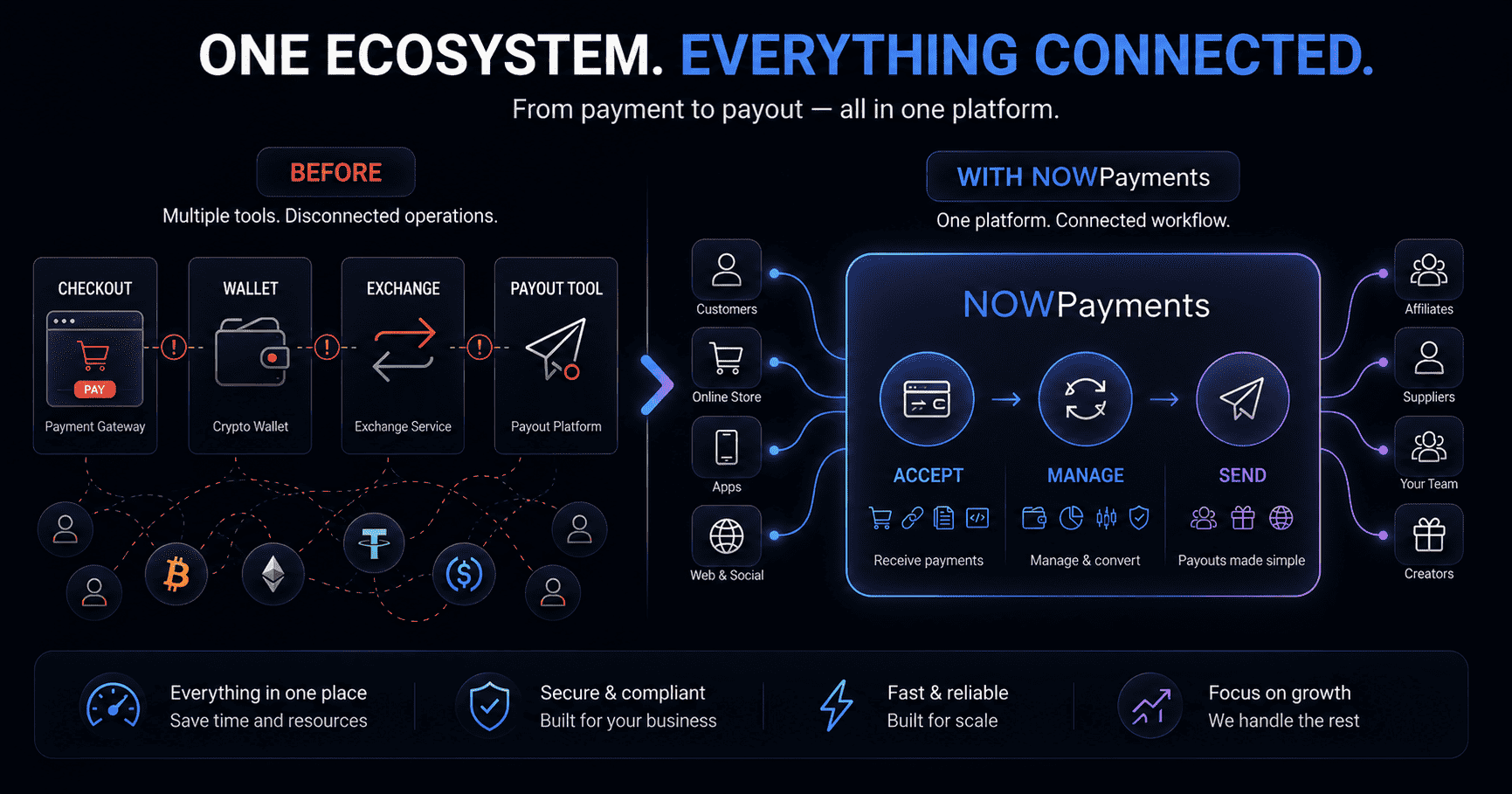
Custody turns incoming transactions into an operational balance. Instead of moving funds through separate wallets, exchanges, and payout tools, the merchant can manage everything inside one ecosystem.
Key advantages include the following:
- Easier onboarding. Start accepting funds without connecting external wallets first.
- Lower network fees. Consolidate funds inside the platform to reduce on-chain movements.
- Faster operations. Convert, withdraw, and pay out without leaving the dashboard.
- Better treasury management. Hold, convert, and deploy funds from one place.
- Optional external wallets. Merchants who prefer direct custody can still connect a payout wallet and disable custodial processing.
On NOWPayments, for example, incoming payments are settled to platform balances. You choose a primary balance currency, such as USDT TRC20, to consolidate incoming funds automatically, and you can create additional balances in other currencies. Funds can then be withdrawn, converted, or used for payouts directly inside the platform.
What can modern crypto payment processors do?
The category has evolved well beyond checkout. Today, a processor often supports the full lifecycle of digital assets inside a business:
- Accept payments
Checkout pages, invoices, payment links, QR codes, e-commerce plugins, and APIs let merchants collect funds from customers on websites, apps, and social channels.
- Manage settlement
Autoconversion lets a customer pay in one asset while the merchant receives another, often a stablecoin such as USDT or USDC. This protects against volatility and simplifies accounting.
- Hold balances
Custodial balances act as a treasury layer. Merchants can consolidate funds, wait for favorable conversion rates, or keep working capital in stablecoins.
- Send payouts
Mass payouts, email payouts, and cross-border disbursements make it possible to pay affiliates, creators, suppliers, and teams without building a separate payout stack.
- Automate workflows
APIs, webhooks, and custom integrations connect crypto operations to billing, accounting, e-commerce, and CRM systems.
In short, modern crypto payment solutions function as operating infrastructure for businesses that want to receive, hold, convert, and send digital assets from one place.
Business workflows
Crypto processing becomes easier to evaluate with concrete use cases.
- E-commerce. A customer pays with Bitcoin at checkout. The merchant receives the equivalent in USDT to a custodial balance and withdraws it later to a bank account.
- Marketplace. Buyers pay in different cryptocurrencies. The platform settles everything into a single stablecoin balance and distributes seller earnings through mass payouts.
- Affiliate business. Revenue arrives through crypto payments. Commissions are calculated and paid out to affiliates in USDT, with email payouts reducing wallet friction.
- SaaS. Customers pay invoices in crypto. Funds are converted into a preferred stablecoin and managed as part of the company’s treasury.
These differences also appear in NOWPayments’ research on stablecoin use across business models, which examines how billing, checkout, settlement, and payout requirements vary between SaaS, eCommerce, and trading platforms.
In each case, the same infrastructure handles pay with crypto on the inbound side and sends funds on the outbound side.
How to choose a crypto payment processor
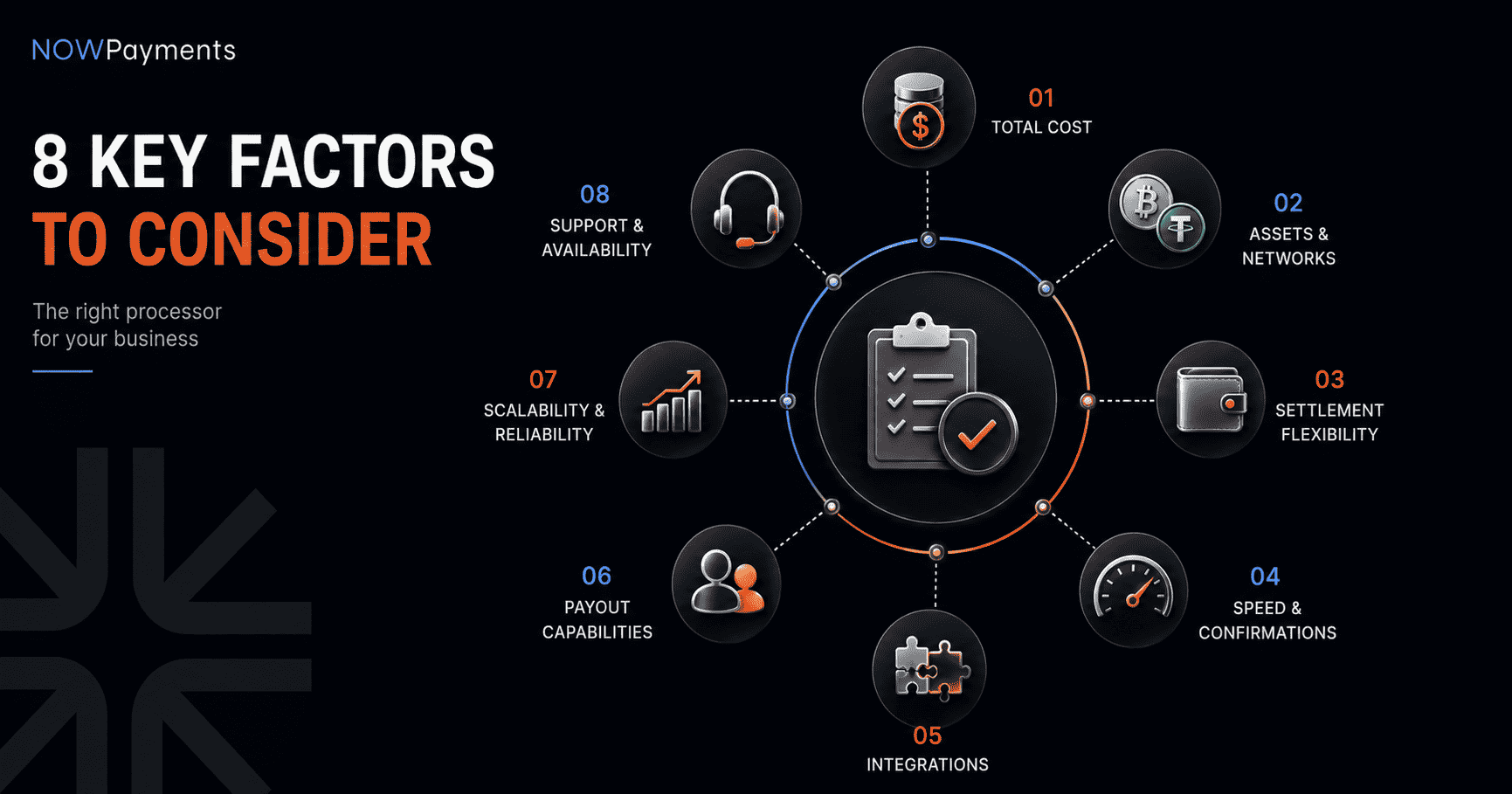
Choosing a crypto payment provider means looking beyond the headline fee. The right fit depends on how your business needs to receive, hold, convert, and send digital assets.
Ask direct questions before committing:
- How long has the platform operated, and how many merchants does it serve?
- Is the infrastructure reliable at high volume?
- Does it support the coins, stablecoins, and networks your customers actually use?
- Is the checkout experience easy for end users?
- What happens when something goes wrong?
- Can it handle mass payouts, cross-border settlement, and treasury workflows?
A processor is strategic infrastructure. The cheapest option is rarely the best if it lacks the assets, settlement model, or support your operations require.
How NOWPayments combines payments, settlement, and payouts
NOWPayments is a crypto business ecosystem founded in 2019. It is designed for companies that want to accept crypto payments on websites, mobile, or social channels and manage the full financial workflow in one platform.
Instead of connecting separate tools for checkout, conversion, and disbursement, merchants can use NOWPayments for the following:
- Payments. Checkout pages, invoices, payment links, widgets, donation buttons, and e-commerce plugins.
- Wide asset support. 300+ cryptocurrencies, including USDT and USDC across multiple networks.
- Autoconversion. Receive your preferred currency regardless of what the customer pays with.
- Custodial balances. Simplified onboarding, lower network fees, and centralized fund management.
- Mass payouts. Bulk disbursements to affiliates, creators, suppliers, or teams.
- Email payouts. Send funds using only the recipient’s email address.
- Fiat withdrawals. Convert crypto and withdraw fiat starting from €15.
- API and enterprise tools. Custom integrations, webhooks, and dedicated account optimization.
- 24/7 support. Business support and operational guidance.
Pricing is transparent: deposit service fees start at 1% for single-currency payments and 1.5% for multi-currency payments, with the potential to reduce fees to 0.3% for eligible partners. Conversions cost 0.5%, payouts carry a 0% service fee, and setup, integration, and dedicated support are free.
Integration Steps
Step 1. Sign Up for NOWPayments
- Start with a NOWPayments account.
If you already have one, just log in, there is no extra setup needed at this stage.
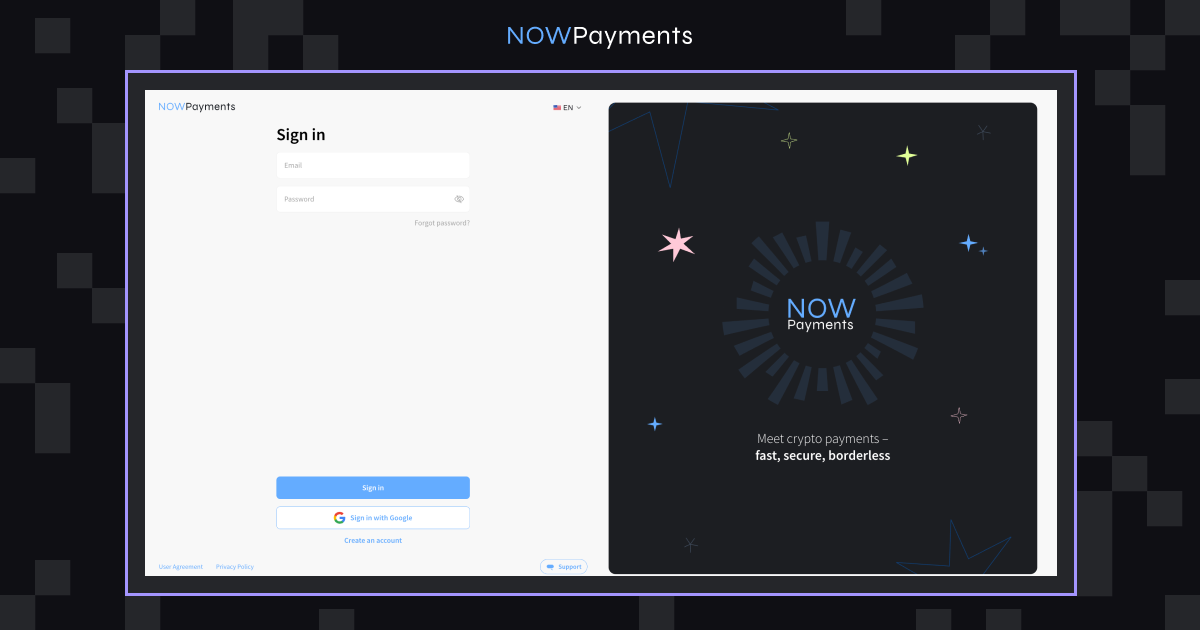
- Receive a verification email and confirm
- Once registered, log in to your NOWPayments dashboard.
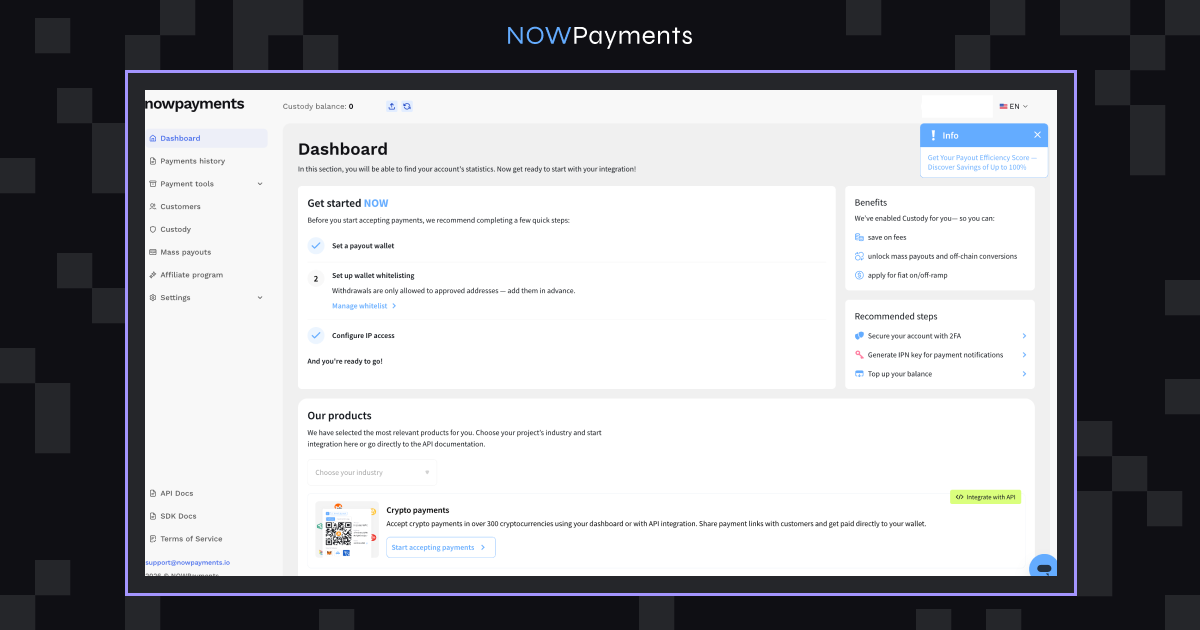
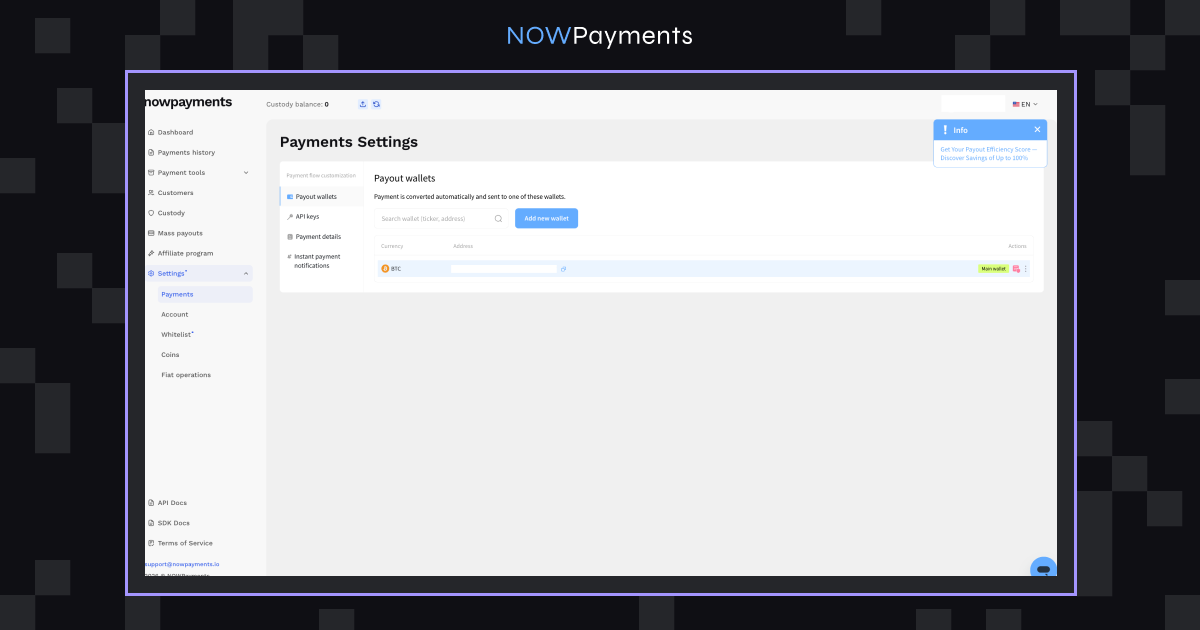
- Add your payout wallet
- Generate Your API Key
Go to your dashboard → API Settings → generate your API key.
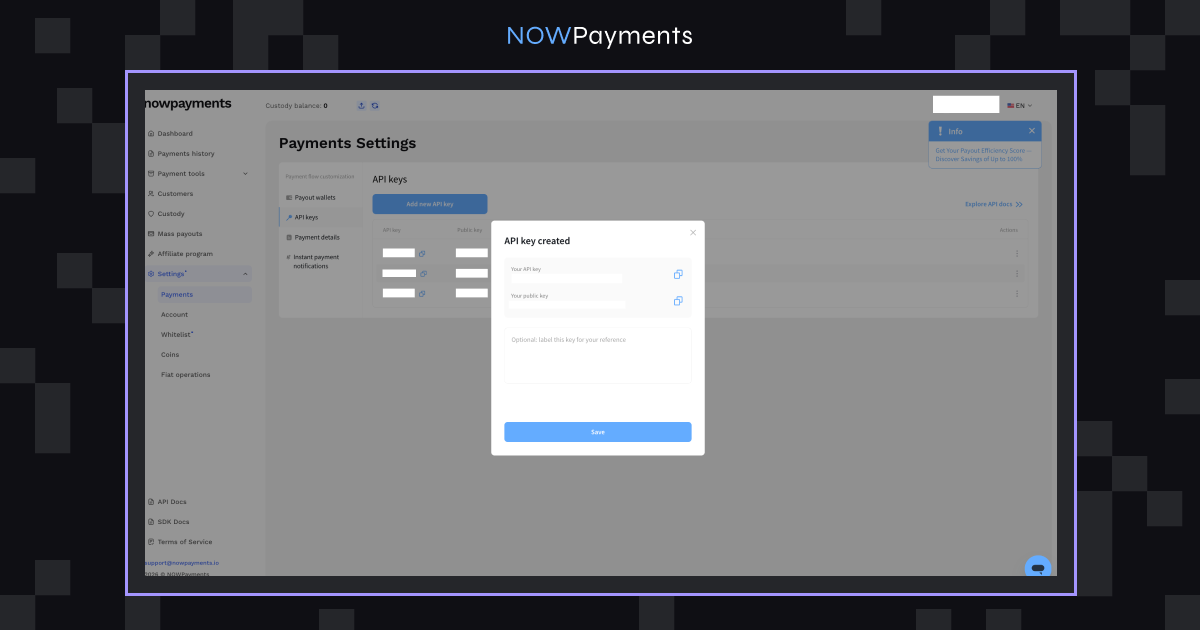
Step 2: Set Up Your Account
- Go to coin settings and choose which currencies you wish to enable for your customers to pay.
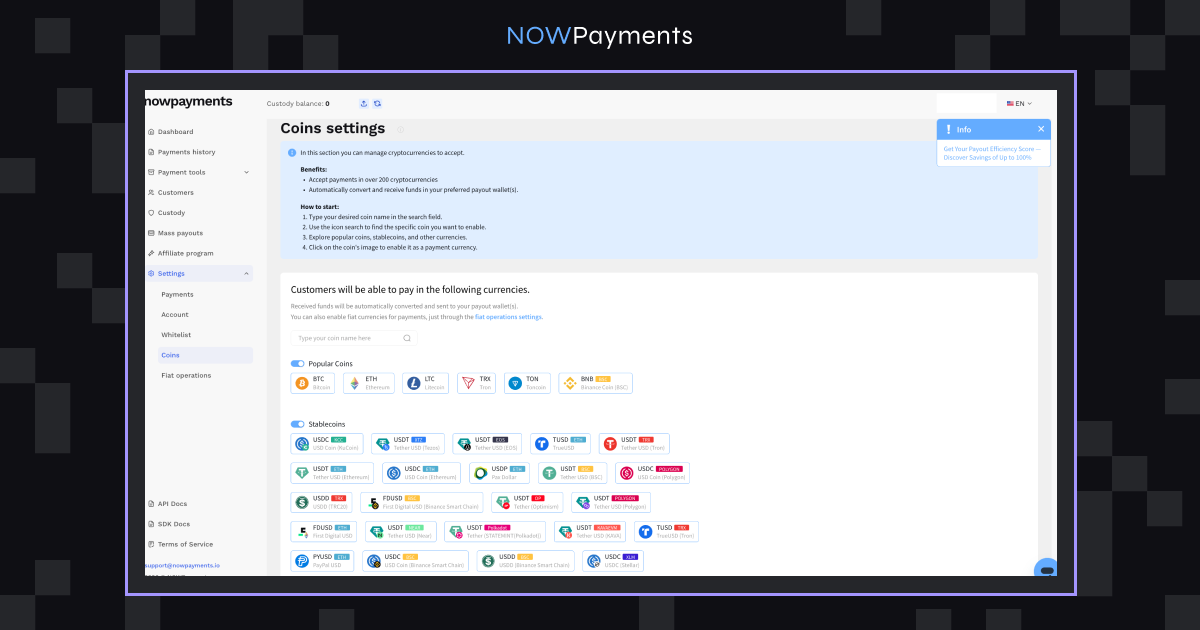
- Enable 2FA for better security and save your backup code or use an app.
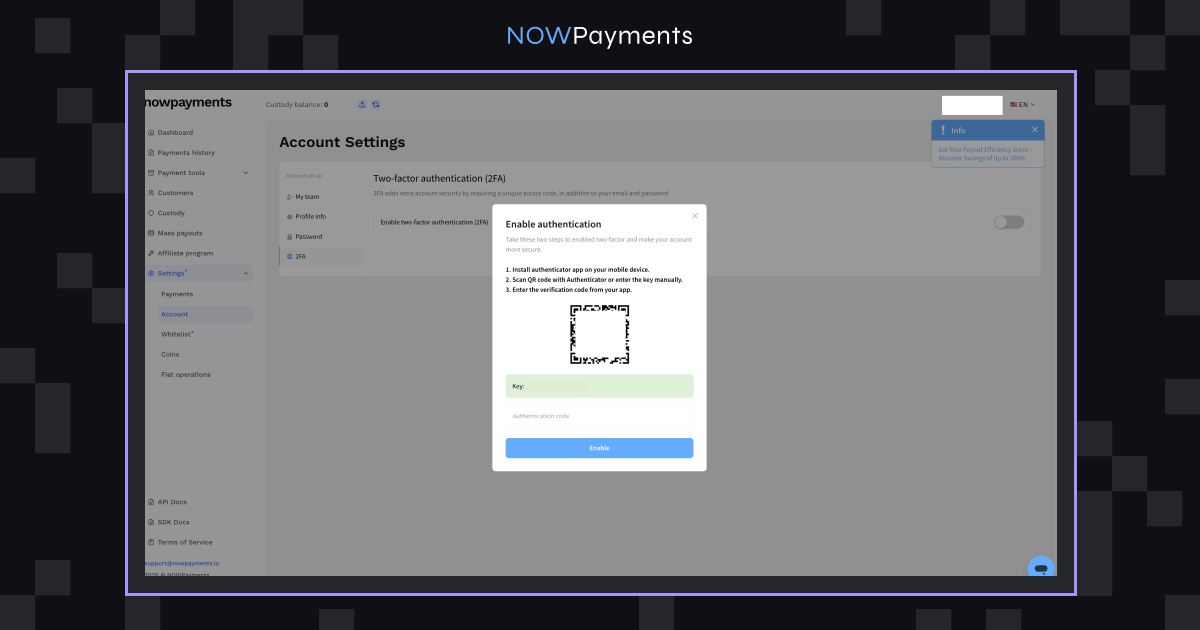
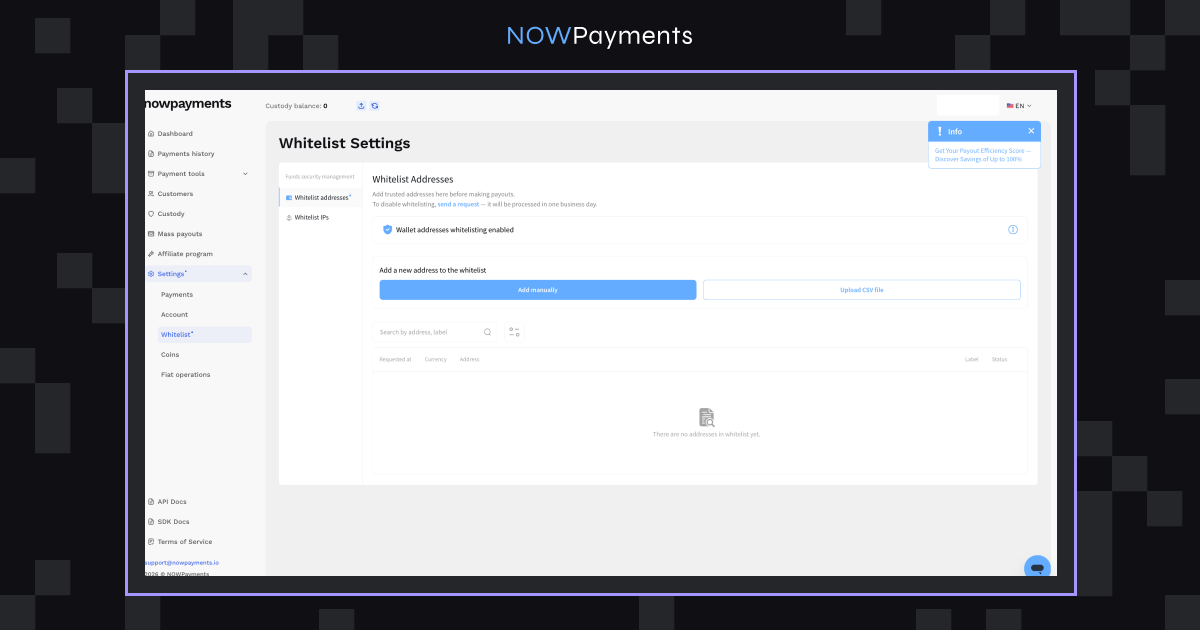
- Whitelist IPs and Wallet Addresses
- Add your IP address in Whitelist IPs, including IPv6 and IPv4
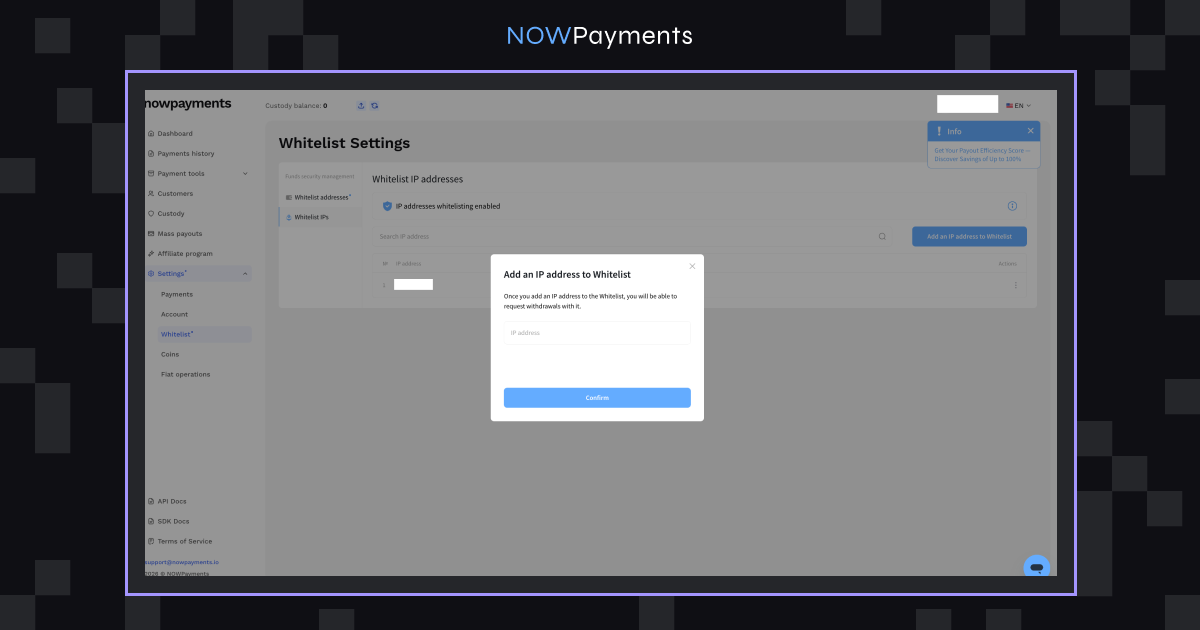
- Add recipient wallet addresses:
- Manually
- Or via CSV
Conclusion
A crypto payment processor connects customer transactions with merchant settlement while handling the infrastructure behind the process. Modern providers go beyond checkout, offering conversion, balance management, payouts, and other tools. When choosing one, businesses should compare total costs, supported networks, settlement models, integrations, and operational capabilities.
Custodial processing can simplify these operations by reducing on-chain movements and bringing fund management into one place. NOWPayments combines payments, payouts, conversions, custody balances, and stablecoin settlement in one ecosystem, helping businesses manage the full crypto flow without relying on multiple separate tools.
Ready to build your crypto payment flow?